A Better Match for Valentine’s Day: Games, Benchmarks, Strategy
Valentine’s Day is one of those moments when traffic gets expensive fast, and expectations get even higher. This usually means a familiar mix: more pressure to convert, less room to experiment, and very little patience from users who just want to pick a gift and move on.
Add to that a crowded promo landscape, and the risk of running the same on-site offers as everyone else — and it’s easy to waste high-intent traffic without realizing it.
One fix is to stop doing ‘just one more pop-up’ and rethink the format. Short interactive games tend to get more curiosity and fewer instant closes than static messages.
This mini guide with Valentine campaign recipes built around gamified widgets you can launch on-site. We’ll also share what we’ve seen in our clients' widget benchmarks.
Valentine’s Day isn’t just ‘cute content’ — it’s a conversion spike
Valentine’s Day is often treated like a soft, emotional holiday. Hearts, pink banners, themed widgets, and an email or two — and that’s it. But in reality, it’s one of the most commercially active moments of the year.
In the US alone, around 56% of people planned to celebrate Valentine’s Day in 2026, with total spending projected at $27.5 billion and an average spend of $188.81 per person. That’s not casual browsing money. That’s people actively looking for gifts, experiences, and last-minute solutions. In other words: high intent, high competition, very limited attention.
This also means one important thing for marketers: Valentine’s traffic is expensive. Brands pay more to bring people in — and then often waste that traffic on the same discount popups everyone else is running.
When every site shows ‘10% off for Valentine’s Day’, the offer itself stops being the differentiator. Visitors skim, close the pop-up, and keep scrolling. What cuts through instead is emotion plus instant reward.
That’s where interactive gamified widgets come in. Not because they look fun, but because they change how value is perceived:
- a won discount feels more valuable than a shown one;
- a quick moment of surprise creates an emotional spike;
- emotion makes the interaction more memorable — and brands that create a small experience are easier to remember than brands that just show a banner.
Based on our data, this kind of gamified interaction consistently leads to higher engagement and stronger conversion outcomes compared to static promos.
What our data shows about conversions on Valentine’s Day
When we looked at how website widgets perform around Valentine’s Day, one pattern stood out very clearly: click-based interactions pull far ahead of email subscriptions. In short, mechanics that give people an instant result — a revealed prize, a discount, a small win — outperform anything that asks for a promise for later.
Seasonal widgets do get more clicks
We compared Valentine-themed widgets with non-seasonal ones across our dataset and saw a consistent uplift in engagement:
- Average CTR for Valentine’s Day widgets — 6.20%
- Average CTR for non-seasonal widgets — 5.85%
That’s roughly a +6% CTR uplift just from aligning the widget with the holiday context. The intent is already there — people are in gift-search mode — and a seasonal trigger helps convert that attention into action.
Subscriptions tell a very different story
Email capture behaves almost the opposite way during Valentine’s campaigns:
- Avg. subscription CR for non-seasonal widgets — 0.72%
- Avg. subscription CR during Valentine’s campaigns — 0.11%
That drop isn’t a design issue or a copy problem. It’s behavioral. Looking at both data and user behavior, a few reasons why email signups often underperform on Valentine’s Day keep repeating.
1. ‘Get it done’ mindset
People aren’t browsing or researching. They’re trying to solve a task: find a gift, check out, move on. An email form feels like friction when the goal is speed.
2. Skepticism toward commitment
For a first-time visitor, leaving an email creates a sense of obligation. On Valentine’s Day, users want an outcome now, not a relationship with a brand they just met. This aligns with what behavioral research often describes as skepticism toward commitment combined with a desire for immediate value.
3. Emotional rewards beat rational ones
‘Get 10% off for your email’ competes poorly with: ‘Scratch to reveal your gift’, ‘Pick a Valentine surprise’, ‘Spin to unlock a deal’ etc. The latter triggers curiosity and a small dopamine hit. A reward doesn’t have to be expensive to work. It just has to feel valuable. Randomness, surprise, and a sense of achievement amplify that feeling far more than a static percentage ever will.
Gamified mechanics that drive sales on Valentine’s Day
If Valentine’s Day traffic is about speed and intent, then the mechanics that work best are the ones that deliver a result instantly. Just a quick interaction and a clear payoff. Below are gamified mechanics that consistently show strong CTR — and, more importantly, work well in sales-focused Valentine campaigns.
Spin-the-wheel: strong first-touch engagement
Best for: new visitors, welcome flows, flash-sale landings, homepage promos.
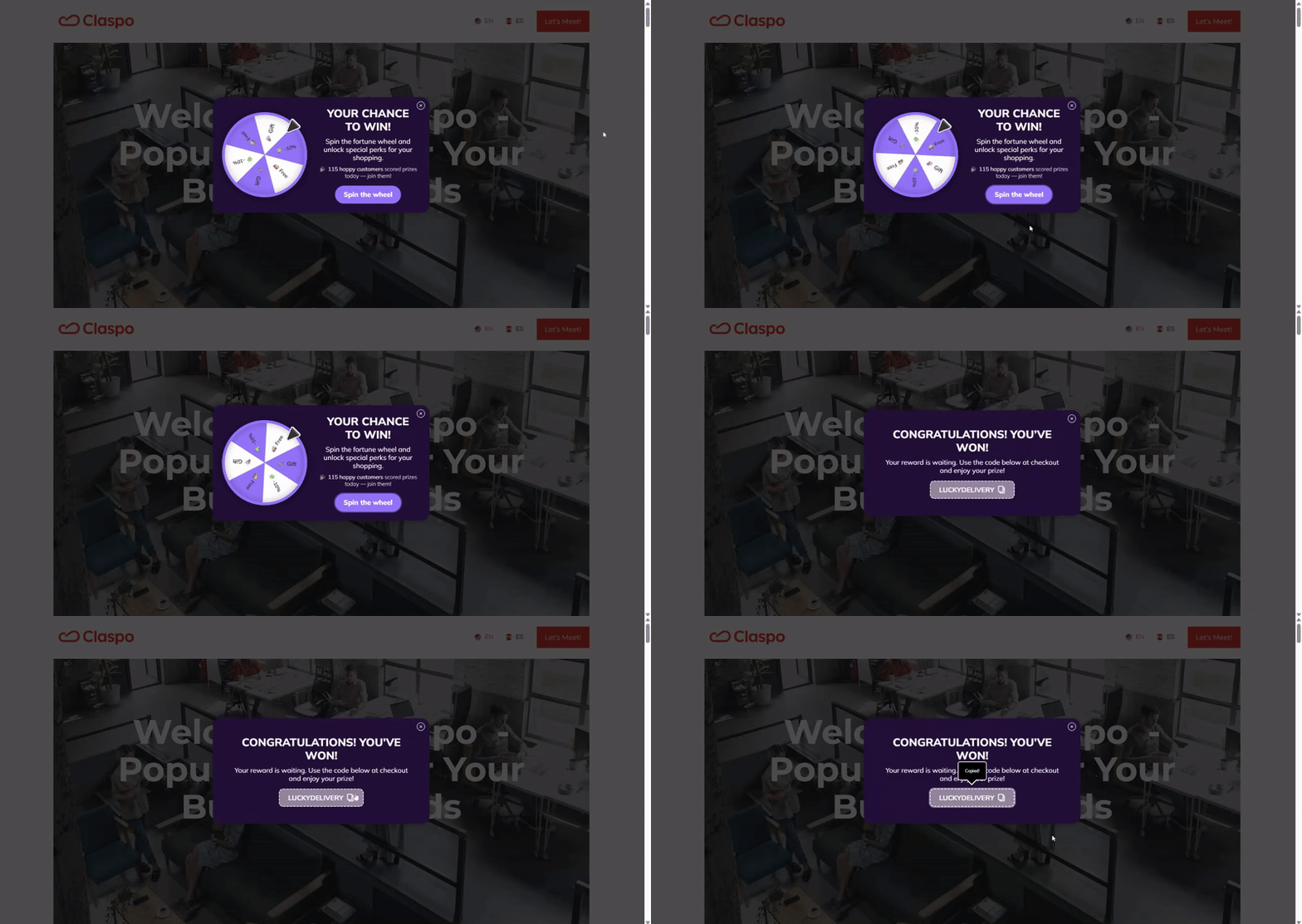
Why it works: Spin-the-wheel taps into anticipation. The motion itself creates a short moment of suspense, and the reward reveal feels immediate. On Valentine’s Day, this works especially well because visitors are already emotionally primed — they’re looking for something nice and special rather than carefully comparing offers. From a UX perspective, it’s also very easy to understand. No explanation needed. Spin, see what you get, move on.
What our data says:
- Average CTR — 9.54%.
- Top 10% (90th percentile) — 27.28% and higher.
Pick a gift: when choice drives engagement
Best for: flash deals, bundle promos, special Valentine collections, limited-time offers.
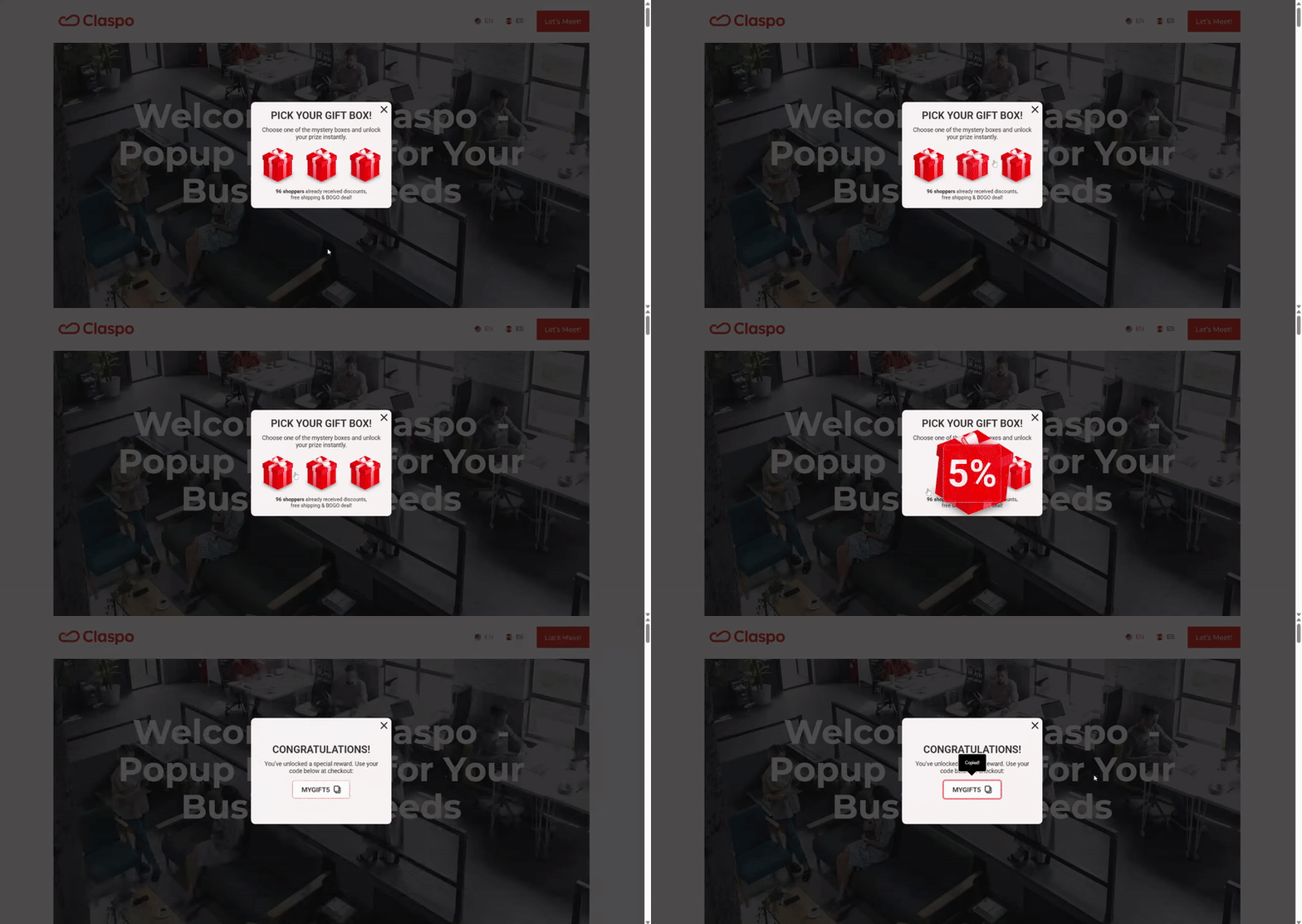
Why it works: Pick-a-gift adds one powerful element on top of curiosity: choice. When users pick a box themselves, the outcome feels personal — even if the reward pool is fixed. The reveal also mirrors a familiar Valentine moment: unwrapping a gift.
That ‘I chose this’ effect increases emotional ownership, which is especially valuable during gift-focused shopping moments.
What our data says:
- Average CTR — 10.58%.
- Top 10% (90th percentile) — 32.73% and higher.
Scratch card: earned rewards, lower friction
Best for: returning visitors, exit-intent flows, loyalty or repeat-purchase pushes.
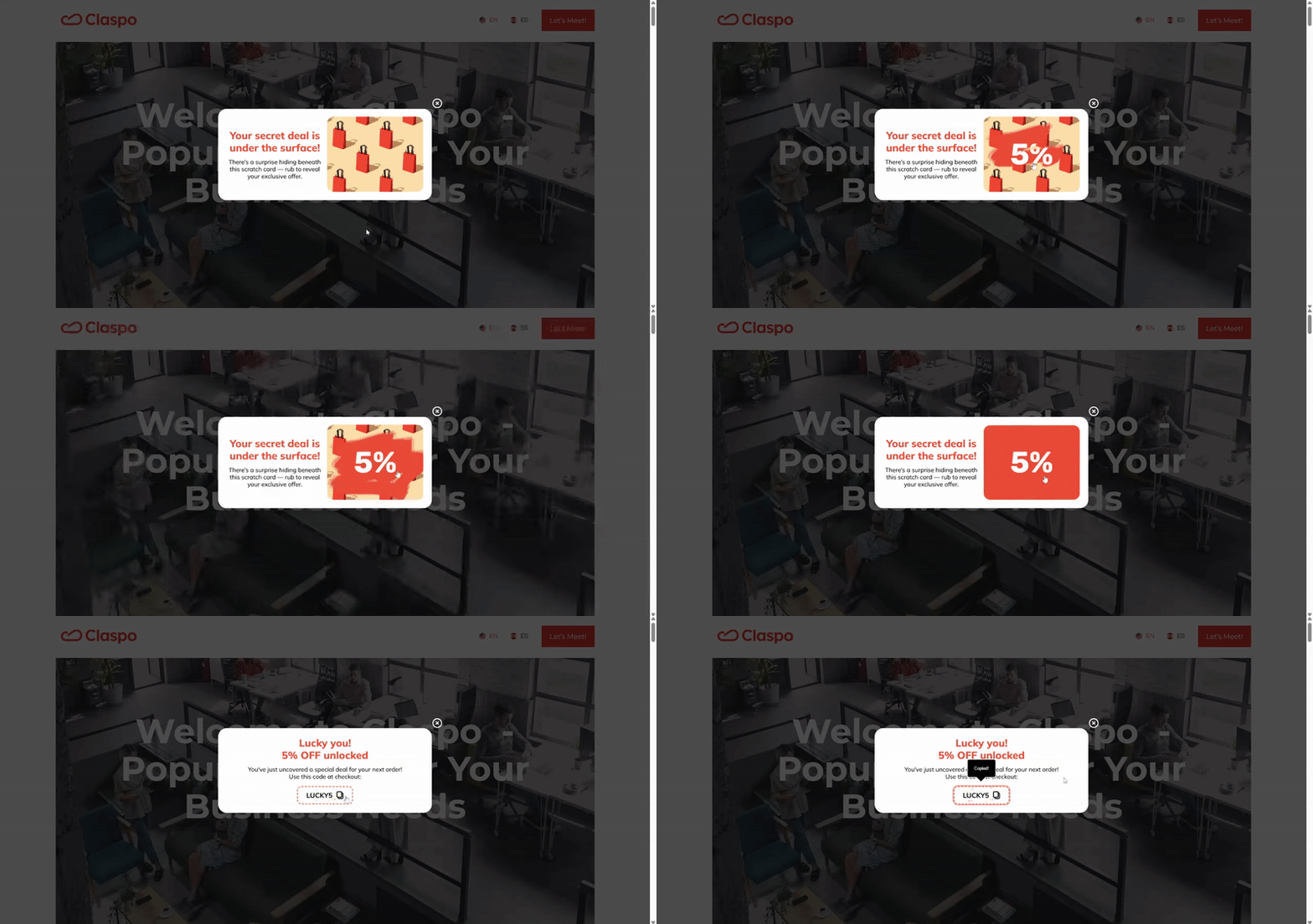
Why it works: scratching creates a small sense of effort — and effort makes the reward feel earned. Even a modest incentive feels more meaningful when it’s revealed through an action. Scratch cards also work well late in the session, when users hesitate before leaving or checking out.
What our data says:
- Average CTR — 7.73%.
- Top 10% (90th percentile) — 16.24% and higher.
Slot machine: fast rewards for high-volume traffic
Best for: flash-sale campaigns and short-term promos aimed at large volumes of visitors who arrive with clear purchase intent.
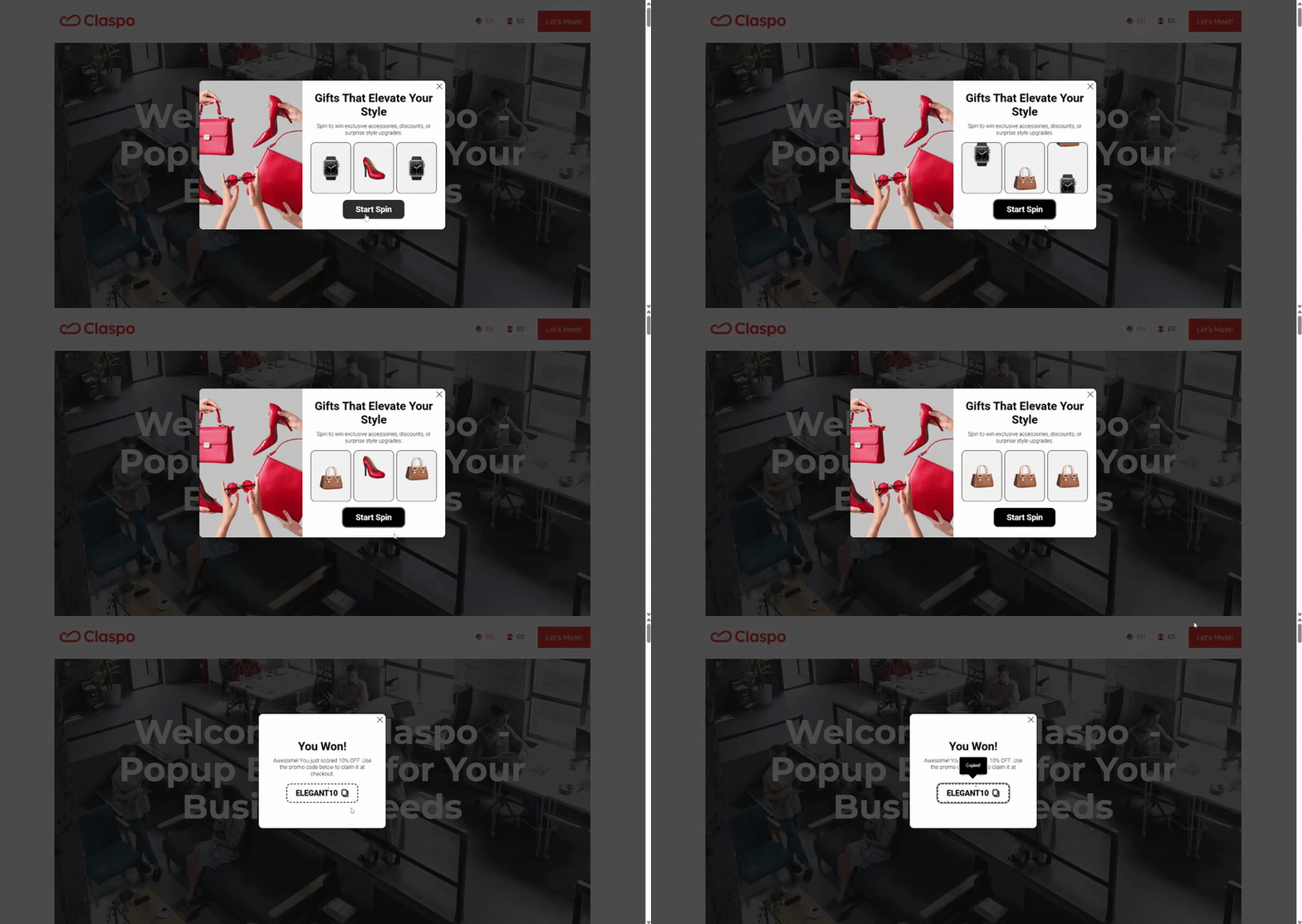
Why it works: Slot machine mechanics are built around speed. The spin-and-match motion delivers an outcome almost instantly, which makes it a good fit for visitors who are moving fast and scanning for a deal rather than exploring the brand. On Valentine’s Day, this often includes:
- users coming from paid ads;
- last-minute gift shoppers;
- visitors landing on promo or sale pages.
The interaction feels familiar — most people instantly understand how it works — and the short spin creates just enough tension to hold attention without slowing the session down. There’s no learning curve, and no decision fatigue.
From a behavioral point of view, a Slot machine works well when urgency is already present. Instead of asking users to think or choose, it reinforces momentum: spin, see the result, act on it.
What our data says:
- Average CTR — close to 9%.
- Top 10% (90th percentile) — 25% and higher.
Memory matching game: a fresh way to stand out on Valentine’s Day
New mechanic!
Memory matching is one of our newer game formats — and that’s exactly why it deserves attention during Valentine’s campaigns.
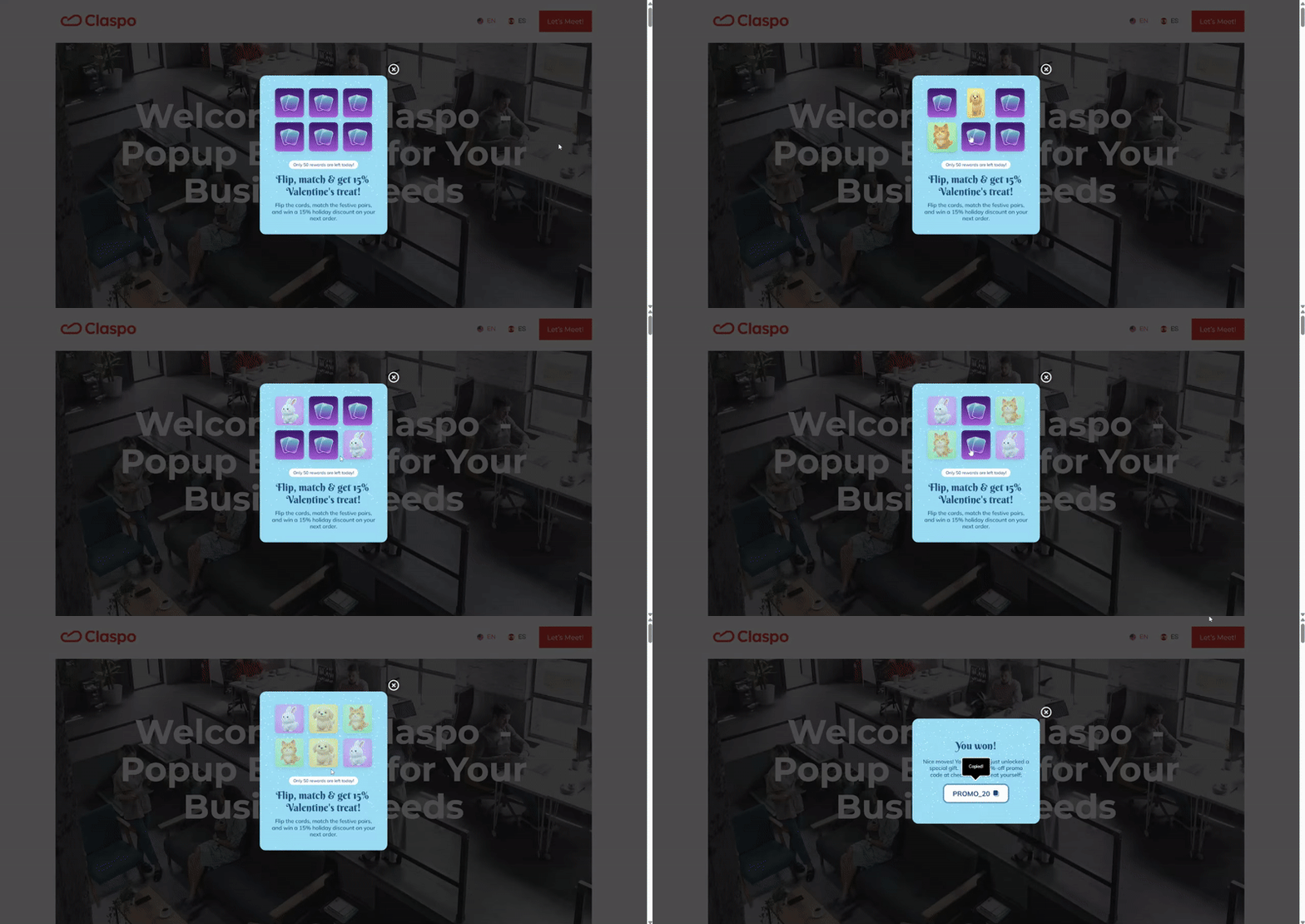
When many brands rely on the same classic mechanics year after year, introducing a less common game can become a real differentiator.
Valentine’s Day is crowded. Even brands that already use gamified widgets often stick to wheels or scratch cards. A different mechanic helps your campaign feel new, even if the offer itself is familiar.
Best for:
- Post-purchase and thank-you page experiences.
- Retention-focused scenarios and repeat customers.
- Brands that already use classic gamified mechanics and want something less expected.
Why it works: Memory matching asks for a bit more engagement than instant-spin mechanics — and that’s a feature, not a drawback. Instead of a single click, users complete a short task. That small effort changes how the reward is perceived: it feels earned. The game also holds attention slightly longer, which strengthens emotional involvement and improves recall.
There’s another important factor here: novelty. Because the mechanic is less common, users don’t immediately recognize the pattern. That moment of ‘oh, this is different’ helps break autopilot.
Early performance signals: while this mechanic is still relatively new, our early adopters have already seen strong results — CTR above 26% in optimized setups.
Of course, the game alone isn’t the whole story. Behavioral triggers, placement, and timing matter — but the freshness of the mechanic clearly plays a role in engagement.
One important thing to keep in mind: different mechanics resonate with different users. Some people chase fast wins, others enjoy choice, effort, or exploration. That’s why no single game works universally — and why understanding users' motivations matters more than picking a top-performing widget. We explore these player patterns and behavioral triggers in our gamification ebook.
Treasure hunt: exploratory play for high-intent visitors
New mechanic!
Treasure hunt is one of the newest game formats — and it’s fundamentally different from classic mechanics. Instead of a single interaction, it invites users to search, explore, and uncover a reward step by step.
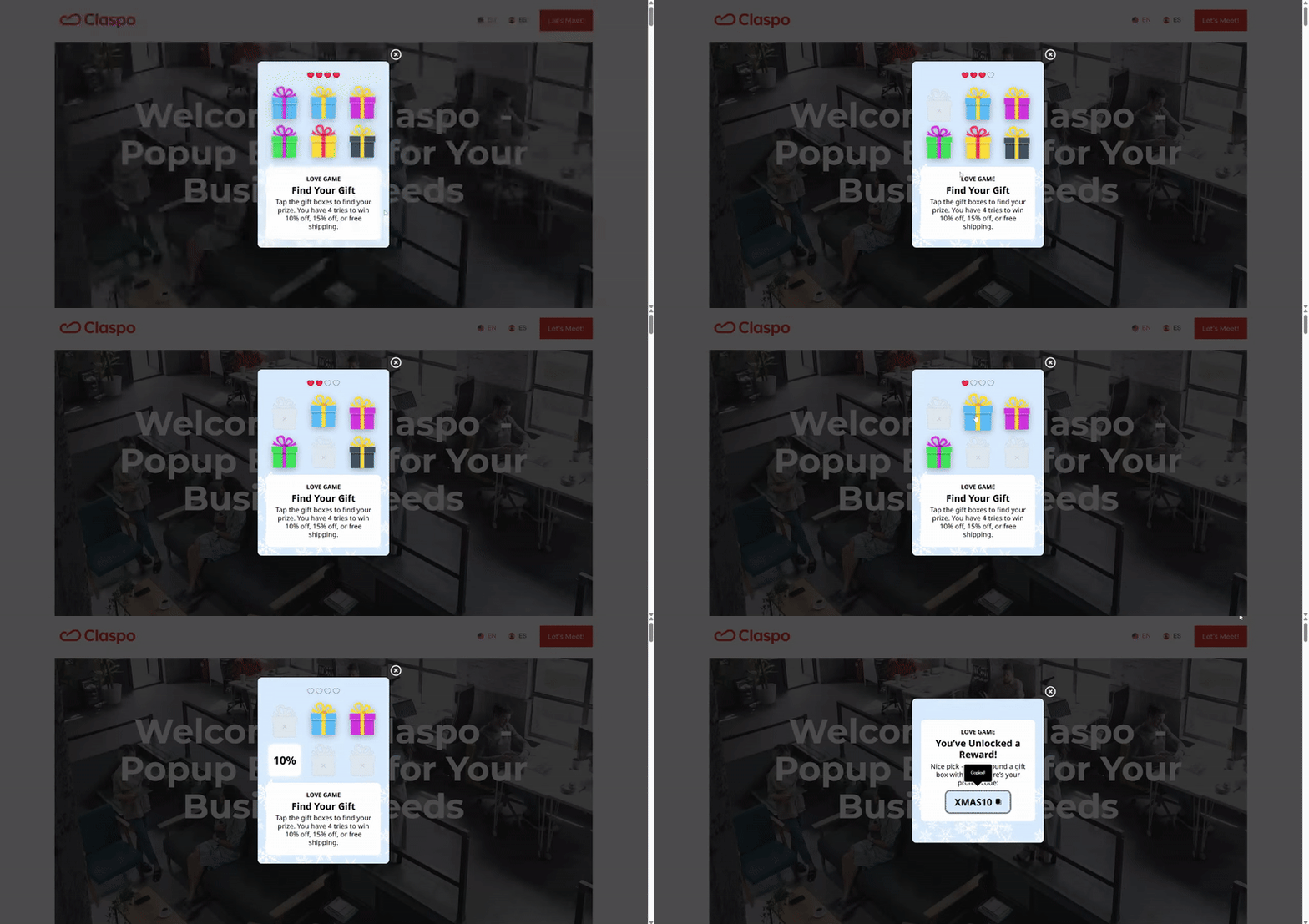
Treasure hunt isn’t about speed or urgency. It’s about engagement and memory. For Valentine’s Day campaigns that aim to stand out through experience — not just discounts — this mechanic is worth testing.
Best for:
- Product collections, gift guides, or curated Valentine pages.
- Mid-funnel visitors who are already browsing, not just landing.
- Brands that want to create a memorable on-site experience, not just trigger a click.
It’s less suited for cold traffic or exit-intent scenarios, where faster mechanics usually win. Treasure hunt shines when users already show interest and are open to exploring.
Why it works: Treasure hunt taps into a different motivation than instant-win games. Instead of anticipation (‘what will I get?’), it relies on:
- curiosity — the desire to find what’s hidden;
- progression — the feeling of moving closer to a goal;
- completion — the satisfaction of finishing a task.
Because the reward isn’t revealed immediately, users stay engaged longer. The experience feels less like a promo and more like a small challenge.
Early performance signals: while it’s still too early to talk about stable benchmarks, early adopters have already seen promising engagement — CTR close to 18% in initial campaigns.
As with other mechanics, performance depends heavily on placement and behavioral triggers — but the format itself clearly resonates with users who are willing to engage a bit more.
How to collect emails on Valentine’s Day
Sometimes sales aren’t the only goal. Your CRM still needs fresh contacts, and skipping email collection entirely isn’t always an option. The good news is that email capture can work on Valentine’s Day — just not in the usual ‘subscribe to our newsletter’ format. Gamification helps here, but only if you use it the right way. For example, you can promote a themed lead magnet or special offer through a valentine's day email signature, turning everyday correspondence into a subtle yet effective way to collect new contacts during the holiday season.
Gamified forms vs. traditional signup forms
Across our benchmarks, gamified signup flows consistently outperform classic forms — even outside seasonal campaigns:
- Average CR for all signup forms — 3.53%
- Average CR for gamified signup forms — 9.18%
Looking at specific mechanics:
- Spin to Win — 9.25%
- Scratch Card — 11.29%
- Gift Box — 7.26%
That gap exists because gamified forms change the context of the email request. Whether the email is entered before or after the interaction, it’s tied to a clear outcome — a chance to play and unlock a reward.
Two tactics that keep email capture from killing conversions
1. Prize first, email second
This is the safest and most reliable approach. The flow looks like this:
- The user plays (spins, scratches, picks a gift, etc).
- They immediately see what they’ve won.
- Email is requested only to deliver the prize or discount code.
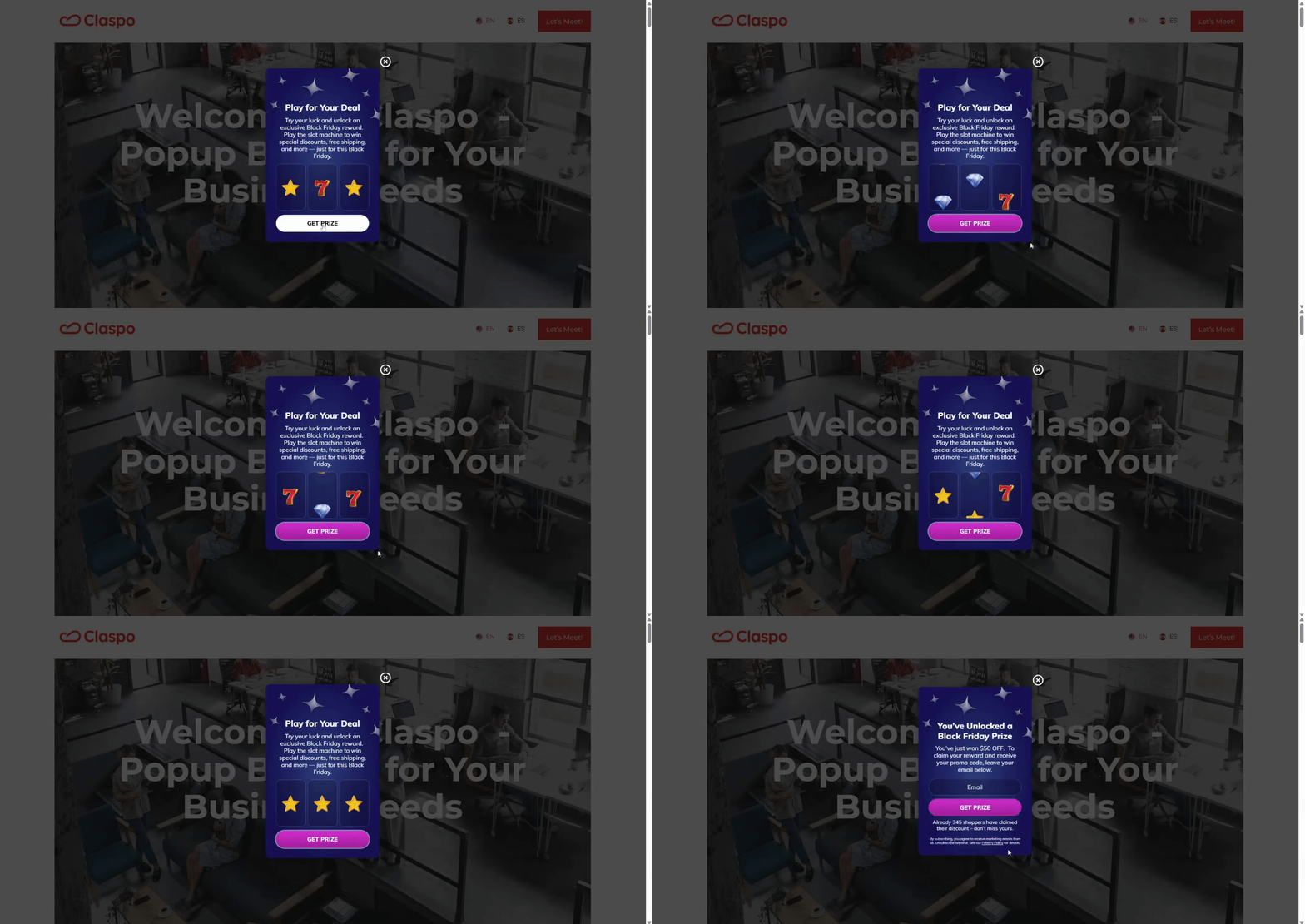
At that point, the email doesn’t feel like a tax. It feels like a formality. This taps directly into reciprocity: people are far more willing to share contact details after they’ve received something of value.
2. Use gamified email capture only for returning visitors
One more effective approach is to separate games from email capture based on user familiarity. How it works:
- First-time visitors: play the game, see the reward, continue shopping — no email required.
- Returning visitors: play the same game, but get the option to save the reward by email or receive it in their inbox.
The experience stays consistent, but the expectation changes based on context. Returning users are less skeptical and more open to sharing contact details. The email request feels fair — it’s tied to convenience, not access. The quality of collected emails is higher, because users already showed interest.
A 7-day rollout plan for Valentine’s Day campaigns
Valentine’s Day campaigns usually don’t fail because the idea is bad — they fail because everything goes live at once and then never changes. A more effective approach is to adapt the interaction as the deadline approaches. The closer it gets to February 14, the less patience users have — and the more decisive your UX needs to be.
Here’s a simple 7-day structure that matches how people actually behave in the final stretch.
Days 1-2: Lead with frictionless sales mechanics
At this stage, users are still exploring options and comparing gifts. They’re open to playful interaction, but they’re not ready to commit beyond the purchase itself. What to launch:
- Spin the wheel, Pick a gift, or Slot machine.
- Clear, instant rewards: discount, free shipping, small bonus. No forms.
Early interactions should feel easy. When nothing slows users down, they’re more likely to explore further and return on their own.
Days 3-4: Switch the game for returning visitors
At this stage, repeating the exact same interaction doesn’t work. Returning users recognize patterns quickly. If they already spun a wheel or scratched a card, showing the same mechanic again feels recycled — even if the reward changes.
Instead of forcing email into the same experience, a better move is to change the game itself. What to do:
- Keep the same instant-win mechanic for first-time visitors.
- Show a different game to returning users + add an email gathering to send a newly unlocked reward.
Instant-win mechanics can be replaced with Memory matching, where a small amount of effort restores engagement and makes the reward feel earned. For users who have already browsed several pages, introducing Treasure hunt works well because it turns exploration into a goal-oriented experience.
Days 5-7: Add urgency, but simplify everything else
In the final days, attention drops and impatience rises. Users skim faster, scroll less, and tolerate fewer steps. What to adjust:
- Keep the strongest-performing gamified mechanic.
- Add urgency elements (time-limited rewards, visible countdowns, reduced reward availability).
Avoid introducing new mechanics at this point. Familiarity is an advantage under pressure. Users should instantly recognize what to do. Urgency works best when it’s visible and honest. Clear deadlines help users finalize a choice they’ve already been considering.
Measuring success: how to read widget metrics without fooling yourself
The problem usually isn’t lack of data. It’s knowing what each metric actually tells you, and what conclusions you can safely draw from it. For gamified widgets, it helps to look at performance in layers.
Views vs. clicks: where problems really show up
The first thing to look at isn’t CTR in isolation — it’s the relationship between views and clicks:
- Views tell you how often the widget was shown. This reflects targeting, triggers, and timing.
- Clicks (or interactions) show whether people found the experience worth engaging with.
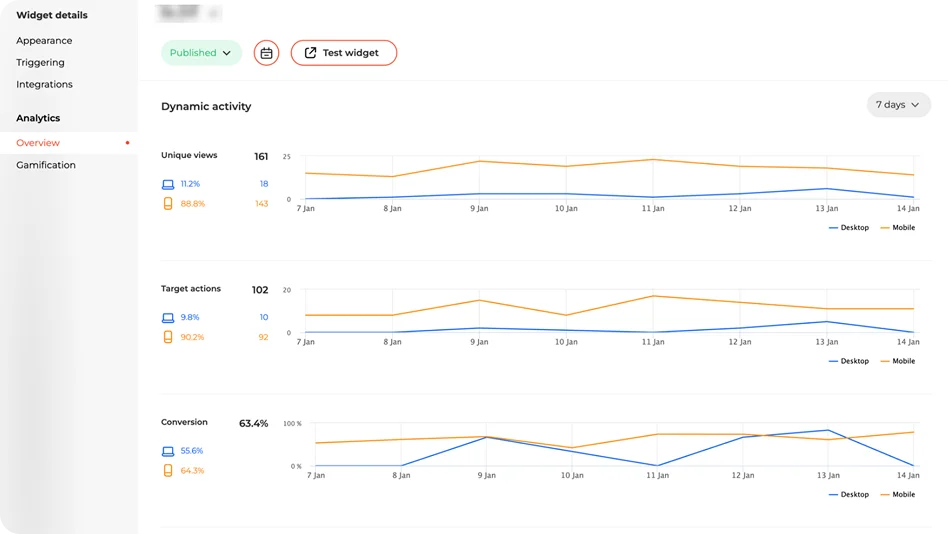
Comparing views and clicks helps answer a simple question: did users actively ignore the widget, or did they never really get a chance to notice it? When views are high but clicks stay low, the issue is usually relevance — the widget is visible, but the message, mechanic, or timing doesn’t match user intent. When views are low but CTR is strong, the setup is often too restrictive. In that case, the mechanic itself works, it just isn’t being shown often enough.
Don’t ignore device split: mobile and desktop behave very differently
Looking at widget performance by device isn’t just a ‘nice-to-have’. For gamified widgets, it often explains why something works or doesn’t. Here’s what device stats actually tell you.
Views by device show where your real exposure is coming from. If most views come from mobile, optimizing mobile UX will move your results far more than improving desktop metrics.
Clicks (or target actions) by device help spot UX friction. A pattern could look like this: mobile generates most views, but desktop shows higher CTR. It usually means the mobile experience needs attention: button size, animation speed, close icon placement, etc.
Prize distribution: what this metric really tells you
Prize distribution shows which prizes users won and saw inside the widget. This data helps you understand whether your reward logic and win odds are set up the way you intended.
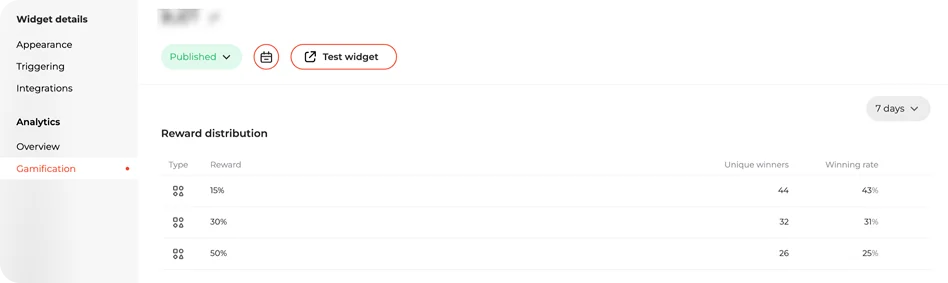
If expensive prizes are won too frequently, the campaign may look successful on the surface (high engagement, happy users), but quietly eat the margin. Usually, this isn’t strategic at all — it’s just bad odds math.
And if the lowest reward keeps winning, users quickly lose trust, regardless of how correct the setup looks on paper. That perception alone can hurt trust and future engagement.
This metric helps you catch both problems early. Prize distribution isn’t about performance, it’s about control. For example, one of our customers, the brand WHOSE, deliberately set up their Spin-the-wheel so that the second-best discount appeared most often. For customers, it still felt like a solid win — something worth smiling about — while for the brand it didn’t blow up the budget. This balance between perceived value and real margins helped the widget drive strong engagement without hurting profitability. You can see the full results in the WHOSE case study.
Promo code redemption beats promo code exposure
To see whether a gamified incentive actually helped close a purchase, you have to look outside the widget:
- at reports from your e-commerce platform like Shopify or WooCommerce,
- checkout analytics,
- CRM or order management systems where promo codes are applied.
This is where you can see how often a code was redeemed, which orders used it, and whether it had any impact on conversion or order value.
To understand the full picture, you need to read Claspo data together with your e-commerce or analytics reports. Claspo shows how many users interacted with the widget and how many saw or won a specific reward. Your other tools then show whether those rewards were actually applied at checkout. When CTR is high but redemption stays low, it usually means the reward was fun in the moment but didn’t help users make a purchase decision, or the timing was simply off and users weren’t ready to buy yet.
How to get more than just Valentine’s Day sales
Valentine’s campaigns move fast, and that speed makes them useful. Intent is obvious, deadlines are real, and results don’t take long to show up. If you’re running gamified widgets, this is one of the better moments to test — small adjustments often have a noticeable effect. A few things worth testing in Valentine campaigns:
- Game mechanic vs. game mechanic (for example, Spin-the-wheel vs. Pick a Gift on the same traffic segment).
- Reward structure (one strong reward vs. a wider spread of smaller ones).
- Triggers (time delay vs. mid-scroll).
- Urgency elements (with or without countdowns).
If you want to try these ideas in practice, everything described in this guide — gamified widgets, 1000+ templates, behavioral triggers, targeting for new and returning visitors, prize logic, A/B testing and much more — is available in Claspo, including our Lifetime Free plan.
That makes Valentine’s Day a low-risk moment to experiment: launch, test, learn, and carry the wins into your next seasonal campaign — without committing to another tool or setup overhead. Sometimes the biggest value of a holiday campaign isn’t just the sales it brings today, but the clarity it gives you for everything that comes next.