
The “Coupon Tax” is Killing Your Margins: How to Secure Your Shopify Store with Dynamic Codes
At 3:00 AM on a Tuesday, a Shopify merchant in New York was woken up by a flood of order notifications. At first, it looked like a dream until he realized that every single order was using a “VIP” discount code he had sent to only five people. A bot scraped the code, and within hours, his highest-margin products were being cleared out at a 40% loss.
If you’re running a Shopify store and your codes look like “WELCOME10” or “SALE15”, congrats — you’ve successfully added a “coupon tax” on every order. Not only do you give away profit, but you also don’t get emails for your list and pay for leads you never captured. With new code scraping browser extensions, static promo codes have become a security vulnerability for your margins.
How you’re losing money without knowing it
This story isn’t about one hypothetical merchant; this is about every merchant who offers promo codes on Shopify. For years, marketers have been teaching them that a promo code is a “nudge” to make a purchase. However, now, a static promo code has become public property. The second you create a promo code in your Shopify admin and click Save, it stops being yours. It’s instantly indexed by scraping bots and fed to millions of shoppers.
How conversions trick you
The number of shoppers increases, and you might see a 5% growth in conversion rate (CR). If you’re starting to celebrate, wait a minute. Look closer at your analytics. How many of those shoppers were ready to buy without any code before the extension auto-injected the parsed code?
Here’s what happened:
- You didn’t win that shopper and potential loyal customer,
- You subsidized a purchase that was happening anyway,
- You failed to trade your discount for an email or phone number.
“A 10% discount is a small price to pay for a sale”, you may say. But let’s look at the impact on your bank account, not the revenue.
Let’s imagine that your Average Order Value (AOV) is $100 and your net margin is 20%.
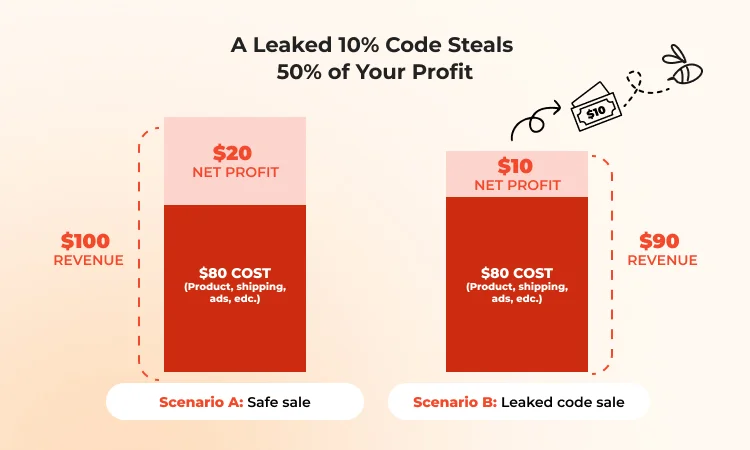
- Scenario A: If your code doesn’t leak, the customer pays $100, and you get $20.
- Scenario B: If your code leaks, then the customer pays $90, and you get only $10.
Even though the discount was “only a 10% off,” it just stole 50% of your actual profit. Let that sink in.
How dynamic codes save the day
To make the difference between static and dynamic codes clear, think of them as doors. If a static code is a door with no lock, a dynamic code has a biometric lock. It’s unique, single-use, and tied to a specific session. It can’t be scraped or shared.
1:1 attribution
In the old way, the “SALE15” code could be used by 1,000 people, and in the end, you couldn’t figure out the attribution channel that brought you leads. With dynamic code, everything is tightly tied to a specific action, such as an email signup in a Claspo popup.
Zero database value
With static codes, every existing one is a back door to your store that you leave unlocked. To put it simply, if you created a special but static code for an influencer campaign 3 years ago, the internet still remembers it. Scrapers and aggregators like Honey and RetailMeNot still have it in their database. If the dynamic code ends up on a coupon site, it’ll be useless because it only fits one lock.
No coupon debt
Shopify allows for 20M unique codes. With dynamic codes, you get automatic cleanup once your visitor uses their code (or the code expires), because the code expires for Shopify as well. You don’t need to delete codes from last year’s Black Friday manually to free up space.
Real, built-in urgency
Shoppers don’t like fake urgency that marketers impose. Seeing a “2-hour sale” for two days undermines your brand authority and kills trust. A dynamic code that expires at a set date changes this. You create real FOMO and give your visitors a unique window of opportunity. Auto-expiring codes (that are valid for only 2–3 days) increase CR without any site-wide promotions.
How to make it work
For the margin-protection strategy, you only need the Claspo app for Shopify. See how to set dynamic Shopify promo codes without leaving the popup editor.
Step 1
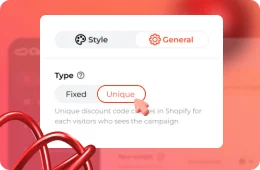
In the editor, you don’t need to type in the word for the promo code. Toggle the “unique” in the code type. This way, Claspo talks directly to your Shopify store’s API, and Shopify will generate the codes for you.
Step 2
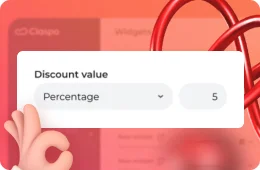
Next, choose your fighter: percentage off (10%) or fixed-amount off ($10). Tips on how to choose between them:
- Percentage off: Use for lower-ticket items where “10% off” sounds more significant than “$2 off.”
- Fixed amount: Use for high-ticket items, where a “ten-dollar gift” makes more sense than doing mental math with percents off.
Step 3
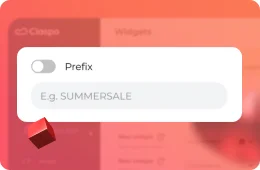
Use a prefix in your codes, like “VIPGIFT-” or “WELCOME-” to help you identify the source in Shopify analytics at a glance. Besides, a prefix makes a random symbol string look neat and professional.
You need to type only the prefix identifier; the unique part of the code will be generated automatically. Don’t be afraid; your customers don’t need to memorize complex codes or type “VIPGIFT-ISD16-04-DDJ93” manually. The code will be automatically applied to the cart at checkout. Your mobile customers will definitely love it.
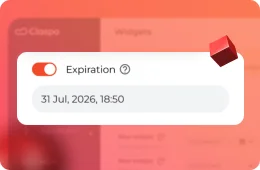
After that, set the expiration date to motivate and gently push your customer toward checkout.
How to use dynamic promo codes beyond basics
Here are some pro tips from our team on how you can use unique codes apart from your basic welcome flow. We recommend trying these tactics:
- Hook the abandoners: Don’t wait until a high-intent shopper drops off. If a visitor looks at the same product three times, trigger a unique “Just for you, for the next hour” promo code. This popup will convert way better than a site-wide banner because it acknowledges the intent and offers a personalized deal.
- Roll out the red carpet for your VIPs: Your frequently returning and high-ticket VIPs help your store thrive, so why not incite them with a unique code? A generous, but static 20% off code will go viral on Reddit in minutes. To protect the margin, opt for a unique code that a specific customer can redeem.
How to stop subsidizing the internet
With the rise of Honey, Capital One Shopping, Coupert, and other scraping bots and browser extensions, static codes have become a relic of the past. To win this battle and stop subsidizing the internet, switch to dynamic, one-time-use codes. Use your discounts for what they were intended: acquiring and retaining loyal customers. Subscribe to our newsletter and be the first to know about the updates and forthcoming release.