15 Best Shopify Popup Apps in 2026: Reviews & Comparison

Summarize
Search “popup” in the Shopify App Store and dozens of apps start to look the same: email capture, discounts, exit intent, Spin-to-Win. But their targeting, testing, pricing, and Shopify features can differ a lot. We compared 15 best Shopify popup apps to help you quickly find the right fit for your store.
TL;DR Best Shopify popup apps compared
Shopify popup app | Best for | Shopify rating | Free access | Paid from/pricing basis |
Claspo | AI-powered CRO and flexible campaigns | 5.0⭐ (35) | Free plan/14-day trial | $39/mo · pageviews |
Wisepops | Revenue-focused CRO and onsite engagement | 4.9⭐ (70) | 14-day trial | $299/mo · pageviews |
OptiMonk | Building custom popups with AI | 4.8⭐ (460) | Free plan | $29/mo · pageviews |
Alia | Hands-off popup optimization | 4.6⭐ (114) | 14-day trial | $100/mo · visitors |
Poptin | Detailed Shopify targeting on a lower budget | 4.9⭐ (336) | Free plan | $25/mo · visitors |
Privy | Popups plus email and SMS marketing | 4.5⭐ (4,216) | No | $24/mo · pageviews for popup plan |
Popupsmart | Promoting Shopify products inside popups | 4.6⭐ (49) | Free plan | $19/mo · pageviews |
Seguno Popups & Forms | Stores already using Seguno Email | 4.9⭐ (68) | Free plan/10-day trial | $10/mo · impressions |
CWILL | High-traffic stores with modest signup volume | 4.9⭐ (7,726) | Free plan/14-day trial | $11.90/mo · new subscribers + emails |
Pop Convert | High-traffic stores wanting predictable costs | 4.9⭐ (8,753) | Free plan/90-day trial | $15/mo · Shopify plan |
Justuno | Identifying visitors beyond popup signups | 4.6⭐ (668) | 14-day trial | $59/mo · unique visitors |
Omnisend | Feeding signups into lifecycle automation | 4.7⭐ (3,182) | Free plan | $16/mo · contacts |
POWR | Scheduled promotional campaigns | 4.5⭐ (436) | Free plan | $7.04/mo · submissions |
Adoric | Product recommendations and upsells | 4.9⭐ (260) | Free plan/7-day trial | $4.99/mo · store orders |
WooHoo | Simple gamified list growth | 4.4⭐ (199) | Free plan/14-day trial | $7.99/mo · visitors |
15 Best Shopify popup apps in 2026
To compare these Shopify popup apps, we looked at Shopify setup, popup formats, targeting and triggers, testing and analytics, integrations, pricing, and free access. We also checked current Shopify listings, ratings and review counts, pricing, and feature availability in September 2026, using official product pages and documentation.
If you’re still at the setup stage, see how to add a popup to Shopify before comparing advanced features.
Claspo — best for AI-powered CRO and flexible Shopify campaigns
Shopify rating: 5⭐ (35 reviews)
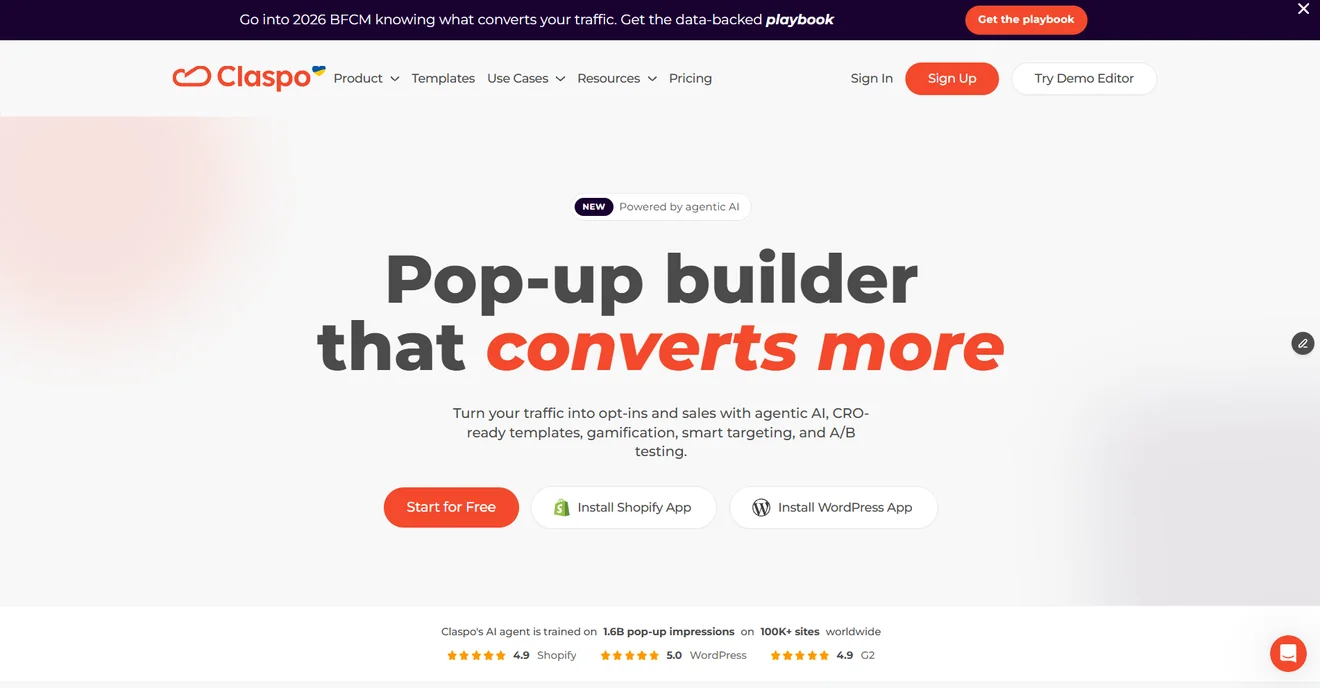
Claspo is a popup and onsite conversion tool for Shopify stores that want more control over targeting, experimentation, and campaign formats. Its current focus is agentic AI: the AI CRO agent analyzes visitor behavior, identifies conversion opportunities, prepares campaigns and test variants, and uses performance data to recommend further improvements.
What stands out:
A/B/C/D/E testing with up to five variants.
Email/SMS capture, quizzes, multi-step forms, and gamified popups.
Static and dynamic Shopify discount codes.
Targeting by behavior, traffic source, cart, and customer data.
The main strength is that Claspo covers many campaign types, and you can control very precisely who sees them, when they appear, and what gets tested. The AI side is still evolving, though, and campaign launches and tests currently require merchant approval.
Claspo pricing starts with a free Shopify plan for up to 3,000 monthly pageviews, with unlimited popups and features but Claspo branding. Paid plans start at $39/month for 50,000 pageviews and include a 14-day free trial.
Choose Claspo if you want hundreds of popup templates for various use cases, advanced targeting, experimentation, gamification, and Shopify discount campaigns. Besides, it’s a great pick if you want AI to take over more of the CRO workflow but still keep control over your campaigns.
If discounts are central to your strategy, compare dedicated Shopify discount apps as well.
Wisepops — best for revenue-focused CRO and onsite engagement
Shopify rating: 4.9⭐ (70 reviews)
Wisepops is an on-site conversion platform for Shopify stores that want more than traditional popups. Alongside popups, it offers embedded campaigns, an onsite notification feed, and web push, so you can engage visitors in several ways without relying on modal campaigns alone.
What stands out:
Popups, embeds, onsite feed, and web push.
AI-powered Shopify product recommendations.
A/B/n testing with control groups.
Revenue and conversion tracking.
The testing side is particularly useful for CRO teams: you can compare campaigns against a control group and use metrics such as revenue per visitor to see whether a campaign actually adds revenue rather than simply receiving attribution for a sale.
The main limitation is price. There is no free Shopify plan, and the current Shopify listing shows $299/month for up to 500,000 pageviews, with a 14-day free trial.
Choose Wisepops if onsite campaigns are already part of your CRO program and you want to measure their impact on conversions and revenue.
OptiMonk — best for building custom popups with AI
Shopify rating: 4.8⭐ (460 reviews)
OptiMonk is an AI-native popup and CRO platform for Shopify. Its current AI agent can create on-brand popups from a website URL and prompt, suggest targeting and triggers, and generate ideas for A/B tests. It can also monitor store data and suggest new campaigns.
What stands out:
Custom popups built through AI chat.
Product recommendations inside popups.
A/B tests for campaigns and larger site changes.
Revenue, order, and AOV tracking.
The best part about OptiMonk is that it’s way more than a basic popup tool. You can tie your campaigns directly into broader onsite experiments—think tailored product recommendations, upsells, and cross-sells.
The flip side? Pricing climbs fast as your traffic grows. There is a free plan for up to 10,000 monthly pageviews; paid tiers start at $29/month for 20,000 pageviews. But once you hit the Growth plan at 100,000 pageviews, you’re looking at $99/month.
Choose OptiMonk if you want to describe a campaign in chat and have AI build it for you, especially if you also plan to experiment with product recommendations and personalized website content.
Alia — best for hands-off popup optimization
Shopify rating: 4.6⭐ (114 reviews)
Alia is a Shopify-focused popup platform built for brands that want help running and improving their campaigns, not just software to build them. Every customer gets white-glove onboarding, and brands can also use a fully managed service where Alia’s team handles testing, creative changes, and performance monitoring.
What stands out:
White-glove onboarding for everyone.
Optional fully managed popup optimization.
AI-powered testing and smart triggering.
Quiz-style zero-party data capture.
Alia also supports email and SMS capture, quizzes, games, surveys, targeting, segmentation, and A/B testing. Its zero-party data can sync into tools such as Klaviyo, Postscript, and Omnisend for more detailed segmentation later.
The trade-off is price; besides, there is no free Shopify plan. Plans start at $100/month for up to 20,000 visitors, with a 14-day free trial. (Checked September, 2026)
Choose Alia if you want someone to help run the popup program for you, including setup, testing, and ongoing optimization.
Poptin — best for detailed Shopify targeting on a lower budget
Shopify rating: 4.9⭐ (336 reviews)
Poptin is a popup and form builder with unusually detailed Shopify targeting for its price range. Instead of only targeting by page or device, you can build campaigns around what a shopper has in their cart, whether they’re logged in, their customer tags, and their previous orders. Poptin also supports Shopify exit-intent popups alongside its cart- and customer-based targeting.
What stands out:
Cart value, items, and product targeting.
Customer tag and login-status targeting.
Order-history targeting.
A/B testing and exit-intent triggers.
Poptin is rather useful for campaigns like VIP offers, free-shipping thresholds, upsells based on cart contents, or different messages for new and returning customers. The free plan is fairly limited, though: it includes Poptin branding, no autoresponders, and only 1,000 monthly visitors.
As we’re writing this in September 2026, the Shopify free plan covers 1,000 monthly visitors and unlimited popups on one domain. Paid plans start at $25/month for 10,000 visitors, with annual billing available at a discount.
Choose Poptin if you want to build popups around real cart and order data without paying for an enterprise-level CRO platform.
For more ideas on using cart, customer, and behavioral data, see our guide to ecommerce popup targeting.
Privy — best for combining popups with email and SMS marketing
Shopify rating: 4.5⭐ (4,216 reviews)
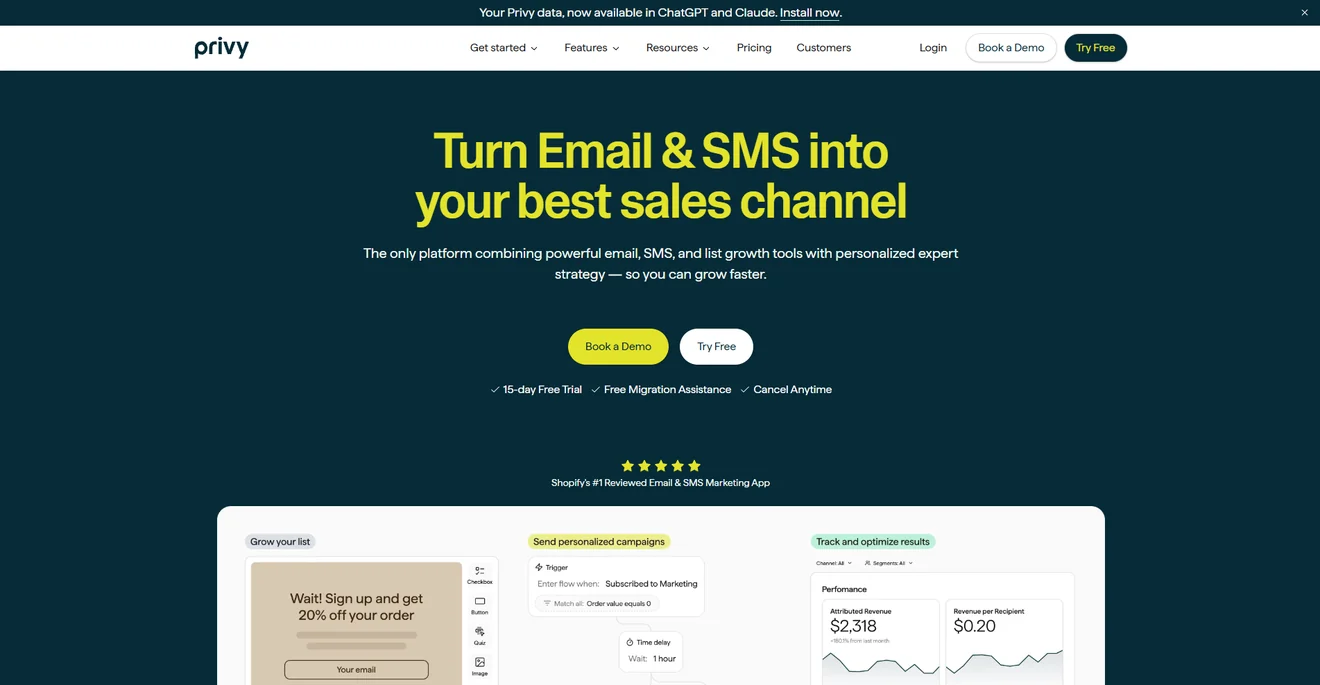
Privy combines popup capture with email and SMS marketing. With Privy, you don’t need to send new subscribers to a separate marketing platform; you can use Privy to collect the contact and then run welcome messages, cart recovery, win-back campaigns, and other follow-ups from the same tool.
What stands out:
Popups plus email and SMS marketing.
Multi-step and mini-quiz forms.
Cart recovery and automated flows.
Revenue and engagement reporting.
This setup can simplify the stack for a smaller ecommerce business that doesn’t already rely on Klaviyo, Omnisend, or another ESP. On the other hand, stores that already have email and SMS covered may only need Privy’s popup plan and won’t get as much value from the broader suite.
As of September 2026, Shopify lists the popup plan from $24/month for up to 10,000 pageviews. Email starts at $30/month for up to 1,500 contacts, while email + SMS starts at $45/month for 1,500 email contacts and 1,250 SMS credits.
Choose Privy if you’d want to capture a subscriber and manage the emails or texts that follow from the same Shopify marketing platform.
If list growth is your main goal, you can also compare the best Shopify email capture popup apps separately.
Popupsmart — best for fast no-code Shopify campaigns
Shopify rating: 4.6⭐ (49 reviews)
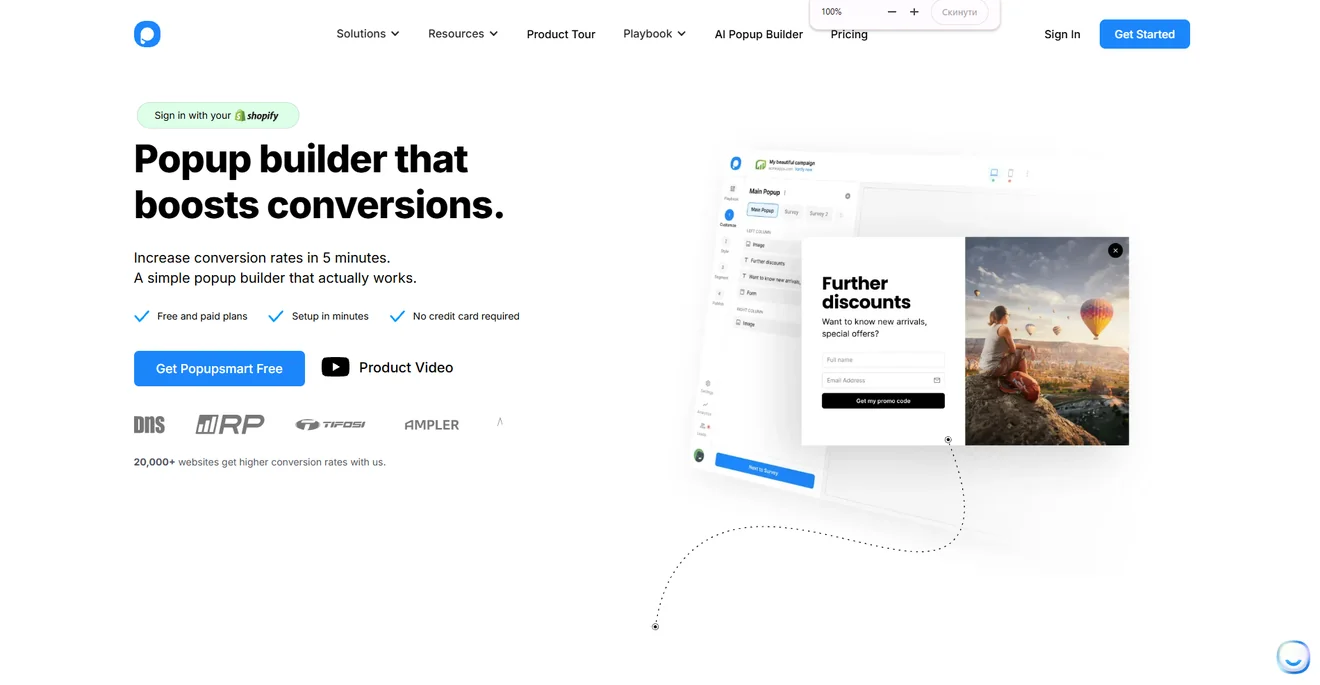
Popupsmart is a no-code popup builder for Shopify stores that want to create campaigns quickly without moving into a more expensive CRO platform. Its current product puts more emphasis on AI, with tools for generating popup copy and images alongside the regular visual builder.
What stands out:
Products and collections inside popups.
Add-to-cart actions from the popup.
AI-generated copy and images.
Spin-to-Win and Lottery Ball games.
Popupsmart also covers the usual lead-capture and exit-intent campaigns, with targeting and autoresponder emails included. One limitation is that A/B testing is only available on the Advanced Shopify plan, so experimentation requires a fairly large jump in price.
As of September 2026, the free Shopify plan includes 5,000 monthly pageviews, one active popup, and 100 email autoresponders. Paid plans start at $19/month for 25,000 pageviews, while the Advanced plan with A/B testing costs $69/month.
Choose Popupsmart if you want to promote Shopify products or collections directly inside popups and launch those campaigns without much setup
Seguno Popups & Forms — best if you already use Seguno Email
Shopify rating: 4.9⭐ (68 reviews)
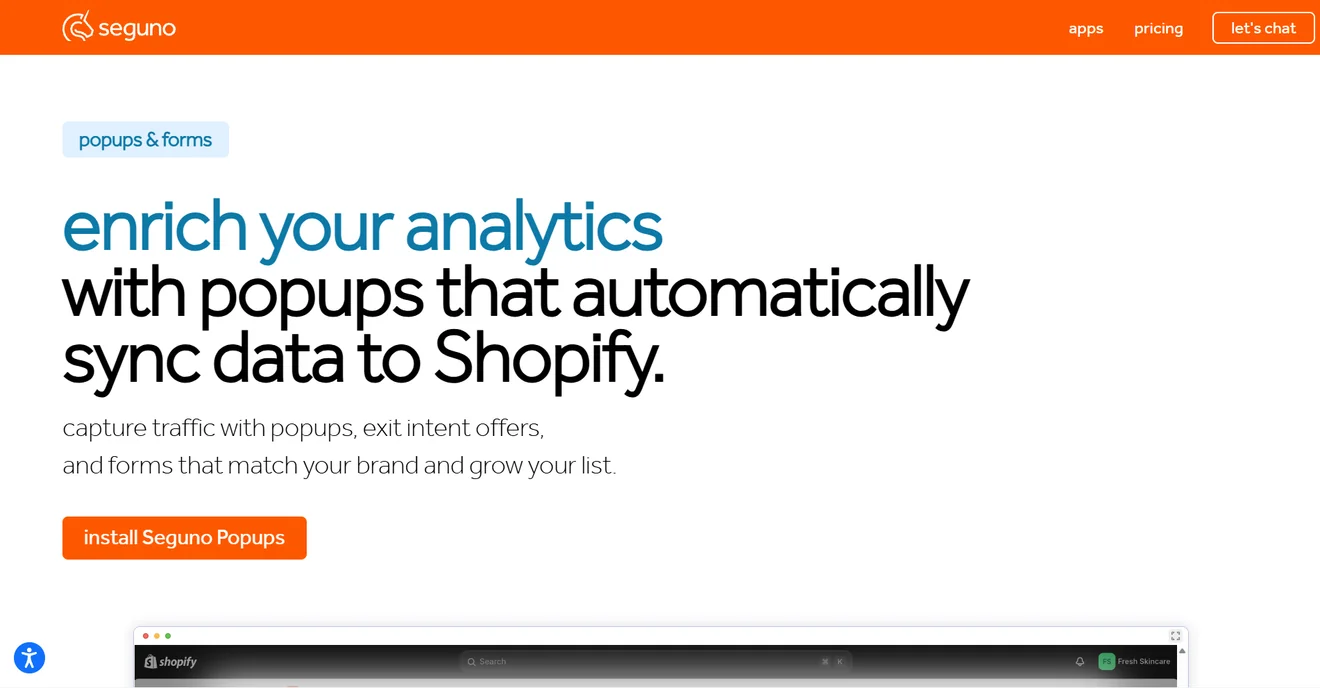
Seguno Popups & Forms is built exclusively for Shopify and runs inside the Shopify admin. It focuses on signup popups and embedded forms, with collected subscriber data written directly to Shopify customer records.
What stands out:
Unlimited plan included with Seguno Email Standard.
Form answers saved as Shopify tags or metafields.
Popups and embedded forms in one app.
Targeting by page, language, country, and schedule.
The Shopify data connection comes in handy if you collect preferences or interests at signup. Those answers can feed Shopify segments, Flow automations, or Seguno Email campaigns, and you don’t need a separate contact database. The trade-off is that Seguno stays fairly focused on list growth and forms and lacks broader CRO and gamification.
The free plan includes 1,000 monthly impressions and one active popup. Standard costs $10/month for 5,000 impressions, plus $10 per additional 10,000 impressions, and includes a 10-day free trial. With the Seguno Email Standard plan, get unlimited impressions, popups, and forms at no additional charge. (Checked September, 2026)
Choose Seguno if you already use Seguno Email and want popups, forms, customer tags, and follow-up campaigns to work inside the same Shopify-based setup.
For a simpler email-list use case, see how to build a Shopify newsletter popup.
CWILL Popups — best for high-traffic stores with modest signup volume
Shopify rating: 4.9⭐ (7,726 reviews)
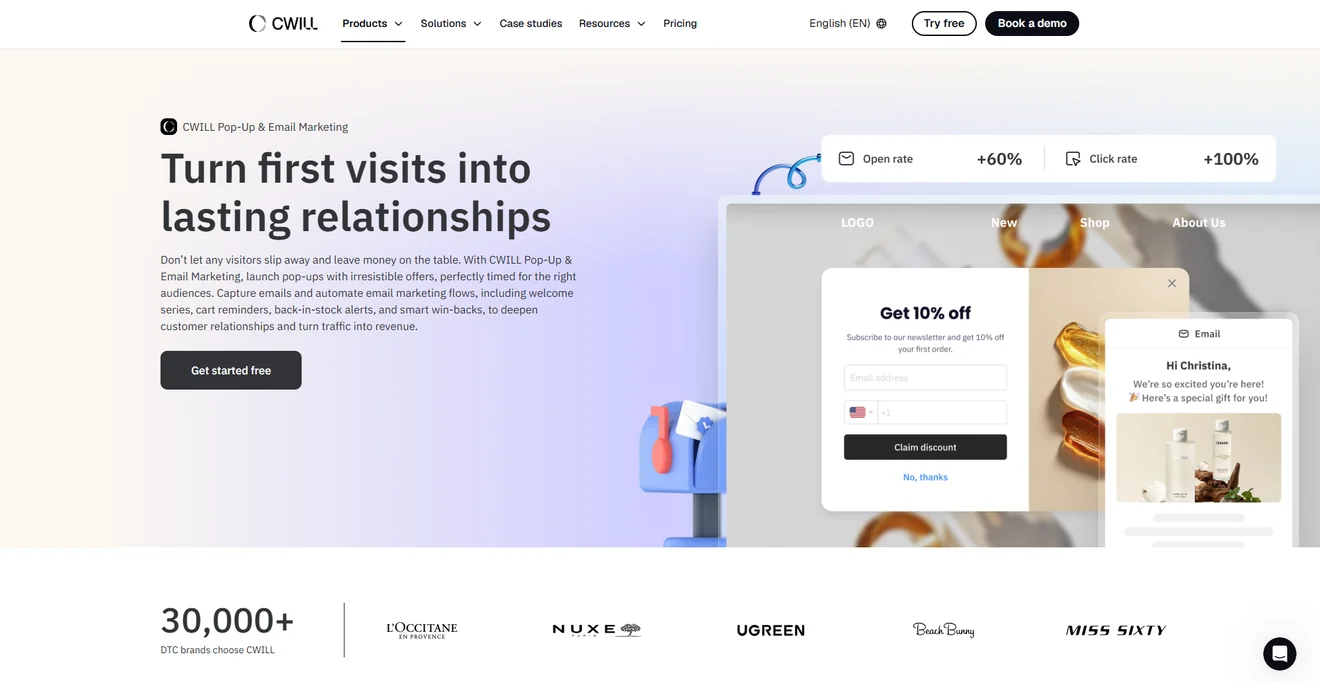
CWILL, ex SendWILL and EcomSend, combines Shopify popups with email marketing and automations. Unlike many Shopify popup apps, its plans don’t limit popup views or store traffic. The limits are based on how many new subscribers and marketing emails you get each month.
What stands out:
Unlimited popup views and store traffic.
Email/SMS capture and spin-to-win.
Welcome, cart recovery, and win-back emails.
Shopify Flow and customer-tag support.
If your store gets a lot of visitors but a relatively small number of new signups, CWILL’s pricing model can work out for you. However, keep in mind that paid plans have subscriber and email allowances, and usage-based charges may apply once you exceed them.
In September 2026, the free plan included 30 new subscribers and 2,000 marketing emails per month, with unlimited popup views. Paid plans started at $11.90/month for 150 new subscribers and 5,000 emails, with a 14-day free trial.
Choose CWILL (SendWILL) if your store gets plenty of traffic but only a few new signups, and you want to run popups without paying based on popup views.
Pop Convert — best for high-traffic stores that want predictable popup costs
Shopify rating: 4.9⭐ (8,753 reviews)
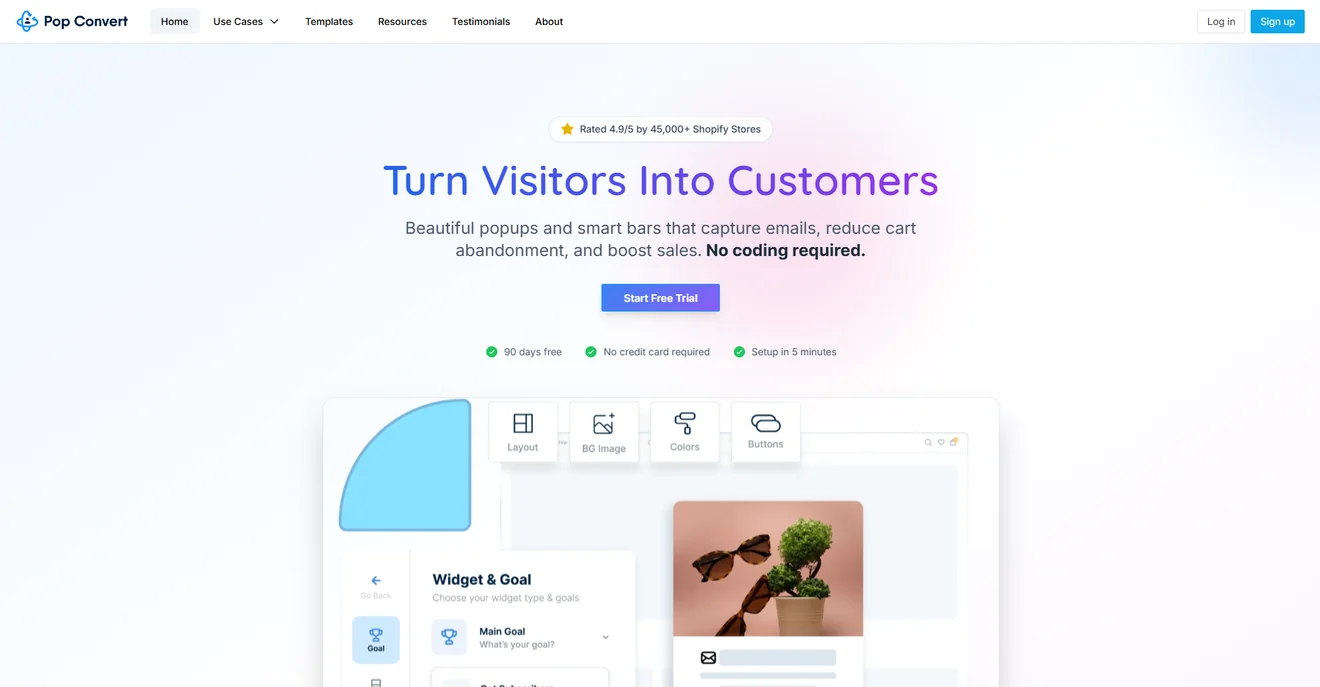
Pop Convert is a native Shopify popup app with smart bars, social proof notifications, and automated emails. Its paid plan is different from most traffic-based Shopify popup apps: visitor and campaign usage is unlimited, while the monthly price is tied to your Shopify subscription.
What stands out:
Unlimited visitors, popups, and smart bars on paid plans.
Spin-to-win, social proof, and cart campaigns.
Automated follow-up emails.
A/B testing and advanced targeting.
That model can be useful for stores with high traffic because popup costs don’t rise with pageviews. The trade-off is that if you’re on higher Shopify tiers, you pay more even if your popup usage is fairly simple.
As of September 2026, the free plan covers 1,000 unique visitors and 50 subscribers per month. Paid pricing starts at $15/month on Shopify Basic, then $29 on Grow, $79 on Advanced, and $129 on Plus. Shopify also lists a 90-day free trial.
Choose Pop Convert if you expect a lot of popup traffic or want to run many campaigns and prefer unlimited usage
Justuno — best for identifying visitors not only with popups
Shopify rating: 4.6⭐ (668 reviews)
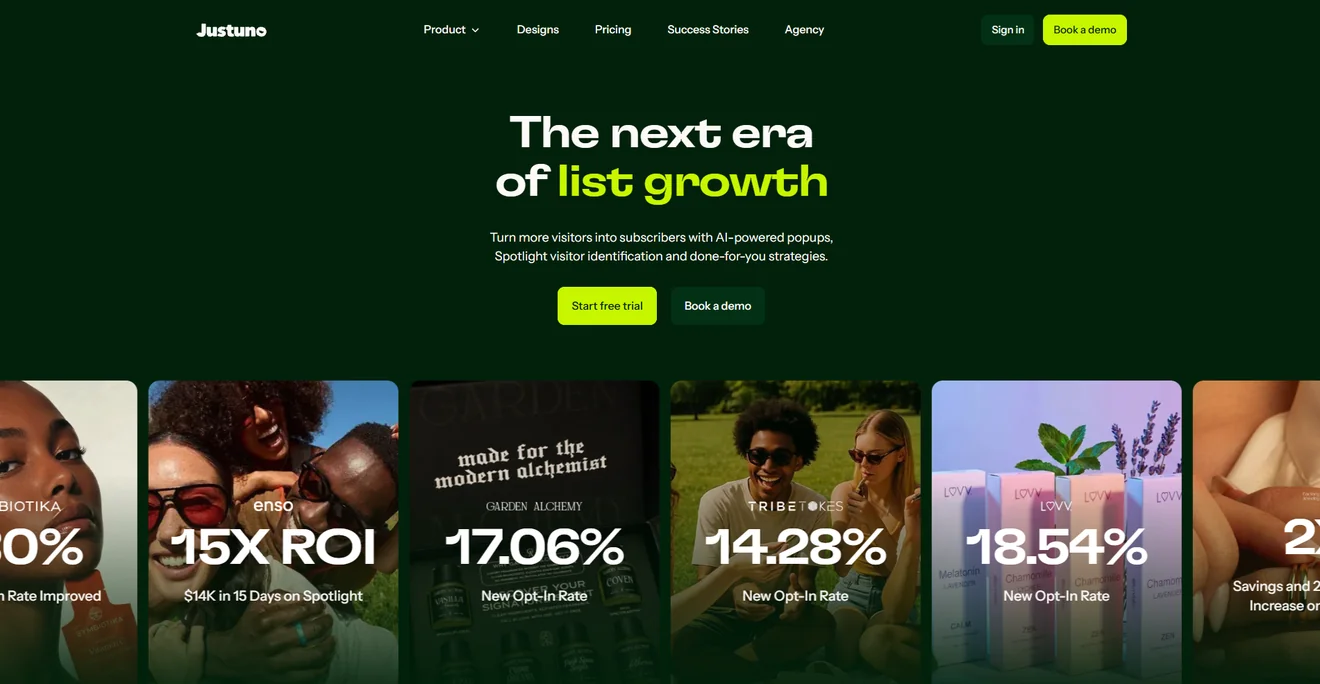
Justuno combines popup-based list growth with Spotlight, their anonymous visitor identification product. Usual forms capture people who submit their data; Justuno’s Spotlight matches additional anonymous sessions to contactable profiles and syncs them to email and SMS tools for follow-up.
What stands out:
Spotlight anonymous visitor identification.
AI-powered popup timing.
Quizzes, surveys, upsells, and cross-sells.
A/B and multivariate testing.
Justuno can also use Shopify customer, catalog, and order data for targeting and product recommendations. The trade-off is price: it starts higher than many popup-only tools, and its broader feature set may be unnecessary if you only need basic lead capture.
As of September 2026, Shopify lists a 14-day free trial. Plans start at $59/month for up to 10,000 monthly unique visitors; white-glove onboarding is included from the 20K plan.
Choose Justuno if you want to grow your list with popups but also recover more anonymous traffic for abandonment and retention campaigns
Omnisend — best for turning popup signups into automated email and SMS flows
Shopify rating: 4.7⭐ (3,182 reviews)
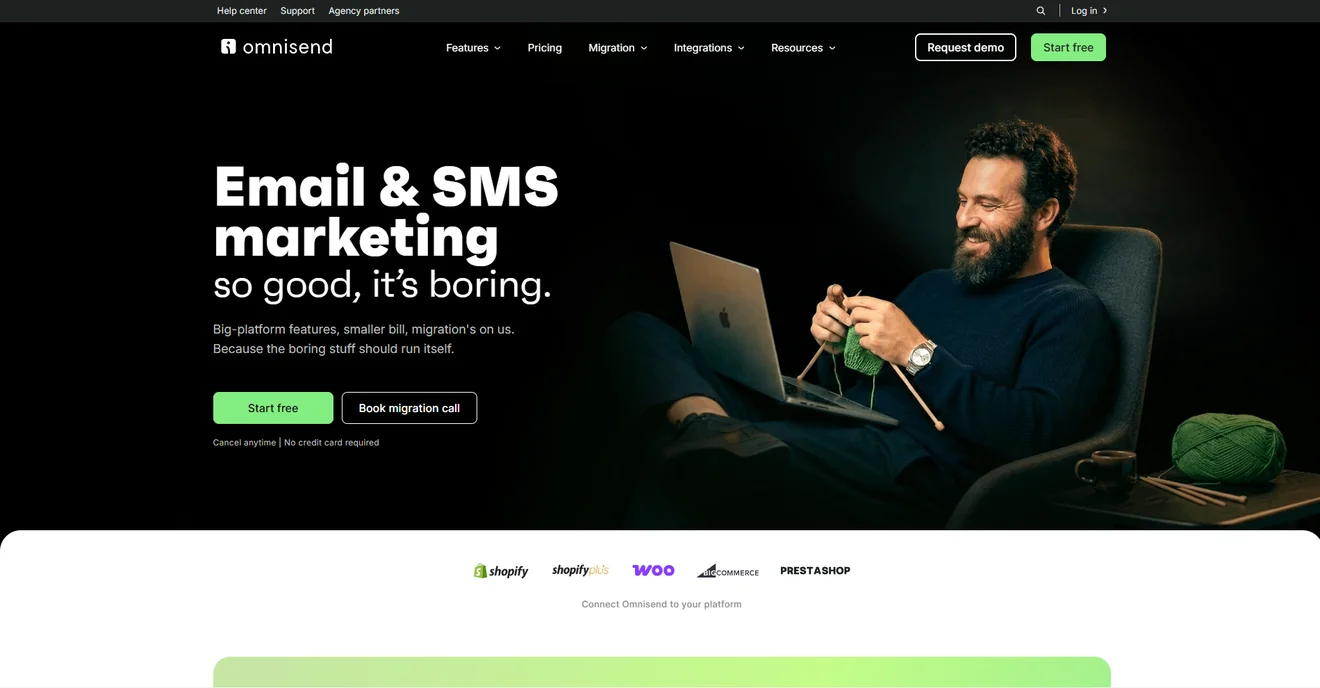
Omnisend is primarily an ecommerce email and SMS platform, with popups and signup forms built into the same system. That makes it a practical Shopify email popup app for stores that want a signup to immediately trigger welcome, cart recovery, post-purchase, or win-back automations.
What stands out:
Popups tied directly to email/SMS automations.
Forms AI on the Standard plan.
Spin-to-win and multi-step forms.
Product recommendation AI on Pro.
Omnisend’s form builder also supports exit intent, scroll and time triggers, page targeting, frequency controls, and segment-based display rules. The trade-off is that it is a full marketing suite, so it can be excessive if you only need on-site popups.
As of September 2026, the free Shopify plan covers up to 250 contacts and 500 emails per month. Standard starts at $16/month for up to 500 contacts, while Pro starts at $59/month for up to 2,500 contacts; pricing increases as the contact list grows.
Choose Omnisend if popups are mainly the first step in your email and SMS customer journey, and you want signup data to flow straight into broader ecommerce automations
POWR Popups — best for scheduled promotional popups
Shopify rating: 4.5⭐ (436 reviews)
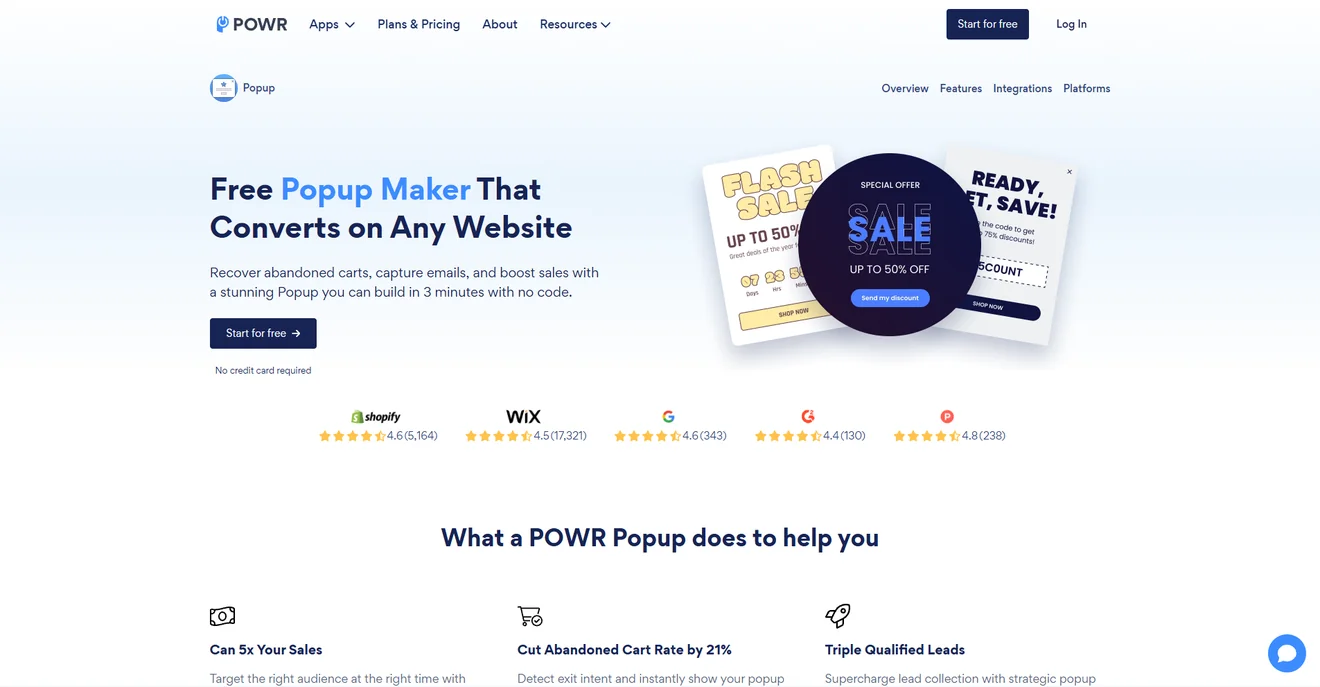
POWR is a no-code popup builder for Shopify stores that mainly need signup forms, discounts, announcements, and limited-time promotions. It offers 250+ templates and 20+ elements, including countdown timers, images, GIFs, and custom CTAs.
What stands out:
250+ ready-made popup templates.
Built-in campaign scheduling.
Countdown timers and coupon codes.
Autoresponder emails after signup.
You can trigger campaigns on entry, scroll, delay, exit intent, or a custom action. The main limitation is that scheduling, advanced triggers, display controls, custom CSS, and major integrations are available only starting from the Pro plan.
The free Shopify plan includes 2,000 monthly impressions and 25 submissions. Starter costs $7.04/month for 10,000 impressions, Pro starts at $15.29/month for 60,000 impressions and 1,000 submissions. (Checked September, 2026)
Choose POWR if you mostly run seasonal sales, launches, or discount campaigns and want a large template library plus scheduling and countdown tools
Adoric — best for product recommendation and upsell popups
Shopify rating: 4.9⭐ (260 reviews)
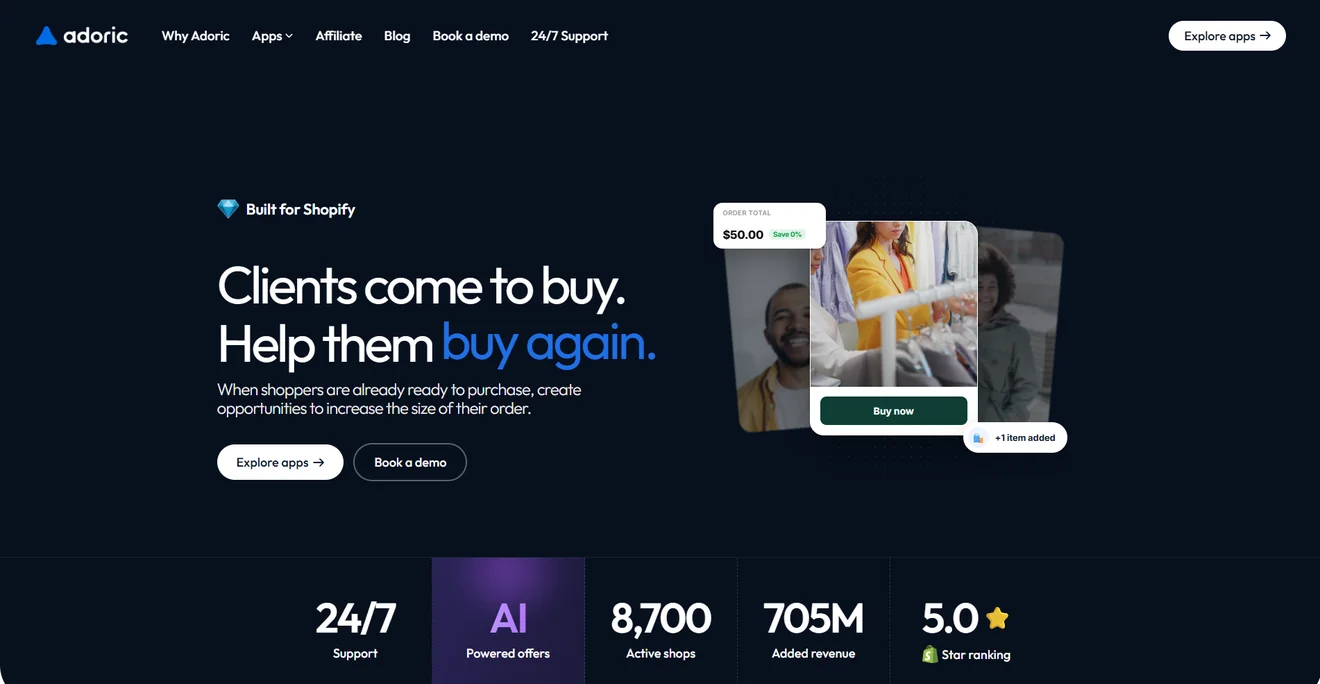
Adoric combines popup campaigns with product recommendations, upsells, cross-sells, and other sales-focused widgets. It’s a good fit for Shopify stores that want to collect emails and increase order value.
What stands out:
Frequently bought together and related products.
Upsell and cross-sell offers.
Exit-intent and gamified popups.
Free-shipping bars and cart-abandonment campaigns.
Adoric can show product recommendations across different parts of the store and supports both automated and manual recommendation strategies. The trade-off is its pricing model: plans scale with monthly store orders, so the cost rises as sales volume grows.
As of September 2026, the Shopify free plan covers stores with up to 20 orders per month. Paid plans start at $4.99/month for up to 100 orders, and Shopify lists a 7-day free trial on paid plans.
Choose Adoric if you want popups to collect contacts and plan to use them for product recommendations, upsells, and increasing order value
WooHoo Popups & Spin Wheel — best for simple gamified list growth
Shopify rating: 4.4⭐ (199 reviews)
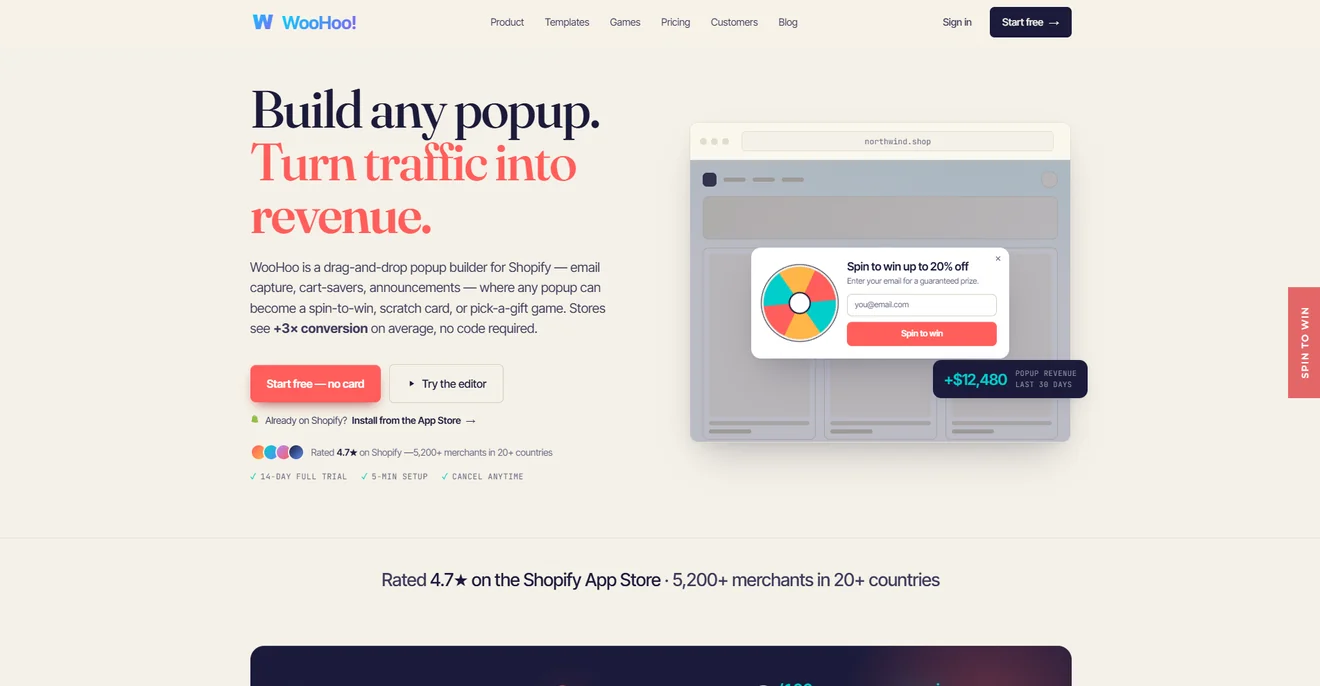
WooHoo is a Shopify popup tool built mainly around gamified email and SMS capture. Spin-to-win is their signature format, but you can also create regular signup popups, discount offers, newsletter forms, and exit-intent campaigns.
What stands out:
Spin-to-win discount wheels.
Email and SMS capture.
A/B testing on every plan.
Integrations with Klaviyo, Mailchimp, Omnisend, and others.
WooHoo gives you the core tools for gamified list building, so don’t expect to find product recommendations, managed CRO, or deeper website personalization. That simplicity can be a plus, but if you want several different game mechanics or broader onsite experimentation, you may find it limiting.
The free Shopify plan covers 500 monthly visitors and includes unlimited campaigns, advanced targeting, A/B testing, and analytics. Paid plans start at $7.99/month for 2,000 visitors, with a 14-day free trial. (Checked September, 2026)
Choose WooHoo if spin-to-win is the main gamified format you want to use for growing your email or SMS list, and you don’t need a broader CRO platform
How to choose a Shopify popup app
Some apps are more popular than others in the Shopify App Store, but that’s not what’s important here. Instead, the choice depends on what you want the popup to do, how precisely you need to target visitors, and how the pricing scales with your store. Here’s what to compare before installing a Shopify popup app.
1. Start with the goal
First decide what you want the app to do. For simple list growth, email and SMS forms may be enough. Other stores may need cart-recovery offers, product recommendations, quizzes, gamification, upsells, or broader CRO experiments. If popups are only one part of your email strategy, an all-in-one Shopify popup app such as Privy or Omnisend may make more sense than a dedicated popup platform.
2. Check the popup types and editor
Look beyond the number of templates. Check whether the Shopify popup app supports the formats you actually plan to use — for example, multi-step forms, spin-to-win, embedded forms, bars, quizzes, or product popups. A no-code editor makes it easier for the marketing team to launch and update campaigns without developer help.
3. Compare targeting and triggers
Basic tools may offer time delay, scroll depth, and exit intent. More advanced apps can use Shopify data such as cart contents, order history, customer tags, login status, traffic source, or location. The more specific your campaigns become, the more important these controls are.
4. Look closely at how pricing scales
“Starts at $10/month” doesn’t tell the whole story. Shopify popup apps may charge by pageviews, visitors, subscribers, impressions, orders, or even your Shopify plan. Think about what will happen to the price as your traffic, list, or sales grow — not just what the entry plan costs.
5. Check integrations and data flow
Make sure subscriber and campaign data can reach the tools you already use, such as Klaviyo, Mailchimp, HubSpot, or Shopify Flow. Also check whether customer tags, preferences, and form answers sync automatically or require extra setup.
6. Don’t skip testing and reporting
If optimization matters, look for A/B testing and reporting. Depending on your needs, useful metrics can include conversion rate, orders, revenue, and revenue per visitor. Larger stores running several campaigns at once will usually benefit more from deeper testing and analytics than stores running one basic signup popup.
Finally, check how campaigns behave on mobile. Your forms should remain easy to read, close, and complete on smaller screens; these mobile popup best practices cover the key considerations.
Summing up
There isn’t one best Shopify popup app that fits every store. Claspo is a strong option if you want AI-assisted CRO, flexible targeting, testing, and several campaign formats in one platform. Alia makes more sense if you want a team to help manage and optimize campaigns for you, while Privy or Omnisend suit stores that want popups and follow-up email or SMS in the same system. If your needs are narrower, tools such as WooHoo, Adoric, or Seguno may be a better fit for gamification, upsells, or Shopify-focused list growth.
Compare the pricing model and features against how you actually plan to use the app before choosing. If Claspo matches your use case, you can explore the Claspo Shopify integration and start with the free plan.
FAQ
Are there free Shopify popup apps?
Yes. Several apps in this comparison offer functional free plans, including Claspo, OptiMonk, Poptin, Popupsmart, Seguno, CWILL, Pop Convert, Omnisend, POWR, Adoric, and WooHoo. The limits differ widely, though. Some cap pageviews or visitors, while others limit subscribers, impressions, orders, or submissions.
What features should I look for in a Shopify popup app?
Start with the campaign types you need, then compare targeting and triggers, mobile behavior, integrations, testing, analytics, and pricing. Also check what the price is based on — pageviews, visitors, subscribers, impressions, orders, or another metric — because that can matter much more as your store grows.
What are the best Shopify popup apps?
The best popup app for Shopify depends on your goal. Claspo is suited to stores that want advanced targeting, testing, gamification, and AI-assisted CRO. Alia focuses more on managed optimization, while Privy and Omnisend combine popups with email and SMS marketing. More specialized apps may be better if you mainly need spin-to-win, product recommendations, or simple signup forms.
Does Shopify have a built-in popup tool?
Shopify does have native tools for forms and customer data, but merchants often use dedicated popup apps for more campaign formats, targeting rules, gamification, A/B testing, or integrations.
Can Shopify popups collect both email addresses and phone numbers?
Yes. Many Shopify popup apps support both email and SMS capture. Before choosing one, check where that data is sent afterward — for example, directly into Shopify customer records, an email platform such as Klaviyo, or the popup app’s own email and SMS system.
Do popup apps slow down Shopify stores?
Any third-party app can affect page performance depending on how its scripts are loaded and how many tools are running on the storefront. Check the app’s Shopify setup, test page speed before and after installation, and avoid running several overlapping popup or marketing apps when one can handle the same job.