9 Best Justuno Alternatives for Ecommerce in 2026

Summarize
Most teams don’t go hunting for Justuno alternatives because Justuno suddenly stopped doing its job. The irritation tends to build more quietly. Traffic grows, and the monthly bill comes along for the ride. Five live workflows that once seemed workable start holding up the campaign calendar. And sometimes, after another invoice lands, the team realizes how little of the personalization toolkit it actually uses. Perhaps the business now needs bundled email and SMS, broader gamification, or product-page experiments.
That makes a generic feature checklist almost useless. Nine tools can all promise popups, targeting, and A/B testing while solving very different problems — and charging by completely different units.
We’ll treat the move as a business decision. Here we’ll show which platforms suit which use cases, what each one bills for, where important features are gated, and what you would give up compared with Justuno. The goal is to leave you with two or three sensible tools to test, not nine open tabs and a longer headache.
Best Justuno alternatives at a glance
Pricing checked on September 8, 2026. Allowances are not directly comparable: vendors may charge by pageviews, unique visitors, active profiles, or contacts. Prices below reflect publicly available month-to-month rates unless stated otherwise.
Product | Best for | Free option | Pricing basis | Shopify | Key differentiator |
Claspo | Businesses that want to scale without waiting for higher tiers to unlock key tools | 14-day free trial on every paid plan | Pageviews; paid plans from $39/mo | Native app; product cards, ecommerce targeting, and Shopify discount sync | All features on every plan, plus 8 gamification mechanics |
OptiMonk | Teams testing product-page messaging and cart-aware campaigns | Free plan: 10,000 pageviews/mo; no trial | Pageviews on pages with active campaigns; paid from $29/mo | Native app with cart and product rules, conversion goals | Dynamic product-page content and split-URL testing |
Sleeknote | Ecommerce teams running many campaigns across several domains | No free plan; 14-day unrestricted trial | Unique monthly visitors; Core starts at $62/mo | Native app with cart targeting, product recommendations, and subscriber sync | Unlimited campaigns and domains on Core, with mobile layouts |
Privy | Small and midsize stores that want signup campaigns and follow-up messages in one place | No free plan; 15-day trial | Displays plan: pageviews, from $24/mo; Email: mailable contacts, from $30/mo | Native app with contact sync and cart-recovery tools | Popups connect directly to Privy email and SMS workflows |
Poptin | Ecommerce teams looking for affordable popups, onsite selling tools, and optional email | Free plan: 1,000 visitors/mo; no trial | Visitors; paid popup plans from $25/mo | Native app with customer, order, and cart targeting, product recommendations, and coupon sync | Three games are available even on the free plan |
Picreel | Single-site teams prepared to pay extra for exit intent or unbranded campaigns | Free plan: 5,000 pageviews/mo; 15-day trial | Pageviews; Essentials costs $19.99/mo, while exit intent requires the $59.99 Business plan | Native app, but Shopify-specific data rules are not detailed | Low entry price, though several signature features and white labeling cost more |
Wisepops | High-traffic brands coordinating several onsite channels | No free plan; 14-day trial | Pageviews; Shopify plan costs $299/mo for 500,000 pageviews | Native app with built-in cart and product properties | Six onsite channels, plus control groups and revenue attribution |
OptinMonster | WordPress publishers and content-led teams that need content locking | Limited WordPress free option; 14-day money-back guarantee | Pageviews; Basic starts at $21/mo, with advanced features gated by tier | Native app requires Growth plan at $49/mo | Deep WordPress publishing options and content locking |
Klaviyo Sign-Up Forms | Stores already using Klaviyo for email and SMS | Free Klaviyo account: 250 active profiles and 500 email sends/mo | Active profiles and sends; forms add $0 until they push the account into a higher tier | Native integration with profile, order, and cart data | Captured data and consent flow straight into Klaviyo segments and automations |
What Justuno does well — before we compare Justuno alternatives
Justuno’s main strength is not just popups, but how its onsite personalization tools work together. Campaigns can draw on visitor profiles, behavioral and commerce data, audience segments, and visual workflows.
A profile can retain pages and products viewed, cart and purchase history, traffic source, and earlier workflow activity. Marketers can use this context to personalize offers or choose what someone sees next.
Spotlight extends this model beyond known contacts. The paid add-on attempts to match anonymous sessions through an identity network and, once a match enters a Visitor ID workflow, pass the resolved email address to a connected ESP or CRM. This goes beyond browser-level returning-visitor recognition, although a matched email should not be equated with a new explicit form signup.
Product recommendations take this further. Justuno supports eight algorithms, including upsell, cross-sell, previously viewed items, and abandoned-cart products, with filters for inventory, price, margin, and other catalog data.
The workflow builder ties these pieces together with if/then branches, delays, experiments, profile updates, and data transfers to connected tools. For teams that prefer outside help, the Done-For-You plan also covers campaign design, implementation, QA, publishing, and managed A/B testing.
Why teams consider Justuno alternatives
Justuno’s depth can be an advantage, but it can also leave focused teams paying for more platform than they use. Justuno’s pricing is based on monthly visitors. Lite starts at $59 for 10,000 visitors and reaches $1,299 at 3 million.
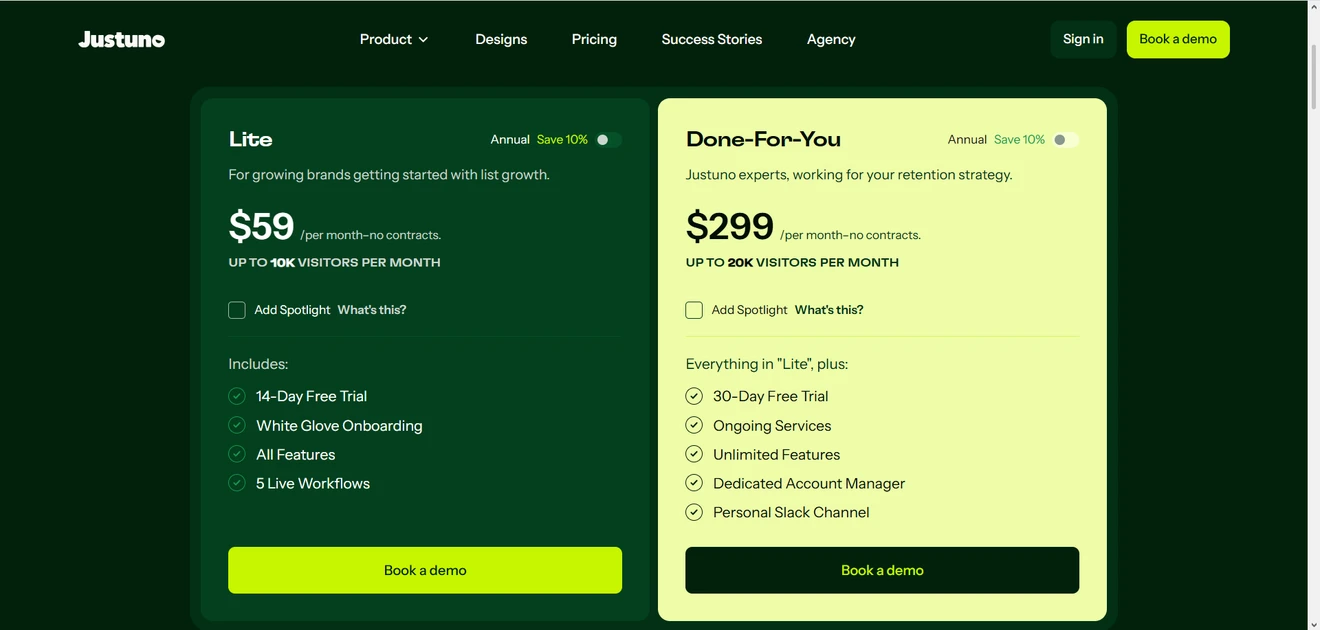
The cost per visitor falls as traffic grows, so this is not a case of pricing becoming less fair at scale. The practical issue is that the bill can increase even when a team still runs the same few campaigns.
The Spotlight feature adds another variable. Visitor identification is not included in the base price, and its surcharge also changes with traffic.
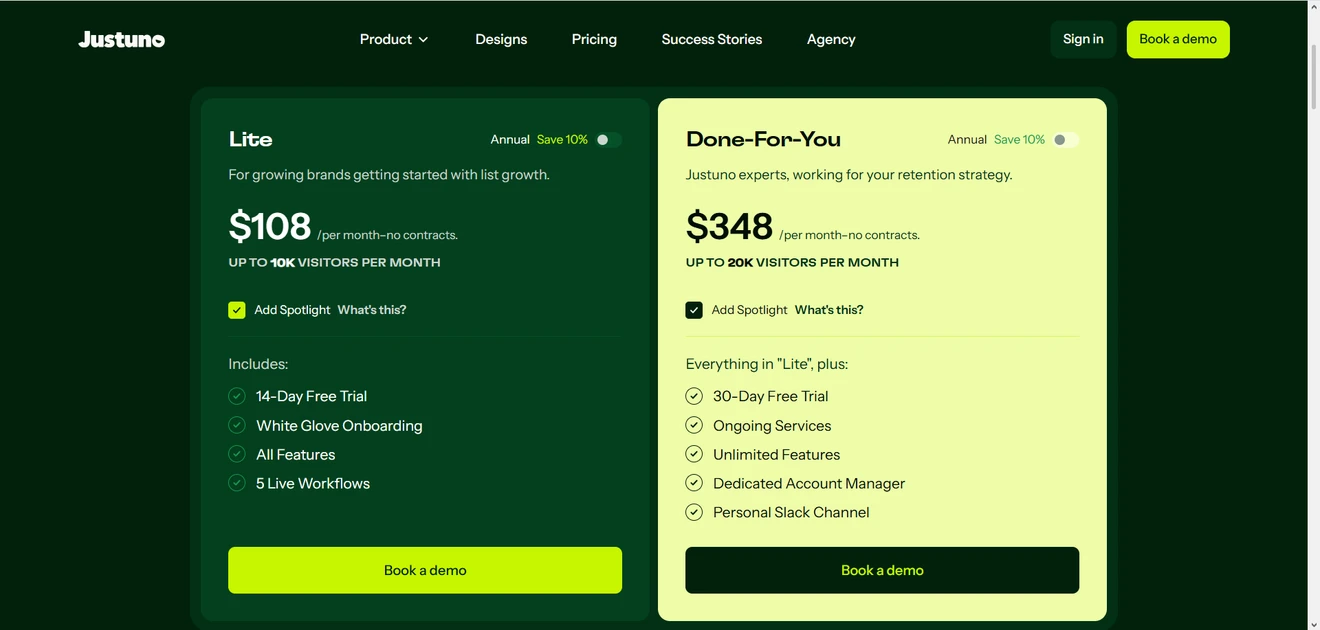
For brands that adopted Justuno partly for Spotlight, the combined cost may become harder to justify if the recovered revenue does not grow with it.
Lite’s operating limits stay fixed across its traffic tiers: five live workflows, two custom segments, five custom properties, one custom AI recommendation, and three team seats. It also excludes custom analytics dashboards. For teams that outgrow those limits, the next public step is the Done-For-You plan, which starts at $299 and bundles higher limits with managed services. That works for brands wanting hands-on support. An in-house team may simply need more room, not a CRO strategist.
In that situation, alternatives to Justuno with a more flexible self-service tier may be a better fit.
How we evaluated Justuno competitors
To build this list of Justuno alternatives, we chose products that overlap with Justuno in at least one core area, including popups, lead capture, ecommerce personalization, product recommendations, or onsite engagement. Each one also had to serve a distinct buyer scenario. Otherwise, we would simply have nine variations of the same popup builder.
We reviewed every product using the same criteria: campaign formats, targeting and personalization depth, testing and analytics, integrations, Shopify fit, support, plan limits, and pricing. Because “10,000” can mean visitors, pageviews, or contacts depending on the vendor, we also checked what each platform actually uses as its billing unit.
Our research draws on official product and pricing pages, knowledge bases, and Shopify App Store listings. Pricing was checked on September 7-8, 2026. Where official sources showed different terms or prices, we noted the discrepancy instead of quietly choosing the more convenient number.
The “Best for” labels are our editorial assessment based on the documented capabilities, limitations, and cost of each product.
9 Justuno alternatives compared
Below are nine products that overlap with Justuno without trying to be the same thing. Each review answers one practical question: would switching solve the problem that brought you here, or simply replace it with a different set of limits?
1. Claspo — best overall among Justuno alternatives for flexible campaigns
Verdict: Claspo is our best overall pick for teams that want a free start, varied onsite formats, and no feature gating.
Why consider it: Claspo offers eight game mechanics, while Justuno’s public materials document a much smaller set. The choice matters: in our 2026 benchmark of around 170 million impressions, gamified mechanics averaged 8.08% CR versus 3.67% for standard email-capture popups. Every fifth widget published by Claspo users included a game.
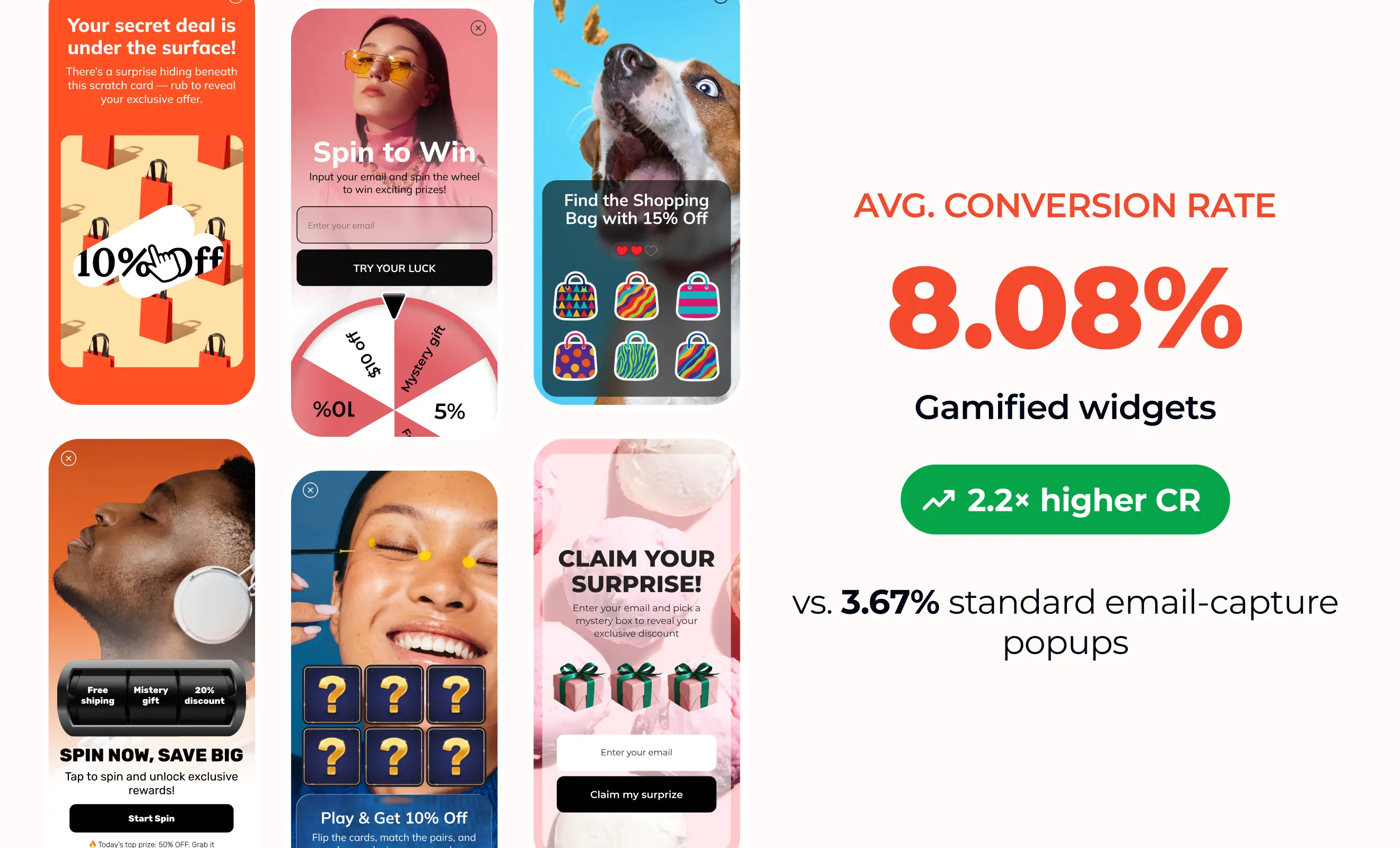
Every plan includes all features and unlimited team members. Claspo also offers an AI CRO agent, which finds conversion gaps, selects tactics, builds campaigns, and measures results. Free migration is included with any paid plan and usually takes about seven days.
Key features:
eight gamified mechanics;
linear and conditional-logic quizzes;
behavioral, page, audience, and custom-data targeting — including exit intent, engagement, traffic source, location, device, new vs. returning visitors, and existing-subscriber exclusion;
dynamic content populated from URL parameters, cookies, Data Layer, and Shopify data;
Claspo integrations that pass collected data to the email and marketing tools already in your stack;
A/B/C/D/E testing with up to five variants; the system can suggest a relevant test for an existing popup and prepare the variants;
a library of CRO-ready templates.
Shopify fit: for teams comparing Justuno alternatives for Shopify, Claspo has a native Shopify app. Marketers can add Shopify product cards directly to popups, target campaigns using cart, product, and customer data, and create discount codes inside the Claspo editor. Each new code is automatically added to the Discounts section in Shopify.
Where Justuno is stronger: Spotlight goes further in anonymous visitor identification, and the platform has a deeper commerce product-recommendation engine. Our Claspo vs Justuno comparison takes a closer look at the differences in campaign tools, pricing, and Shopify use.
Pricing: Paid plans start at $39/month; Pro 2000 costs $399/month for two million pageviews. Every paid plan comes with a 14-day free trial.
Best for: businesses that want to scale fast with full access to the platform’s capabilities from the start.
2. OptiMonk — for product-page personalization
Verdict: among Justuno alternatives, OptiMonk suits ecommerce teams that want to personalize onsite messages and product-page content using visitor and cart context.
Why consider it: OptiMonk leans further into page-level experimentation. Its Dynamic Content and Smart Product Page Optimizer can rewrite product-page copy, generate variants, and test them against Add to Cart or Purchase goals. Split-URL tests compare complete pages, not only campaign creatives.
Key features:
Popups, sticky bars, embedded and dynamic content;
behavioral and cart targeting;
product recommendations;
cart-value countdowns;
A/B and split-URL testing.
Where Justuno is stronger: Justuno offers deeper visitor profiles, Spotlight anonymous visitor identification, eight recommendation algorithms, and managed campaign execution through Done-For-You.
Shopify fit: its native app provides cart and product rules, Shopify conversion goals, and a dynamic free-shipping bar. Embedded Content requires an app extension.
Pricing: with monthly billing, paid tiers start at $29 for Essential, $99 for Growth, and $249 for Premium; Master is custom-priced. These are starting prices for the default pageview allowances. Users can raise the traffic limit without switching plans, although the monthly price rises with it.
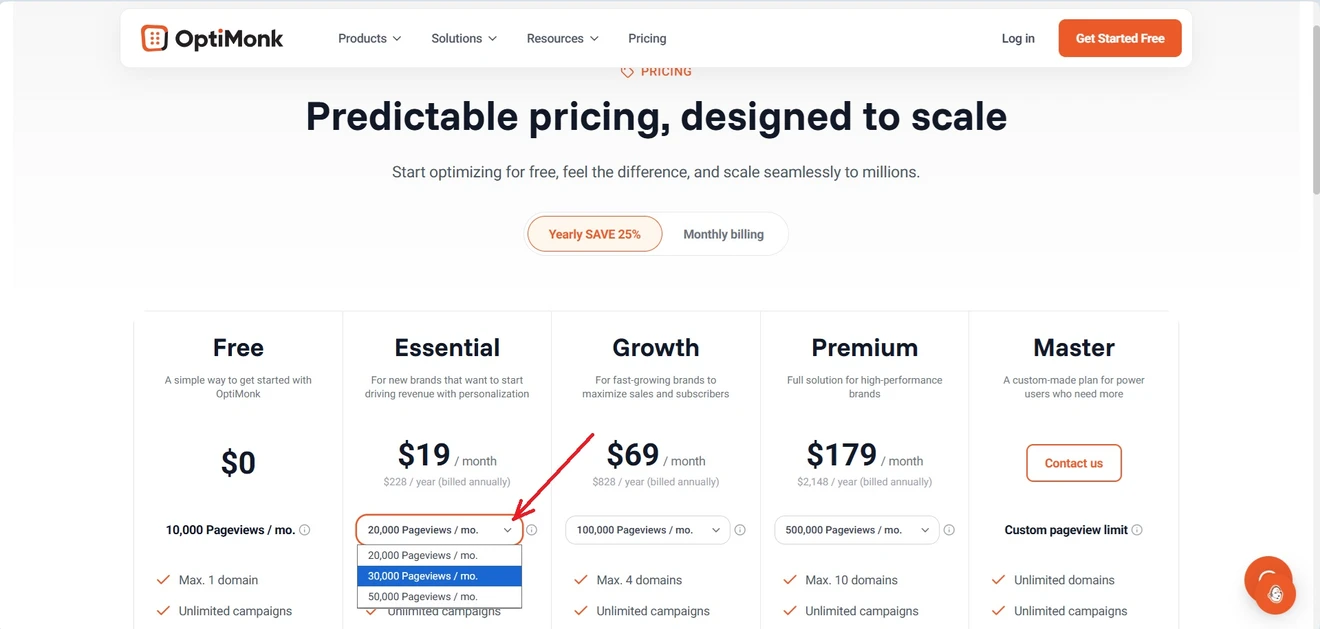
Free plan covers 10,000 pageviews/month, one domain, and unlimited campaigns. Only pages with active campaigns count, so OptiMonk’s limits are not directly comparable with Justuno’s visitor-based pricing. No separate trial.
Best for: Shopify teams testing product-page messaging and cart-aware campaigns across one or two stores.
3. Sleeknote: best for multi-domain campaigns
Verdict: for teams comparing alternatives to Justuno, Sleeknote combines multistep forms, Shopify-aware personalization, mobile controls, and optional gamification.
Why consider it: Core plan includes unlimited campaigns and domains; Justuno Lite includes five live workflows. Sleeknote supports popups, forms, surveys, quizzes, and multistep flows, with mobile layouts.
Its gamification add-on has six formats, including:
Spin to Win,
Scratch to Win,
quizzes,
Learn to Earn,
Seasonal Calendar,
Daily Offers.
Key features: Sleeknote covers the campaign types ecommerce teams tend to use day to day: multistep forms, quizzes, product recommendations, and countdowns. Display rules can respond to exit intent, time, scroll depth, location, device, or cart contents. Reporting updates in real time, and there is a built-in A/B test for two variants.
Where Justuno is stronger: Sleeknote can personalize individual campaigns, but it does not have the same profile-and-workflow setup as Justuno. Justuno keeps detailed visitor histories, can identify some anonymous sessions through Spotlight, and offers campaign execution through its Done-For-You plan.
Shopify fit: once the native app is connected, Sleeknote can use cart data to decide when a campaign appears. Products and collections can be pulled straight into recommendation campaigns, while new subscribers can be sent back to Shopify.
Pricing: Sleeknote’s entry plan is Core at $62 a month for up to 25,000 monthly visitors. Adding the gamified formats brings the starting price to $85.
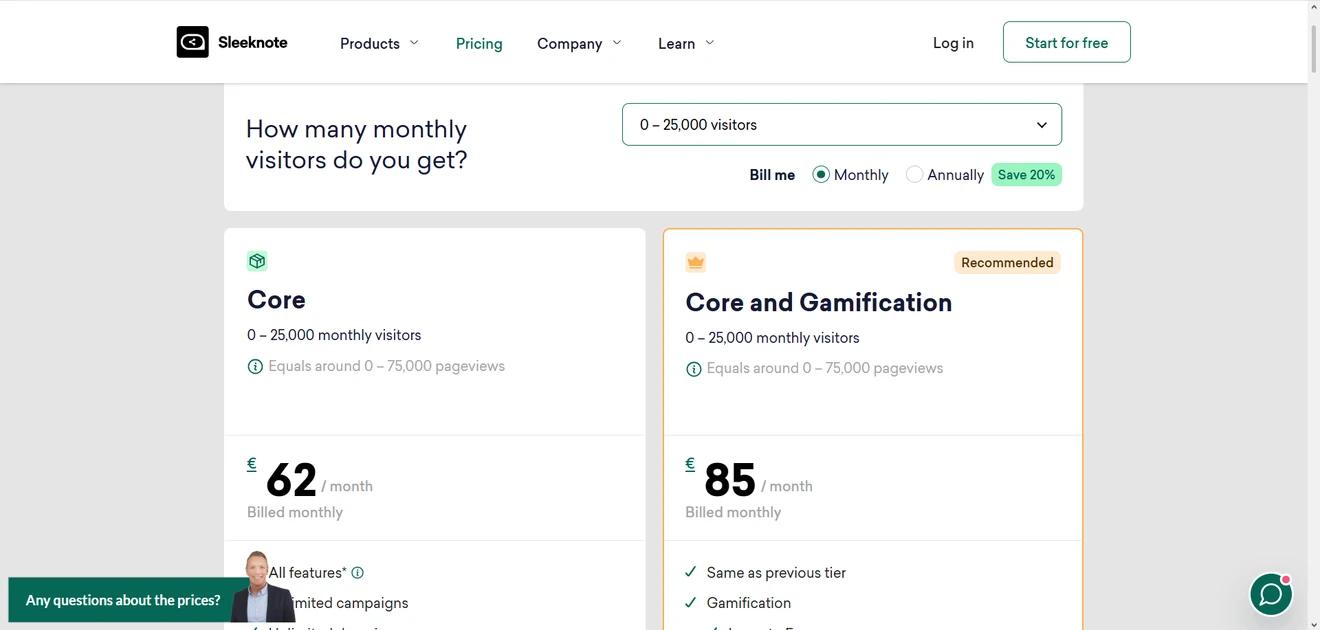
The unrestricted trial lasts 14 days and requires no card, but there is no free plan. Pricing above 500,000 visitors is custom.
Best for: ecommerce teams managing many campaigns or domains and willing to buy gamification separately.
4. Privy: from popup to email and SMS
Verdict: for Shopify stores comparing apps like Justuno, Privy’s appeal is straightforward: onsite signups can flow directly into email or SMS follow-up.
Why consider it: contacts collected through Privy popups enter its audience for segmentation and automation. Welcome, cart-recovery, post-purchase, and win-back messages can all follow from the same signup.
Key features: Privy is not limited to standard popups. A campaign can sit inside the page, slide in from the side, or run as a landing page. Longer signups can be broken into several steps. You can also set a delay, wait until someone has scrolled far enough, or catch them just before exit. Cart recovery, cross-sell offers, Spin-to-Win, and a basic test for two display versions are available too.
Where Justuno is stronger: Privy trades some personalization depth for consolidation. Justuno provides richer visitor profiles, Spotlight identification, more developed product-recommendation logic, and visual onsite workflows.
Shopify fit: adding Privy app to a Shopify store does not require any code. New contacts are synced back to Shopify, and checkout activity can be used to bring back shoppers who leave without completing their orders.
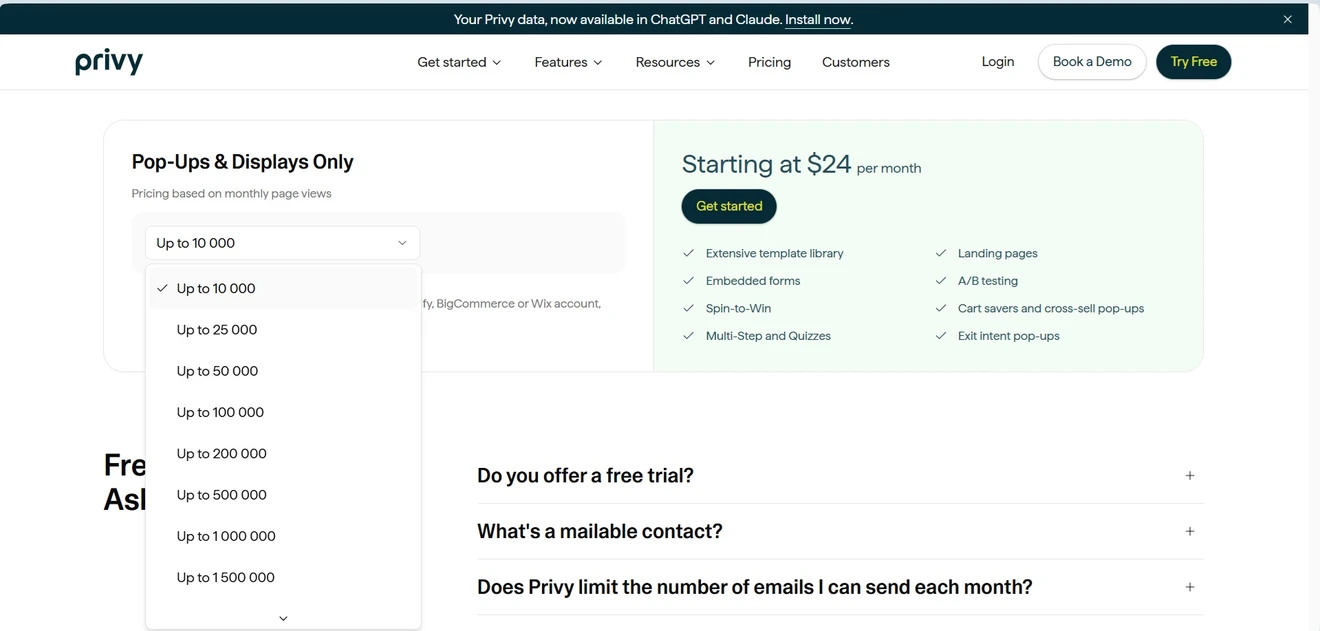
Pricing: Pop-Ups & Display-only plan runs from $24/month for 10,000 pageviews to $1,500 for 3.5 million. Since pageviews and visitors are different units, the entry price is not directly comparable with Justuno’s $59 tier. Email is separate, starting at $30/month by mailable contacts, with unlimited sends and 250 SMS credits. Extra SMS costs more. The trial lasts 15 days; no free plan.
Best for: small and midsize Shopify stores that would rather manage signups and follow-up messages without jumping between tools.
Trying to choose between a dedicated onsite tool and Privy’s built-in messaging? Our Claspo vs Privy comparison goes deeper into that trade-off.
5. Poptin: budget popups and email
Verdict: Poptin gives teams seeking free Justuno alternatives a low-cost start, ecommerce tools, and an Email & Poptins plan for follow-up.
Why consider it: unlike Justuno, Poptin has a permanent free tier with unlimited popups, A/B tests, and three games: Spin the Wheel, Pick a Gift, and Scratch Card.
Key features: the platform does not force every campaign into the same box. A message can slide in quietly, take over the screen, remain visible in a bar, or sit directly within the page. Display rules cover exit intent, inactivity, scrolling, page, and traffic source. Poptin also supports surveys and quizzes.
Where Justuno is stronger: Justuno keeps more context around each visitor and offers Spotlight, visual workflows, managed services, and deeper product-recommendation logic. Poptin reserves cookie, JavaScript, and order-history targeting for paid plans.
Shopify fit: Once the Shopify app is connected, Poptin can decide who sees a campaign based on what is happening in the store. It can take the current cart into account or look at what a customer has ordered before. Product recommendations can appear inside the campaign, while coupons created in Poptin are passed back to Shopify.
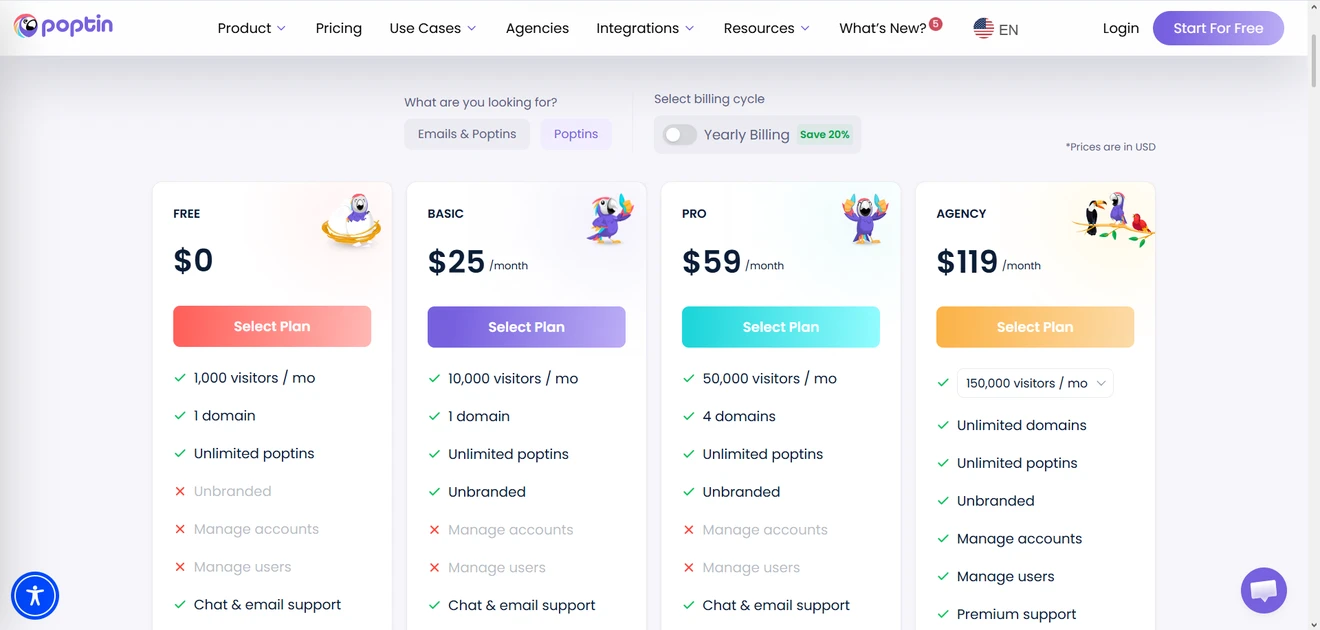
Pricing: Free Forever plan covers 1,000 monthly visitors on one domain, with branding and no autoresponder. Poptins-only plans run from $25/month for 10,000 visitors to $119 for 150,000. No free trial is offered.
Best for: ecommerce teams that want affordable onsite selling and list growth tools and may want to manage email in the same platform.
6. Picreel: a cheaper alternative to Justuno?
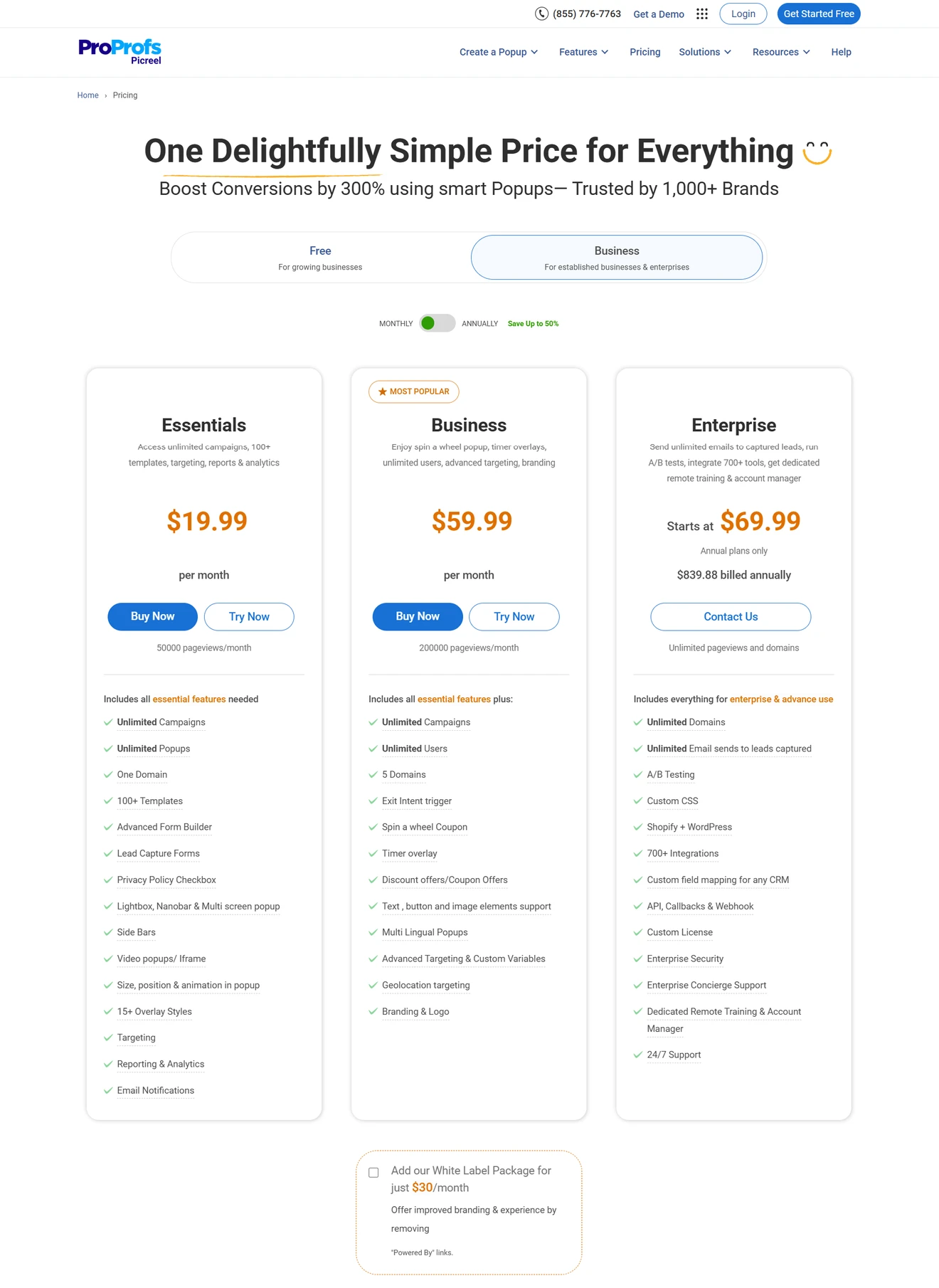
Verdict: Picreel looks cheaper at $19.99/month, but that price does not include exit intent. Move to Business and remove Picreel branding, and the cost reaches $89.99/month.
Why consider it: Picreel’s AI can take a popup from first draft to later edits. It can also match the site’s branding and flag rises or dips in campaign performance.
Key features: the platform supports multi-screen campaigns, video, and iframe content. But exit intent and Spin the Wheel are not in the cheapest plan (Essential). Coupons, timers, multilingual campaigns, and advanced targeting also start on Business.
Where Justuno is stronger: Justuno makes exit intent available in Lite, keeps more visitor context, and adds Spotlight and a more developed workflow layer.
Shopify fit: The native app handles installation. Documentation does not specify which Shopify cart, customer, or product fields can guide targeting.
Pricing: Essentials costs $19.99/month for one domain and 50,000 pageviews. Business, needed for exit intent, starts at $59.99/month. Free Forever covers 5,000 pageviews, and there is a 15-day trial. Removing “Powered by” adds $30/month.
Best for: single-site teams that can work with Essentials as it is — or have room in the budget for upgrades once exit intent and unbranded campaigns become important.
7. Wisepops: onsite activation beyond popups
Verdict: for teams comparing Justuno competitors, Wisepops treats popups as one of six channels rather than the whole product.
Why consider it: a campaign can live inside the page or in an onsite notification feed, while web push keeps contact going after the visit. Bars and quizzes are available too. Wisepops also claims experiment reports with control groups, p-values, and revenue tied to order value.
Key features: targeting can use behavior, traffic source, custom properties, and Shopify cart data. AI product recommendations work across onsite formats, but not web push.
Where Justuno is stronger: Justuno keeps richer visitor profiles and can identify some anonymous sessions through Spotlight.
Shopify fit: the app activates in the theme editor. Built-in properties cover cart value, discounts, item and product IDs; custom data can come through JavaScript or GTM.
Pricing: the Shopify self-service plan costs $299/month for up to 500,000 pageviews, or $2,990/year. There’s a 14-day free trial, but no free plan. Pricing on the main Wisepops website is less clear, though: different parts of the pricing page currently show starting prices of €499 (FAQ section) and €599.
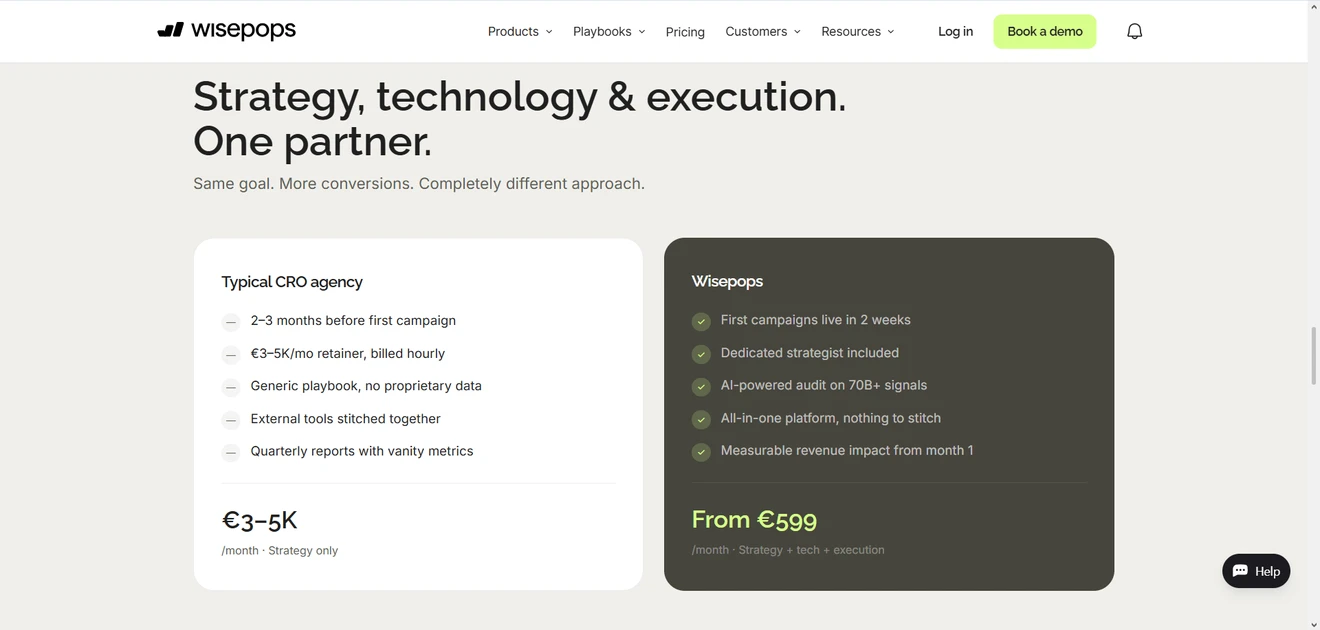
You can’t simply buy a plan; you can only purchase one after a demo session. Non-Shopify buyers should confirm the rate.
Best for: high-traffic brands running several onsite channels and using control groups to see whether those campaigns create extra revenue.
If Wisepops makes your shortlist, our Claspo vs Wisepops comparison puts campaign formats, testing options, and pricing side by side.
8. OptinMonster: built for WordPress lead capture
Verdict: OptinMonster stands apart from Justuno competitors and alternatives through its WordPress controls and content locking, not ecommerce personalization.
Why consider it: publishers can place forms inside articles, lock the remaining content until a visitor opts in, or open with a Yes/No step. The WordPress plugin handles placement across the site.
Key features: the format library covers bars, slide-ins, full-screen gates, sidebars, and lightboxes. A campaign can wait for a chosen scroll depth, time, page, or return visit.
Where Justuno is stronger: OptinMonster divides important features across tiers. Want A/B testing or content locking? That means Plus. Exit-Intent pushes you to Pro, while Shopify data requires Growth. Justuno Lite already includes multivariate testing, AI Smart Timing, visitor profiles, product recommendations, workflows and other important features.
Shopify fit: on Growth, campaigns can react to cart contents, viewed or carted products, and past purchases. They cannot appear on checkout-related pages.
Pricing: At $21 month-to-month, Basic looks inexpensive at first. The catch is the allowance: one site and 2,500 pageviews.
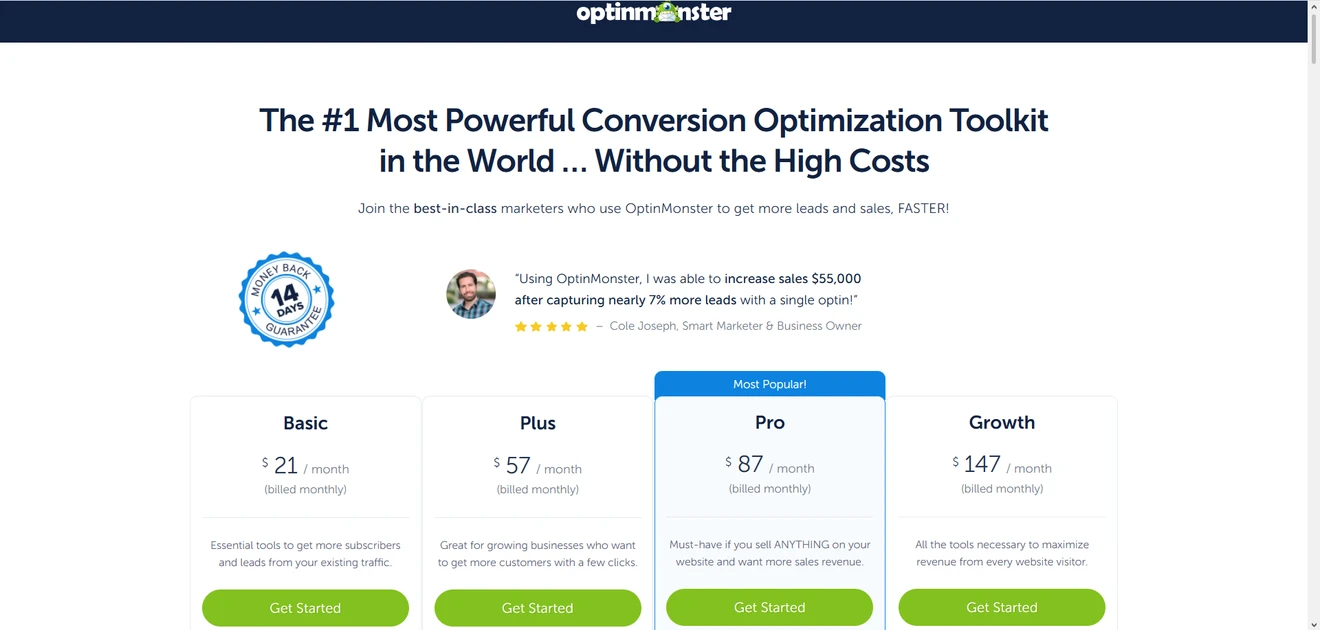
There’s no trial, although you do get 14 days to ask for your money back. WordPress has a small free option — three campaigns, capped at 500 lifetime impressions. Shopify pricing is different: Growth is listed at $49/month and comes with a 30-day trial.
Best for: WordPress publishers and resource libraries that care about where campaigns appear and specifically need features like content locking.
9. Klaviyo Forms: signup data straight into flows
Verdict: Klaviyo Forms make sense among alternatives to Justuno mainly when Klaviyo already handles the store’s email and SMS.
Why consider it: preferences and consent collected across several steps land directly on the Klaviyo profile. Shopify cart data can decide which form appears, and A/B tests can compare as many as seven variants.
Key features: popup, flyout, full-page, and embedded forms can span several steps. They collect profile properties and can include Spin-to-Win.
Where Justuno is stronger: Justuno goes beyond form capture with persistent visitor histories, product recommendations, and workflows that decide what someone sees next. It also offers managed campaign execution. Klaviyo becomes most useful after the signup enters its messaging stack.
Shopify fit: the integration syncs profiles and orders. App Embed is required for popups and flyouts; embedded forms need an app block and embed code.
Pricing: Forms are included with Klaviyo, so existing users do not pay extra at first. However, new signups count as active profiles and may push the account into a higher tier.
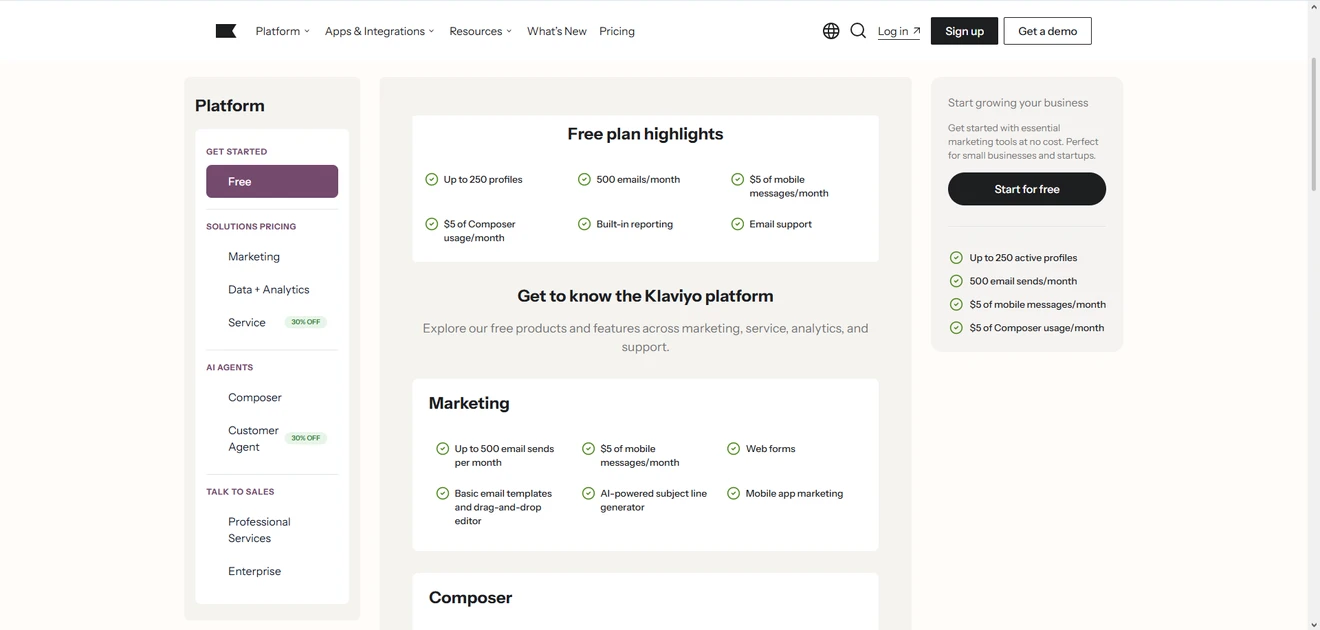
Free covers 250 profiles and 500 monthly sends; the calculator puts 1,500 profiles at $45/month and higher. Free forms show Klaviyo branding, and custom code needs a paid plan. No separate trial.
Best for: teams already using Klaviyo and wanting signup data to enter email and SMS flows immediately.
How to choose the right Justuno alternative
Start with the reason you are leaving Justuno. Then compare the alternatives against the campaigns you already run, the data they require, and the traffic you expect over the next year.
Decision factor | What to compare | Why it matters |
Billing model | Visitors, pageviews or active profiles; included volume; overages; annual commitment | Two similar starting prices can produce very different bills at your actual traffic level |
Feature access | Plan gates, paid add-ons, campaign limits, domains, team seats and branding removal | A low entry price means little if the feature prompting the switch requires an upgrade |
Personalization depth | Behavioral, cart, order and customer data; dynamic content; visitor recognition; custom properties | Check whether the platform can reproduce the campaigns you already run, not merely display a popup |
Campaign formats | Popups, embeds, bars, quizzes, gamified popups, product recommendations, onsite notifications and web push | More formats are useful only when they match the campaigns in your roadmap |
Shopify fit | Installation, cart and product rules, customer data, discount creation, product blocks and checkout restrictions | A Shopify app alone does not guarantee access to the store data or actions you need |
Testing and reporting | Number of variants, control groups, significance indicators, conversion goals and revenue attribution | Testing tools differ considerably even when every vendor lists “A/B testing” |
Integrations | Native connections, field mapping, two-way sync, consent transfer, APIs and webhooks | Confirm that collected data reaches the correct ESP, CRM or ecommerce workflow |
Support and migration | Onboarding, live support, migration assistance, campaign setup and ongoing optimization | Moving to self-service may lower the software bill while increasing the team’s workload |
If you currently use Justuno’s Done-For-You plan, do not compare subscription prices alone. That fee also covers campaign design, implementation, QA, publishing, and managed A/B testing. A cheaper self-service Justuno alternative may still cost more once those tasks return to your team or agency.
Before you start comparing features, pick two or three things you really can’t compromise on. Use those as your filter. Everything else can wait. Otherwise, it’s easy to get distracted by the platform with the longest feature list, even if half of those features won’t matter to your team.
Which Justuno alternative fits your team?
No single platform wins every use case. OptiMonk deserves a closer look for product-page personalization. Privy makes more sense when popups, email, and SMS need to share one workflow; existing Klaviyo users may not need to leave their stack at all. OptinMonster fits WordPress publishers, while Wisepops suits teams adding onsite notifications, web push, and control-group testing.
Claspo is for teams that want more than a cheaper popup tool. Our AI CRO agent can audit performance, suggest tactics, and build campaigns, while every feature stays available on every plan. During the 14-day trial, you can take one of the popup templates, adapt it to a campaign you already run, and see how the setup behaves with your own traffic. Ready to move? The Claspo team will handle the migration for free, including setup and recreation of every campaign.
FAQ
What is the best Justuno alternative in 2026?
Claspo is our overall pick among the top Justuno alternatives in 2026. It combines broad campaign formats, eight game mechanics, an AI CRO agent and a 14-day free trial. Still, the right choice depends on the campaigns you need to run, the data behind them, and how the platform charges as your business grows.
What is the best free alternative to Justuno?
Among free Justuno alternatives, OptiMonk has the largest free tier: 10,000 pageviews and unlimited campaigns on one domain. If feature access matters more than a free allowance, start Claspo's 14-day free trial: every paid plan includes the same targeting, gamification, personalization, and testing tools.
Which Justuno alternative is best for Shopify?
For a Shopify store that wants a dedicated onsite campaign tool, Claspo is our pick. It supports product cards, ecommerce targeting, discount sync, and gives every plan the full feature set. Still, different Justuno alternatives for Shopify solve different problems. OptiMonk focuses on product-page testing, Privy combines signups with email and SMS, and Klaviyo Forms fits stores already working inside Klaviyo.
Which Justuno competitor is best for WordPress?
OptinMonster is the clearest WordPress choice. Its plugin handles campaign placement across a site, including inline forms, sidebars, fullscreen gates, and content locking. The trade-off is its tier structure: A/B testing and content locking require Plus, while exit-intent starts with Pro. These publishing controls make OptinMonster more relevant than most apps like Justuno when the website is content-led rather than ecommerce-first.
Is Justuno worth the price?
It can be, particularly for teams that actively use visitor profiles, product-recommendation algorithms, visual workflows, Spotlight, or Done-For-You services. The value is harder to see when a team runs only a few campaigns, keeps hitting Lite limits, or watches the bill rise with traffic while its use of the platform stays the same. What matters is how much of the toolkit produces measurable value.
Can a Justuno alternative replace product recommendations?
Yes, but check the exact recommendation logic before choosing a Justuno competitor for ecommerce. OptiMonk, Sleeknote, Poptin, and Wisepops all support some form of product recommendation. That does not mean they reproduce Justuno’s eight algorithms, catalog filters, and visitor-history context. List the scenarios you need — such as cross-sell, previously viewed, or abandoned-cart products — and confirm each one separately.