13 Discount Popup Examples to Grow Sales and Email Lists


Summarize
A discount popup saves your sales because it can help turn website visitors into subscribers, encourage first purchases, recover abandoned carts, and increase order value. Based on our analysis of over 779M popup impressions, a visible promo code in a popup increases conversions by more than 2 times.
We’ve collected 13 real campaign discount popup examples, from welcome coupons and exit-intent offers to gamified discounts and cart promotions. From this guide, you’ll learn how each discount popup example works, reasons to try them in your campaigns, and what you can A/B test. We also explain how to choose the right discount, set up targeting and timing, and measure your campaign results with Claspo’s conversion benchmarks.
Key takeaways
Match the popup format with your goals. Collect emails with welcome discounts, trigger exit-intent emails to win back abandoned cart customers, and raise your average order value with cart discounts.
Test gamified discounts. Claspo's 2026 benchmark found an 8.08% average signup CR for gamified popups versus 3.67% for standard email popups. Slot machines reached 12.60%.
Keep offers accessible with teasers. Email popups with teasers averaged 6.89% signup CR. Teasers let shoppers revisit an offer after closing the popup.
Match timing to visitor intent. Trigger welcome offers after engagement and recovery discounts when shoppers hesitate or move to leave. There's no universal best delay.
Check KPIs. Promo code redemption, purchase, AOV, and margin will give you an idea of the value of your discounts.
What is a discount popup
A discount popup gives shoppers an instant incentive — like a coupon code or free shipping — in exchange for placing an order or signing up for an email. The mechanics depend on your conversion objective. You can display the code outright or require an email opt-in first. For extra push, many campaigns layer on countdown clocks, gamified widgets, or tailored category discounts.
With a discount coupon popup builder like Claspo, you can build these in minutes and set exact rules for when they trigger: on page arrival, during browsing, at cart addition, or right before someone leaves.
What is the best timing for a popup discount
It’s important to understand that the perfect moment to show the popup with an offer depends on the visitor’s stage in the purchase process and their actions on the website. A discount as a welcome offer can be relevant if a visitor examines a product, and cart abandonment can be a reason to show a cart recovery offer. The main idea is not to make every discount popup appear after 10 or 20 seconds, but to tie its trigger to the visitor’s behavior.
Page/audience | Trigger | Avoid | Tracking metric |
Homepage/new visitors | Time on page, scroll depth, or a second pageview | Interrupting visitors immediately | Signup CR |
Category/product pages | Meaningful scroll, repeat product views, or time spent browsing | Generic offers unrelated to viewed products | Popup CTR, coupon redemption |
Cart | Cart inactivity or exit intent, with cart-value targeting | Discounting orders likely to convert at full price | Recovered sales, incremental revenue |
Seasonal promotions | Campaign dates, traffic source, or a genuine deadline | Fake countdowns or expired offers | Purchase CR, AOV |
Returning customers | Visitor or subscriber status, purchase history, or loyalty segment | Showing first-order discounts to existing customers | Repeat purchases, margin |
Mobile visitors | Rapid upward scroll, inactivity, or other supported behavioral signals | Relying on desktop cursor movement | Mobile CR, dismiss rate |
Set frequency and audience exclusions
Even an offer that comes at the right time will irritate users when shown again and again. Set your frequency limit to once per session, then optimize as needed according to the campaign’s performance.
Use targeting rules to avoid showing discounts to people who don't need or qualify for them:
Existing subscribers: Don’t show email-capture offers once visitors have subscribed.
Previous purchasers: Exclude them from first-order discount campaigns.
Coupon recipients: Don't show the same offer after they've claimed it.
Overlapping campaigns: Prioritize one relevant popup instead of displaying several competing offers.
Adjust timing for mobile
Mobile visitors don't move a cursor toward the browser's close button. Mobile exit-intent detection therefore relies on different behavioral signals. Claspo uses fast vertical scrolling as the mobile exit-intent signal.
Make sure mobile discount popups are easy to dismiss; besides, don’t interfere with key conversion activities. Test the timing of mobile offer exit-Intent signals separately from your desktop campaign.
Pro tip: If visitors dismiss your discount before they're ready to use it, try adding a teaser. In Claspo's 2026 popup benchmark, email popups with teasers averaged a 6.89% signup conversion rate, compared with 3.67% for standard email popups. A teaser keeps the offer accessible after the main popup closes.
Discount popup examples that boost conversions
Decide what you want shoppers to do: subscribe, complete a purchase, add more items to their cart, or explore a promotion, and thus you’ll find your best discount popup for your next campaign. We've grouped these 13 examples by business goal, with practical notes on offers, timing, design, and what to test.
First purchase & email capture
The welcome discount popup
Best for: Growing email lists and encouraging first purchases from new visitors.
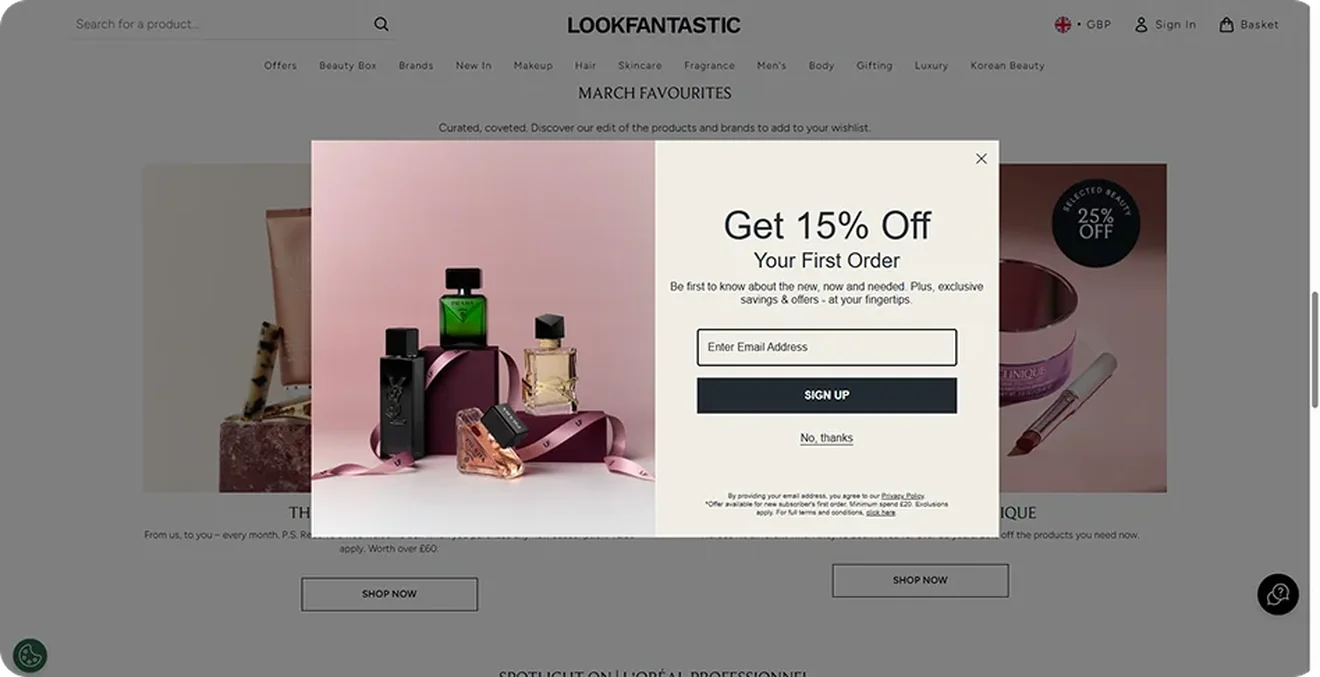
Let’s start our list with the most common and effective discount popups — welcome popups that serve as both a subscription form and a first virtual handshake with your potential buyers. They might look like newsletter popup templates, but don’t confuse these two. Here, the mechanic assumes you offer a 10-15% discount in exchange for an email address. It lowers the risk and “first-purchase anxiety” for new visitors.
Data insight: Ecommerce welcome discount popups average a 5.19% CR, but the top performers hit 9.10%. Our research shows that 90% of top-performing ecommerce opt-in forms offer a discount (because a clear financial incentive is the strongest driver for cold traffic).
Design best practice: Keep the form clean. 9 in 10 winning forms use a modern design, clear offer, and one solid call-to-action (CTA) at the bottom.
What to test: An email-only form versus email and name. Keep the offer and trigger unchanged, then compare signup rates and subsequent purchases.
Cart recovery & urgency
Exit-intent discount popup
Best for: Recovering abandoning shoppers who have shown purchase intent.
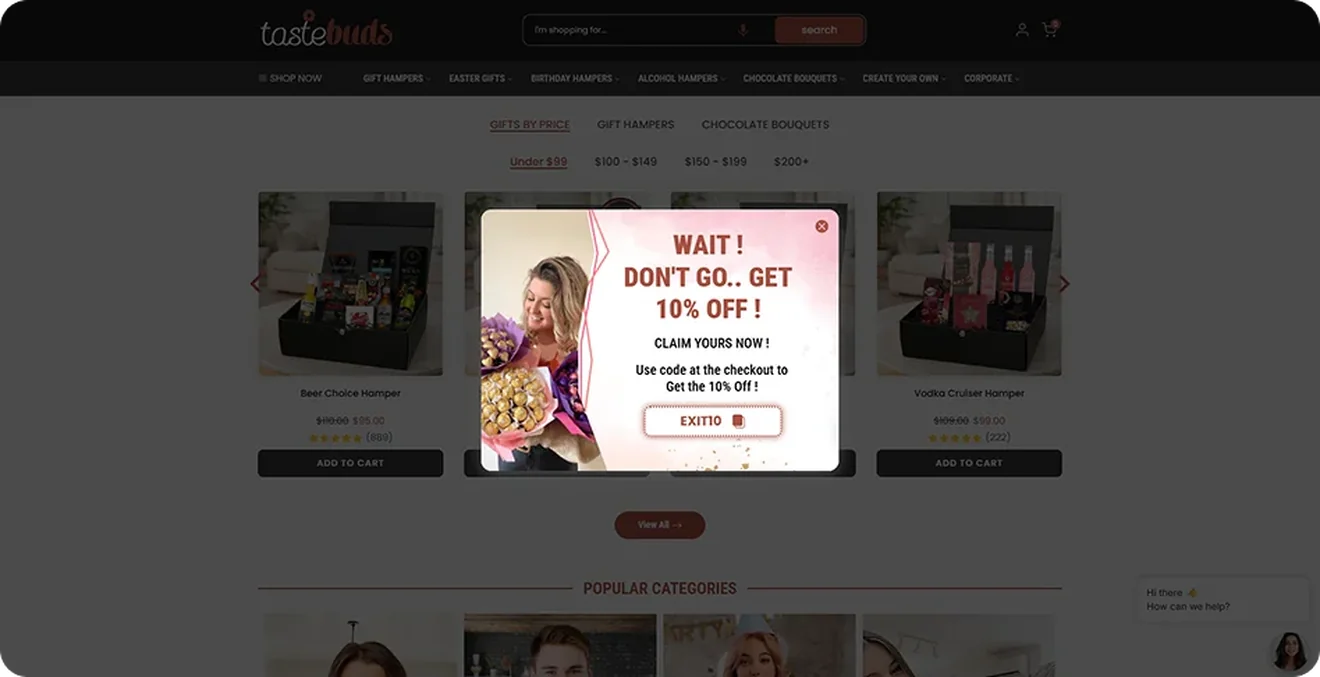
These discount popups are your deal savers because they appear when a user is about to leave. A strong copy like “Wait! Save 10% before you go” can make the tables turn and get you another satisfied customer. Because of their behavioral nature, exit-intent discount popups work much better than static discount popups for ecommerce.
Data insight: 5.67%CR is the average rate of exit-intent discount popups with a promo code; that’s over two times the average discount popup conversion rate.
Trigger and timing: Show the offer when visitors demonstrate exit intent, ideally after viewing products or adding something to their cart. Exclude shoppers who have already claimed the discount.
What to test: A free shipping offer against a fixed percentage discount. Measure recovered purchases and the cost of each incentive, not just popup clicks.
Countdown timer discount popup
Best for: Flash sales, seasonal promotions, and genuinely time-limited offers.
This discount popup type highlights that a deal expires in real-time (5 minutes left, a weekend deal, etc.) In Claspo benchmarks, thousands of discount popups showed that urgency alone doesn’t work, but Urgency + Promo code yields a 3.43% CR.
Trigger and timing: Don’t use fake urgency. If your visitors realize that the timer restarts on every visit, your trust and CR will fade. Use countdown timer popups during an active promotion, using the actual campaign deadline.
What to test: A discount popup with and without a countdown timer. Compare coupon redemptions, completed purchases, and average order value.
AOV & merchandising
Cart discount & cross-sell popups
Best for: Increasing average order value with complementary products.

These discount popups trigger when a user has items in their cart but hasn’t moved to the checkout for a set time (e.g., 30 seconds). The brand Sneak uses the complementary cross-sell approach to increase AOV and get the deal while the user is already in a “buying mood.” Besides, thanks to this discount popup type, users don’t need to go to the product page — one click is all it takes to add the discounted product to the cart. This keeps the users in the checkout flow.
Data insight: Our research shows that discount popups used to increase AOV convert at an average of 5.41%, but the top 10% reach a 19.55% CR by using personalized recommendations like this.
Trigger and timing: Show the offer after an item is added to the cart or during cart review. Recommend relevant products and let shoppers add them in one click.
What to test: A discounted complementary product versus a free-shipping threshold incentive. For many shoppers, shipping costs are the leading reason for abandonment. If you remove this barrier, you’re more likely to seal the deal. Compare add-on acceptance, AOV, and profit per order.
Product category discount popup
Best for: Promoting specific collections or products to shoppers already interested in them.

Here is another strategy which will help you increase the number of conversions. This strategy involves creating targeted discount popups which will display only on certain webpages. For example, the popup can be created to appear on refrigerator webpages at an online appliance store. The more relevant the offer is, the higher the chances of conversions it will have.
Trigger and timing: Relevant categories and/or products only after engaging actions like scrolling and looking at several items. Exclude products that are not applicable to the promotion.
What to test: Category vs. Store-wide discount coupon. Measure coupon redemption rate and product conversion rate/profit margins.
BOGO and tiered gift discount popups
Best for: Increasing items per order, encouraging larger baskets, and promoting selected inventory.

This discount popup type is your magic wand that can clear out stock and boost the number of items per order. However, Bondox's tiered approach goes a step further by leveraging gift-with-purchase (GWP) to increase AOV. They replaced flat discounts with rewards for reaching higher spending brackets ($49, $99, $199). This is a great alternative for premium brands that want to avoid discount erosion.
Trigger and timing: Use tiered gifts strategically. Shoppers hate being just a few dollars away from a better gift. Show the offer on relevant product or cart pages, especially when shoppers are close to qualifying for the next reward tier. Make the spending requirements and eligible products clear.
What to test: A BOGO discount versus a tiered gift incentive. Compare AOV, items per order, reward redemption, and gross margin.
Personalization & qualification
Discount popup with segmentation
Best for: Collecting customer preferences and delivering more relevant discounts and follow-up emails.

These discount popups work so you don’t have to. A simple choice component will help you collect zero-party data, segment your email list, and send relevant and personalized emails for your marketing campaigns.
You might say, “But the conversion will drop because of the extra step”, and you might be right, but the subsequent email revenue will be higher because the follow-up offers are personalized.
Data insight: Claspo's 2026 benchmark found that email popups with Choice buttons averaged a 5% signup conversion rate, compared with 3.67% for standard email popups.
Trigger and timing: Display the popup after initial engagement, ideally on the homepage or a category page. Keep the question simple and avoid asking for information you won't use.
What to test: A direct discount signup versus a two-step flow that collects preferences first. Compare signup rates and engagement with subsequent emails.
Discount popup with a quiz
Best for: Helping shoppers discover suitable products while collecting preferences for personalization.

This is a great way to educate your visitors or guide them directly to the product category they’ve come for. As with segmentation discount popups, you collect zero-party data to further personalize email.
Quiz discount popups create a win-win situation: you get your deal, and a shopper gets a curated recommendation and a reward for their time.
Trigger and timing: Show the quiz on relevant landing or category pages after visitors have started browsing. Keep it short, and explain what they'll receive for completing it.
What to test: Opening with a relevant question versus adding a separate “Start Quiz” screen. Compare quiz completion, signup rates, and purchases from recommended products.
Claspo case study: Lavender World tested seven popup approaches with the same 10% discount. A quiz that opened directly with a relevant planting question achieved a 21.3% signup rate, compared with 4.4% for a version that first asked visitors to start the quiz. The variants ran sequentially, so the results don't establish a causal lift, but they make a strong case for testing the first interaction. Read the full Lavender World case study.
Interactive & gamified discounts
Gamified scratch card discount popup
Best for: Email capture, mystery discounts, and promotions where shoppers reveal a reward.
Our benchmarks show that gamified discount popups outperform traditional forms with an average CR of 34% vs 27%. This specific mechanic works well because it triggers “manual scratching,” which activates dopamine receptors. Your visitors feel that they earned the code and are more likely to use it.
Data insight: Claspo's 2026 benchmark found that scratch card popups averaged an 8.66% signup conversion rate, compared with 3.67% for standard email popups.
Trigger and timing: Show the game to new visitors after initial engagement or during a seasonal promotion. Make the reward easy to reveal on mobile and prevent repeated attempts to claim additional discounts.
What to test: A scratch card versus a standard discount popup offering the same reward. Compare signup rates and coupon redemptions.
Mystery offer discount popup
Best for: Creating curiosity around exclusive offers and first-purchase incentives.

This “blind” mystery discount coupon popup creates a powerful curiosity hook. When you hide the reward behind an email signup, a psychological cliffhanger helps motivate visitors to act just to see what they’ve won.
Strategic tip: This discount popup type is great for premium brands, because the offer feels exclusive and not like another 10% generic code.
Trigger and timing: Show the offer after visitors have explored the store or on a relevant promotional landing page. Explain any eligibility requirements before asking for contact details.
What to test: Revealing the discount amount upfront versus keeping it hidden until signup. Compare signup rates, coupon redemptions, and purchases.
Spin-the-wheel discount popup
Best for: Email capture, seasonal sales, and campaigns with multiple reward tiers.
Spin-the-wheel popups give visitors a chance to unlock discounts, free shipping, or gifts. The visible prize options make the potential rewards easy to understand, while the spinning interaction adds anticipation.
Data insight: Claspo's 2026 benchmark recorded a 7.92% average signup CR for spin-the-wheel popups. The top 10% of campaigns reached 43.19%, showing how widely performance can vary.
Strategic tip: Use a reward matrix and offer one strong prize, 2-3 medium, and 1-2 soft rewards. Such transparency increases engagement. Additionally, matching your wheel’s design to a current pop-culture trend or seasonal event makes the interaction feel fresh and timely.
What to test: A guaranteed 10% discount versus a wheel with several reward tiers. Compare signup rates, coupon redemptions, and discount costs.
Case study: The recent case with Man’s Set showed that gamified discount popups not only increase conversions but also validate the market. They offered a gamified discount for pre-orders and sold 50% of a new collection before it even hit the warehouse. This approach turned cold traffic into high-intent buyers.
Can a wheel validate your next products?
See how Man’s Set did it in our latest case study.
Slot machine discount popup
Best for: First-order coupons, email capture, and promotions with immediate rewards.

This gamified mechanic is rather fresh: it holds attention and delivers good results in seconds. Slot machine discount popups are perfect for high-intent visitors looking for a deal.
Even though such a mechanic gives off a gambling impression, premium brands can also use it for promotion. Beauty tech brand Oroskin managed to incorporate it smoothly into its aesthetics. You can style the slots the way you like: use text for discounts, product miniature images to motivate window shoppers, or emojis to match your vibe.
Data insight: The top 10% performers reach a 25% CTR during high-urgency holiday deals or flash sales.
Trigger and timing: Use the game for welcome discounts or time-limited promotions. Keep the interaction short, display the prize conditions clearly, and avoid interrupting checkout.
What to test: A slot machine versus a spin-the-wheel popup with the same rewards. Compare signup rates and the percentage of claimed discounts that lead to purchases.
Matching game discount popup
Best for: Interactive welcome offers and campaigns targeting audiences receptive to playful promotions.
Another fresh game from our collection that keeps users on your site significantly longer. The matching game turns a simple discount into a little challenge.
This is another mechanic Man’s Set used in their campaign: they launched a matching game discount popup to transform their welcome funnel. Visitors played a game to get their reward, which felt like a personal win. This reduced the drop-off rates and helped Man’s Set lower their CAC by 10%.
Data insight: Gamified discount popups like matching games and pick a gift popups are attention magnets. While standard popups set a baseline of 2.48% CR, the game helped Man’s Set grow email-driven revenue by 10% by pulling cold traffic deeper into the funnel.
Trigger and timing: Show the game to new visitors after they've engaged with the site. Keep the number of pairs manageable, especially on mobile, and offer a clear way to close the popup.
What to test: A short matching game versus an instant-reveal discount. Compare game completion, email signups, and coupon redemptions.
High traffic but low sales?
Learn how Man’s Set used gamification to increase their email revenue by 10%.
How to choose the discount type and amount
The right discount should feel valuable to shoppers and still make financial sense for your business. Start with your average order value (AOV), product margins, and campaign goal before deciding how much to offer.
Claspo's benchmark study of 779M+ popup impressions found that 90% of the top 10% of ecommerce signup forms offered a discount: 50% used fixed amounts and 40% used percentage discounts. Here's how to choose between these and other incentives.
Discount type | When to use it | What to watch |
Percentage off (10–20%) | Welcome offers and stores with varying order values | Larger orders mean larger discount costs |
Fixed amount ($10 off) | Stores with predictable AOV or minimum-spend promotions | The discount may be too generous on smaller orders |
Free shipping | When delivery fees may discourage purchases | Shipping costs and minimum order thresholds |
BOGO or free gift | Product bundles, inventory promotions, and first-purchase rewards | Product costs and eligibility conditions |
Tiered rewards | Encourage shoppers to reach a higher cart value | Reward costs and whether AOV actually increases |
For example, Bondox offers different gifts when shoppers spend $49, $99, or $199. This gives customers a clear reason to add more items.
Also, distinguish between two related formats. A discount promo popup announces a promotion, such as “20% off this weekend,” and typically directs visitors to shop. A promo code popup provides a code shoppers can copy or unlock, sometimes in exchange for an email address. Both can advertise the same discount, but the second adds a code-redemption step.
Pro tip: Compare purchase conversion, AOV, and gross margin alongside popup engagement. A larger discount might generate more orders but less profit.
Discount popup design best practices
For years, we’ve been analyzing the discount popups of our users, and we’ve come up with some visual and structural rules that make the difference between a closed discount popup and a clicked one:
Match the message to the visitor's intent. A first-time shopper browsing the homepage may respond to a welcome discount, while someone reviewing their cart might prefer free shipping. Align the offer with the page, traffic source, and shopping stage. Don’t trigger the same generic promotion to everyone.
Keep forms short. Simplicity always wins, so don’t overdesign your discount popups. 95% of top-performing popups use only 1 or 2 fields (Email + Name). Every extra field (phone, preferences) creates friction and kills volume.
Use visual hierarchy. Your promo code should be the largest element. A headline like “Get 15% Off Your First Order” immediately communicates the value. Use contrasting colors for the CTA, but keep the design consistent with your brand.
Write copy that explains the rewards and next steps. High-converting headlines follow a specific rhythm: Benefit → Mechanic → Timing. Check this example out: “Get 15% off [benefit] → Spin the wheel to get discount [mechanic] → Offer ends tonight [timing].”
Make codes easy to redeem. If your tool doesn’t automatically apply discounts to carts, use the “click-to-copy” buttons to spare your users the need to memorize a promo code. If the code is applied automatically, tell visitors so they know what to expect.
Use discount psychology. Our statistics also revealed that for products below $100, a percentage discount (15% off) results in a 12% increase in CTR, while for high-ticket items (over $100), a promo code ($15 off) converts faster and accelerates the checkout process.
Design for mobile screens. Make sure that your CTA button and exit button are large and easy to click with your thumb. Don't forget that Google dislikes pop-ups covering the page on mobile devices. Claspo lets you preview the experience on different screen sizes before publishing and design a mobile version separately from the desktop one.
Use targeting and exclusions. Show welcome discounts to eligible new visitors, category offers to shoppers browsing relevant products, and cart incentives to visitors showing purchase hesitation. Exclude existing subscribers, ineligible customers, and visitors who've already claimed the reward.
Always test and optimize. Sometimes a static form wins, sometimes it’s the game. This is why it’s crucial to never stop testing discount popup variations with your specific audience and goals. Claspo's A/B testing tools let you test up to 5 popup variants and compare their performance.
How to create a discount popup in Claspo
With Claspo, it’s easy to build a discount popup that will convert your visitors. With over 1,000 professionally designed discount templates aimed at conversion rate optimization (CRO), you can launch a data-backed strategy while your coffee is still hot.
If you use HTML, skip this explanation and read how to create an HTML popup.
Step 1: Select a template
Open the Claspo template library and filter by goal, such as Increase sales, or feature, such as Promo code. Choose a layout that fits your campaign: a welcome discount, exit-intent offer, gamified popup, or seasonal promotion.
You can customize any template, so focus on finding a suitable structure; don’t look for an exact visual match.
Step 2: Customize the offer and design
Use the drag-and-drop editor to update the headline, discount value, CTA, colors, and images. Claspo's color themes help match the popup to your website, while the AI assistant can suggest or refine your copy.
Make sure the offer explains what shoppers receive and how to claim it. If you're collecting emails, configure the success screen to display the promo code with a click-to-copy button and a Shop Now CTA.
You can also add a teaser to keep the discount accessible after visitors close the main popup.
Step 3: Set triggers and target your audience
Triggers can make or break your campaign. A discount popup only converts if it appears at the right moment to the right audience.
Here are some tips for high conversions:
Welcome discount: Target new visitors after a time-on-page or scroll trigger.
Exit-intent offer: Show the discount when visitors demonstrate exit behavior.
Category promotion: Target specific product or collection pages.
Cart discount: Use cart-related conditions to reach eligible shoppers.
Set a frequency cap, such as once per session, and exclude existing subscribers, customers who don't qualify, or visitors who've already claimed the offer. Use Claspo's overlap prevention settings if multiple campaigns run simultaneously.
Step 4: Sync, publish, and A/B test
Install Claspo through its Shopify or WordPress integration, or add the script to your website. If your popup collects emails, connect your ESP, such as Klaviyo, Mailchimp, or Omnisend, and map the collected fields to the correct list or segment.
Before publishing, preview the popup on desktop and mobile. Check triggers, exclusions, form submissions, email synchronization, and promo code delivery and redemption.
Once live, use Claspo's built-in A/B testing to compare offers, copy, designs, or triggers. Track signup rates, coupon redemptions, and purchases to identify the best-performing version.
Ready to create your own? Explore Claspo's discount popup templates and customize one for your campaign.
How to measure discount popup performance
A good discount popup conversion rate depends on the campaign goal. Email capture, coupon clicks, and completed purchases are different actions, so comparing them using one metric can be misleading.
Claspo's three-year benchmark study, covering 779M+ popup impressions, provides these ecommerce averages:

These figures are starting points for comparison, not guaranteed results. To evaluate whether your discount popup actually works, track:
Signup conversion rate (CR): The percentage of popup impressions resulting in email signups.
Click-through rate (CTR): The percentage of impressions generating clicks on the popup's target action.
Coupon redemption rate: The percentage of issued or claimed coupons redeemed at checkout.
Average order value (AOV): The average amount customers spend per order. Compare orders with and without discounts.
Incremental revenue: Additional revenue attributable to the campaign beyond purchases that would have happened anyway. Measuring this requires a control group or another reliable attribution method.
Lead quality and unsubscribes: Whether discount-generated subscribers engage with subsequent emails or unsubscribe shortly after joining.
A popup may generate plenty of signups but attract shoppers who never purchase. Similarly, a generous discount might increase conversions while reducing profit margins. Use these metrics together to assess both immediate performance and longer-term business value.
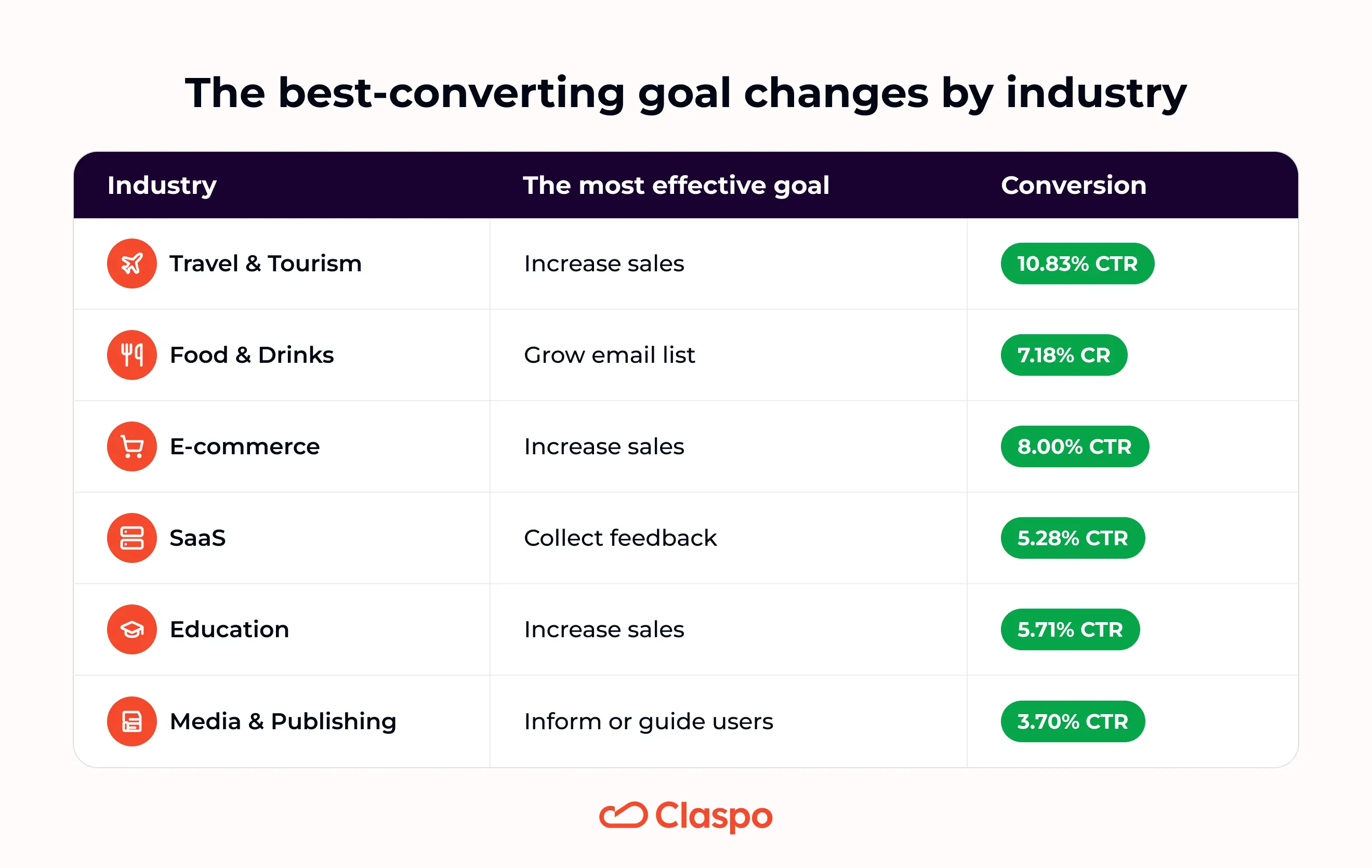
Besides, each industry has its own rules for the game. This is why Travel sees the highest CTR (10.83%), because travelers are more emotionally primed — they are dreaming and planning their trips for a long time and convert much more eagerly. Conversely, SaaS stays lower but more focused because its audience scans for technical value rather than impulse deals.
FAQ
What is a discount popup?
A discount popup is a website message offering shoppers a price reduction, coupon code, free shipping, or another incentive. Businesses use these popups to encourage first purchases, collect email addresses, recover abandoned carts, and increase order value. The offer can appear automatically or in response to visitor behavior.
What discount should a popup offer?
A 10–15% first-order discount is a reasonable starting point for testing, but the right amount depends on your margins, average order value, and audience. Fixed discounts, free shipping, and gifts can be alternatives. Compare redemption rates and profit per order before increasing the incentive.
When should a discount popup appear?
Show discount popups when the offer matches the visitor's intent. Welcome discounts can appear after initial engagement, while exit-intent offers target shoppers who are about to leave. Cart promotions work best when they're relevant to the items or total in the cart. Test timing separately for desktop and mobile rather than using a universal delay.
How do you create a discount popup without hurting user experience or margins?
Use a clear offer, simple design, and relevant targeting. Avoid interrupting checkout, cap display frequency, and exclude visitors who've already subscribed or claimed the discount. Set minimum order values or product restrictions where appropriate, and use unique promo codes to limit unwanted sharing. A/B test your campaigns and monitor purchases, redemption rates, and margins alongside popup conversions.