Partial submissions or how to recover up to 19% of lost leads


Summarize
What is the most expensive click in your business? Not the one that never converts, but the one that starts your form and drops off just before submission.
In most systems, these users disappear from your funnel because they never hit the final “Submit” button. The intent was there, the traffic was paid for, but the lead is lost in the final step — making it difficult to see how much potential value is being left behind.
How partial submission works
Our user data analysis showed that almost 20% of site visitors leave after filling out the email field. We developed a feature that catches those leads midway.
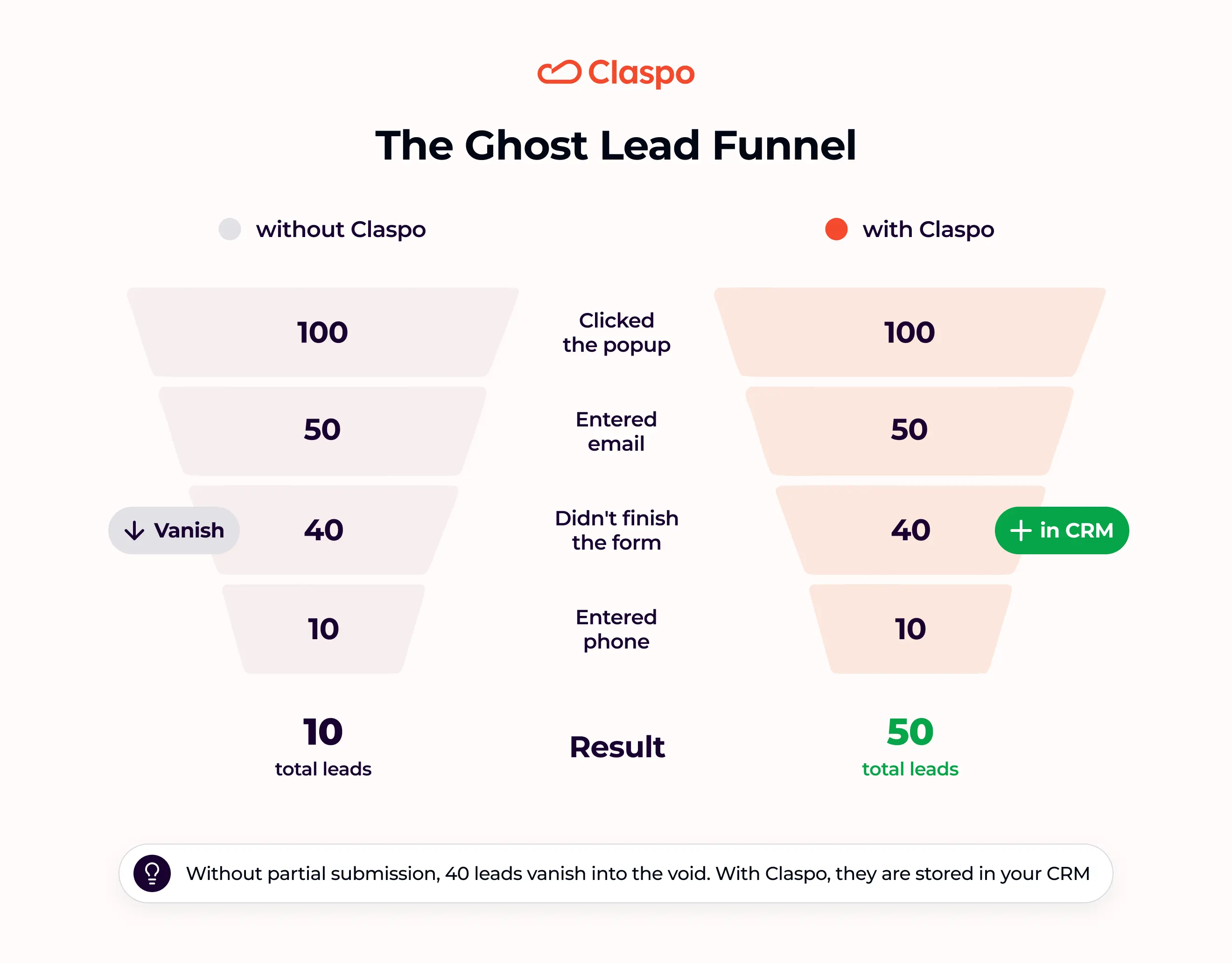
Here's how partial submission works:
Intent-based capture. Claspo saves partial submissions only after a visitor completes all required fields and, if applicable, accepts your consent policy.
Background processing. When a visitor closes a popup, Claspo sends the captured data in the background without interrupting the browsing experience.
Rich lead context. Claspo passes along hidden fields, UTM parameters, and MarTech data, ensuring you know exactly where the lead came from and what their intent was.
The ROI
We recently analyzed performance across 143 popups to see the new feature in action. The results: partial submission is an insurance policy for your marketing budget.
The data showed a consistent pattern in multi-step gamified popups, particularly spin-to-win flows. Users were generally willing to enter their email in step one to get the reward, but a significant portion of that traffic dropped off in step two, which required additional info (phone number or extra details).
This is expected. Our benchmarks based on 779M popup impressions show that phone number fields significantly reduce conversion rates — 0.44% for phone fields vs 2.48% for email-only fields — because they require more effort and raise stronger privacy concerns.
The drop-off pattern:
User submits their email and gives consent to participate in the game.
User is asked for additional info (e.g., phone number).
Break point: some users leave before completing the second step.
Without partial capture, these users would be gone, even after engaging with your brand and entering valuable data. With partial submission, we recover these interrupted entries, turning a lost session into a valuable contact in your CRM. In larger projects, this helped recover contact details for about 16–19% of visitors who filled in key fields but didn’t submit the form.
These are not new visitors, but people who have already started the form. This makes better use of existing traffic without increasing ad spend.
Why Claspo’s partial submission works
Clients often ask: “Will I end up with a database full of broken, dirty leads?”
Our analysis of 1,377 capture events says no. 99.4% of partial submissions were technically complete regarding required fields. In most cases, the “partial” status simply reflected that the visitor left before clicking the final submit button — not that the form was incomplete.
Claspo validates required fields before saving a partial submission, so only entries that meet your form's requirements are sent to your CRM.
How to comply and still convert?
Many marketing teams wonder if it’s okay to save incomplete form submissions under GDPR, CCPA, or ePrivacy rules. In most cases, it is, as long as users are clearly informed and have agreed to it.
1. Transparency
The law does not forbid you from saving data mid-form. Regulations require transparency. If you collect partial form inputs, this must be clearly stated in your Privacy Policy so users understand how their data is processed.
2. Lawful basis
To store or act on partial submissions, especially if you intend to send follow-up emails, you need a valid legal basis:
Explicit consent. The safest approach is usually implemented via a consent checkbox before or during form interaction.
Legitimate interest. In some GDPR cases, it might justify saving partial form data, similar to abandoned cart tracking, but it still needs proper justification and documentation.
We recommend relying on explicit consent, as it creates a clearer and safer user relationship.
3. Data retention
Partial submissions should not be stored indefinitely.
Define a retention period (e.g., 30 days).
Delete or anonymize unused partial entries.
Ensure users can request full deletion under “right to be forgotten”.
4. Ethical use
Compliance also depends on how the data is used.
Avoid aggressive or intrusive phone calls or aggressive sales sequences.
Use gentle recovery messaging (e.g., “resume your form”).
Treat partial data as a support mechanism, not a sales trigger.
We designed Claspo to support these practices. We provide tools for recovery and consent, but you control how they are used in a compliant way. Compliance is required, not optional. Being transparent builds trust and can improve form completion.
Audit your popup forms to capture more leads
Here’s a simple approach to reduce form drop-offs and improve lead capture efficiency:
Ask for the email first. In our analysis, 99.1% of abandoned submissions already contained an email address, while optional fields were rarely completed. Capturing the primary contact early increases the chance of recovering the lead.
Keep forms short. If a field doesn’t directly support your business goals, remove it. Our data shows that optional questions (names, dropdowns, survey fields) are skipped in 99%+ of abandoned sessions, killing your conversion.
Treat partial submissions differently. Tag them in your CRM and send a targeted follow-up to complete signup or resume the flow.
Analyze the drop-off points. Look for the step where abandonment spikes. If only a small percentage leave on the first page of your multi-step popup but most drop off on the third step, it's a strong signal of a confusing question, an unnecessary field, or a lack of trust. Fixing that step can have a significant impact on overall conversion.
Final thoughts
Even if visitors complete most of a form, some still drop off before clicking “Submit”. Without partial submission tracking, those leads are typically lost.
Partial submissions help recover contact information that would otherwise never reach your CRM, making better use of the traffic you've already paid to acquire.
Ready to see how many leads you've been losing?
If you're using Claspo, the feature is enabled by default for popup forms. You can review recovered leads in the Leads section and decide how to incorporate them into your existing follow-up workflows.