10+ Spin-the-Wheel Popup Examples [+Tips & How to Create]

![10+ Spin-the-Wheel Popup Examples [+Tips & How to Create]](https://framerusercontent.com/images/FZo9BpFDl1rM19zxjzYbhCS2Urk.webp?width=1920&height=540)
Summarize
A spin the wheel popup is a simple gamification format that turns a regular signup form into a small on-site game. This opt-in wheel feels more engaging than a static form because people get a quick moment of choice, surprise, and reward before they become leads.
Claspo data shows why this spin to win popup is worth testing. Across more than 779 million widget impressions, standard signup forms convert at 3.53% on average, while gamified pop-ups reach 9.18%. The spin the wheel popup performs slightly higher at 9.25%, making the wheel of fortune mechanic one of the easiest ways to add spin the wheel gamification to your campaign.
Below, we’ll show spin the lucky wheel popup examples, prize ideas, setup steps, and tips to keep visitors spinning without annoying them.
TL;DR
Use the wheel where a discount already makes sense: first visit, sale pages, exit intent, first order, or after purchase.
Let visitors look around first: wait a few seconds, trigger the popup wheel after scroll, or save it for exit intent.
Make the prize pool exciting but safe for margins: most rewards can be small, while bigger prizes stay rare — for example, 60-70% low-value, 15-20% mid-tier, and 5-10% high-value rewards.
Keep the form light: start with email only. Name, phone number, or quiz questions should earn their place.
Test before you scale: compare offers, designs, timing, and form fields before rolling out the winning version.
What is a spin the wheel popup?
A spin the wheel popup is a small game that appears on a website. Visitors see a wheel with different prize sections, enter their email or other details, and spin to reveal what they get. Depending on the setup, the reward can appear right away, arrive by email, or become available after one more step.
For marketers, the main difference is that a popup wheel gives people something to do. It is not just another form asking for attention. There is a short moment of action and curiosity, which can make the offer feel more personal — especially when it is connected to a sale, first order, or the product category someone is already browsing.
Spin the wheel popup benchmarks: are they actually effective?
A single average conversion rate can be misleading. It shows the middle of the story, but not the spread between lower-performing widgets and the campaigns that do really well.
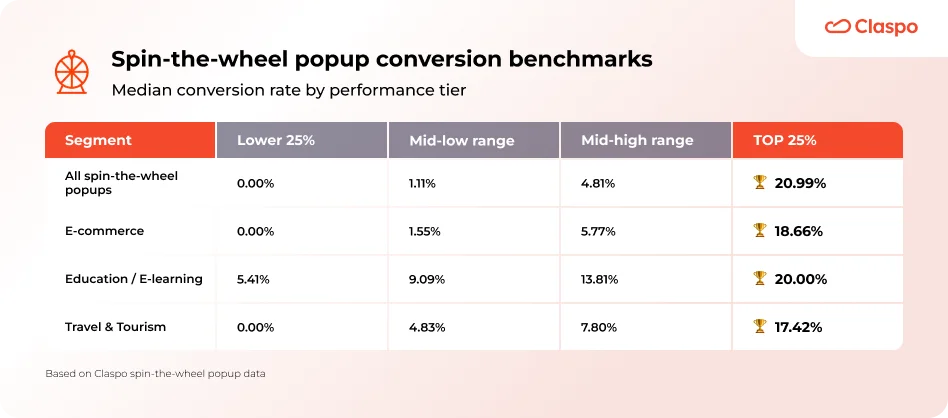
So to make this benchmark more useful, we analyzed spin-the-wheel popups created by Claspo users, which generated 3.4M views in total. Then we sorted each segment by conversion rate and split it into four performance tiers. The table shows the median conversion rate inside each tier — from the lower 25% to the top 25%.
Along with the overall benchmark for all spin-the-wheel email capture popups, we also included three industries where gamified popups are used most often: e-commerce, education/e-learning, and travel & tourism.
So, let's explore how you can improve the effectiveness of your popup campaigns.
Breaking through popup fatigue. Widget fatigue is real. Standard forms and regular popups are often passed over. Many visitors recognize them instantly and close them without reading. Gamified formats break that pattern by asking people to do something first, which can hold attention a little longer. Spin-the-wheel popups use that approach with a simple action before the offer or signup step.
Turning curious visitors into first-time buyers. You never get a second chance to make a first impression. A spin the wheel discount pop-up nails it by making visitors’ first experience memorable and rewarding. It has a low barrier to entry because popup wheel mechanics is so easy; even your grandma could do it (and probably win).
Increasing engagement and conversions. Spin the wheel gamification gets users interacting and sticking around, which leads to... you guessed it: more sales. Discount motivation is also very important. A spin the wheel discount can give hesitant visitors a reason to act now instead of leaving the site. A welcome popup works in a similar way — it appears when people arrive and offers a clear next step, such as joining your newsletter or viewing a first-time offer.
Keeping profits while customers save. The gamified popups help you balance offering value without tanking your margins. Most prizes are cost-effective, while customers feel like they’ve earned a special discount, even if it’s small.
Winning over existing clients. It’s cheaper to keep a customer than to find a new one. Spin to win popups make your loyal fans feel like VIPs and keep them returning for more.
“We recently ran an A/B test on the newsletter opt-in for a D2C client where the only difference was adding a real prize, which also happened to be complementary to the core product. Both versions used the same “spin-to-win” wheel, with the same odds and layout. In Version A, there was no specific prize listed, but in Version B, we put an Apple AirPods 4 on one section of the wheel and called it out in the headline. After 14 days the sign-up rate had gone from 3.4% to 5.8%, a 70% increase, while the unsubscribe rate from the first three emails people got after signing up stayed the same at 0.3%.
We were able to keep people engaged and avoid annoying them using two main methods. First, participation was optional. That's key. The wheel only appeared if someone clicked a “Reveal today’s perk” button, but never popped up by itself. We also set it so that if a person didn’t interact, it wouldn’t show up again during that browser session, limiting repeat views and rage clicks. Second, we used targeting logic to hide the wheel from people who had dismissed it twice, or had already converted and already on the list.
To make sure the results weren’t solely due to the wheel’s design, we also tested a plain sign-up form. In this three-way test, the wheel with the prize got sign-up rates 2.9% higher than the form. This matches studies showing that gamified pop-ups usually get 10-30% conversion rates, versus 1-3% for regular forms (Drip, 2024). While it may draw the eye, what matters for conversion is not the spinning animation, but that the prize feels meaningful and that people feel like they have a choice. If you use a prize, only put it on one section of the wheel, not all of them, so the offer seems special and not automatic.” Gamified opt-ins still depend on solid email collecting tools behind the prize flow.
Steve Morris
Founder and CEO of NEWMEDIA.COM
10 Spin-the-wheel popup examples
Let's examine some spin-the-wheel popup examples. We’ll analyze what strategies they use, what attracts attention, and what may spoil the user experience, and we'll devise solutions to avoid similar troubles.
1. Full-screen spin-the-wheel for email capture
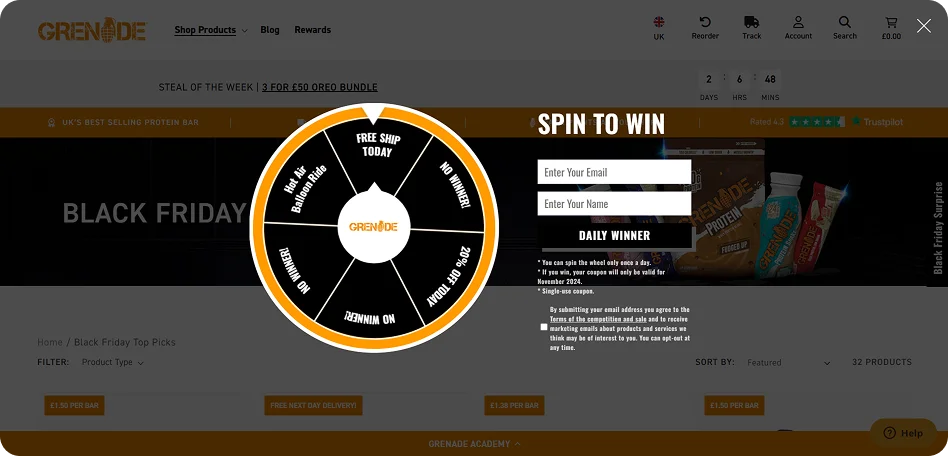
This Black Friday example uses the full-screen format to make the wheel impossible to miss. The dark overlay keeps focus on the offer, while the store remains visible in the background.
Good fit for: Black Friday, Cyber Monday, bundle promos, flash sales, and other high-traffic campaigns where email capture matters.
What you can borrow: the spin to win popup has one clear job — collect emails through a game. The wheel is large, the prize sections are easy to read, and the “daily winner” angle gives people a reason to come back and spin again.
What works well here: the design fits the campaign mood — bold, dark, and sale-focused. The orange wheel frame matches the brand accents on the page, so the popup does not feel completely detached from the store. The translucent background also softens the full-screen format a little — visitors still understand where they are.
What could be improved: only part of the popup wheel includes prizes, so some visitors may feel the email exchange is not worth the risk. If lead capture is the main goal, test a guaranteed-win version with smaller rewards, or make the “try again tomorrow” message more visible.
2. Hero banner Spin the wheel discount
This example places the spin the wheel directly in the hero section, so visitors see the game before they start browsing products. The “Win Guaranteed” message also removes the biggest hesitation: people know they will get something if they play.
Where it fits: use this format for homepage promos, Black Friday deals, daily offers, and campaigns where the discount is meant to drive shopping right away.
What you can borrow: the offer is visible without waiting for a pop-up to appear. Visitors spin the wheel, get a promo code on the next screen, and can copy it instantly. The timer adds a reason to use the code the same day, which works well for short promotions. For more ideas on urgency-based offers, see our article on limited-time offer examples.
How to make it better: this setup is perfect for driving purchases, but why not build your email list, too? Since it’s tied to Black Friday, shoppers are in the mood to buy, making them more willing to share their email in exchange for a discount. For example, WHOSE brand used our Spin-the-wheel gamification to capture 4,450 emails in 7 days, and turn nearly 30% of spins into checkout code use. Use this opportunity to grow your subscriber base and follow up with upsell or cross-sell offers based on their first purchase. Future discounts might be smaller, but by then, they’ll trust you as a seller — making their next purchase decision even easier.
3. Spin to win popup with a timer
This spin the wheel popup adds a countdown timer right on the first screen, so visitors see both the game and the deadline before they decide to join.
Where it fits: short promos, flash sales, holiday offers, limited daily deals, and campaigns where the reward should feel time-sensitive.
What you can borrow: the timer gives the popup wheel a clear reason to act now. It works especially well when the offer is available for a few hours or one day only.
What could be tested: a fixed timer works for campaign-wide deadlines. For evergreen offers, test a relative timer instead — it starts separately for each visitor, so the offer feels limited without ending the campaign for everyone at once.
4. Spin the lucky wheel popup with a teaser
This popup wheel opens from a teaser, so visitors can notice the offer while browsing and decide when to open the game.
Where it fits: pet brands, fashion, beauty, home goods, and other stores where the offer can stay visible without covering the page right away.
What you can borrow: the teaser keeps the spin the wheel popup within reach, while the main banner and scrolling ribbon repeat the prize message. Visitors see the offer more than once before they interact with it.
What could be tested: the form asks for email and first name before the spin. The name field can help personalize follow-up emails, but it also adds friction. Test it against an email-only version.
5. Spin the wheel popup for an anniversary campaign
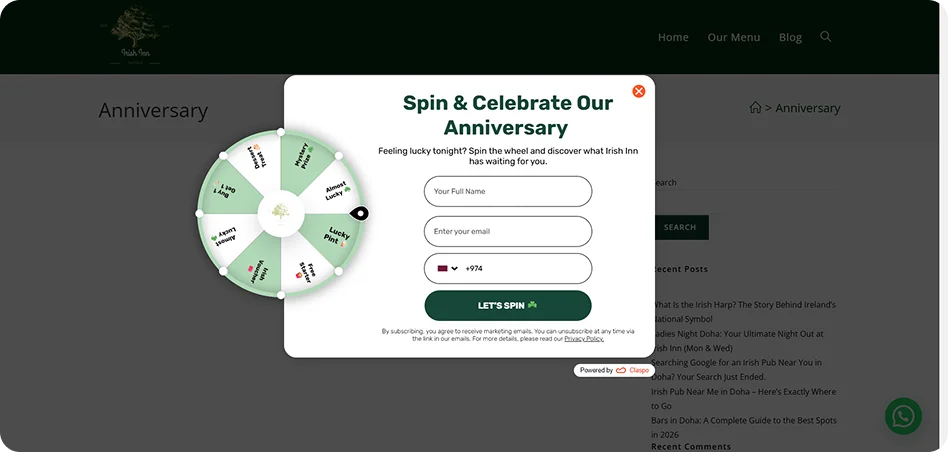
This pop-up works because it has a clear occasion behind it. The brand is celebrating an anniversary, so the wheel does not feel random — it fits the page and the moment.
Best for: a good fit for restaurants, pubs, hotels, and local businesses running an anniversary, seasonal, or event-based promo.
What you can borrow: the headline explains the reason for the offer right away. The spin the wheel popup does not look detached from the site. It uses the same green-and-white palette, and the small logo inside the wheel makes the game feel like part of the brand. The prize names help too. Lucky Pint, Dessert Treat, and Mystery Prize sound like real pub rewards, so the offer feels more fitting than a generic discount.
What could be improved: the form asks for name, email, and phone before the spin. For loyalty campaigns, that may be useful. For faster lead capture, it is worth testing an email-only version.
6. Sticky teaser for modest popup wheel
This spin-the-wheel popup example also demonstrates the use of a teaser. In this case, it uses a small side sticky widget that remains in the user's field of view while scrolling the page.
Where it fits: electronics, gadgets, accessories, SaaS, and stores where visitors may need more time to compare products before joining a promo.
What you can borrow: the teaser keeps the popup wheel easy to find without interrupting browsing. The widget itself is simple: one email field, a clear prize, and a direct “Spin the Wheel” button.
7. Spin the lucky wheel popup with hero image
This spin the lucky wheel popup example uses the prize image to sell the offer before visitors even look at the wheel.
Where it fits: travel, events, hotels, ticketing, experience-based offers, and campaigns where the main prize is easier to understand visually.
What you can borrow: the hero image does some of the persuasion work. Use the image when it explains the reward faster than a line of copy. Here, the plane instantly tells visitors they are spinning for travel-related savings.
What could be tested: the wheel shows several discount values, from 5% to 15%. If the main hook is “flight discounts”, test whether a larger rare prize or one non-discount reward makes the offer feel more exciting.
8. Popup wheel with mixed rewards
This spin the wheel popup does one thing well: it looks like the store it appears on. The pink wheel, tiny plush illustrations, and “one spin away” headline fit the kawaii product world without needing much explanation.
Where it fits: toys, gifts, cute accessories, kids’ products, and stores where “I want this” matters more than a long product comparison.
What you can borrow: the wheel uses product-style visuals, not just numbers. That makes the popup wheel more fun to scan and helps the rewards feel connected to the store. The prize mix is also smart: discounts, free shipping, a free gift, and “none” create more curiosity than a wheel filled only with percentage discounts.
What could be tested: the form asks for email, optional phone number, and SMS consent before the spin. That is a lot of friction for a playful first interaction. If the main goal is email capture, test a shorter version with email only, then ask for SMS later after the visitor wins or uses the offer.
9. Opt-in wheel with a dedicated page placement
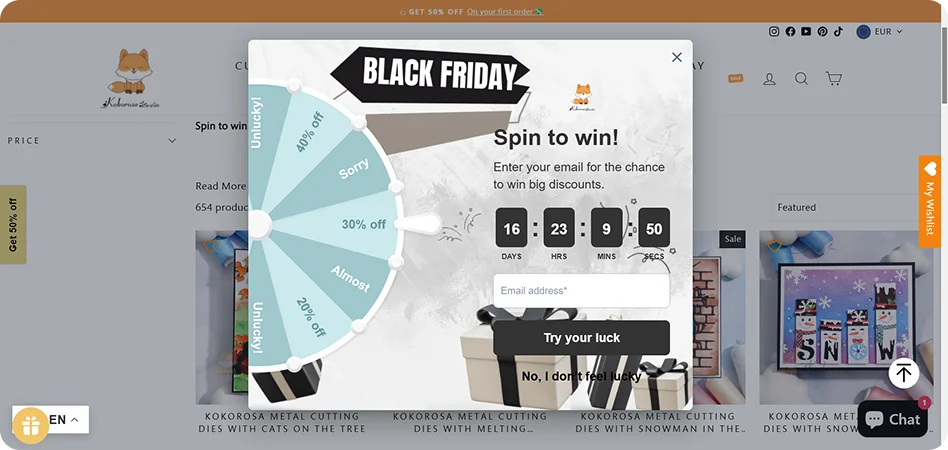
This opt-in wheel is placed on a Black Friday sale page, where a discount game actually makes sense. Visitors land there for deals anyway, so the wheel continues the same promo instead of interrupting a regular browsing session.
Where it fits: Black Friday pages, holiday sale pages, product drops, clearance sections, and any campaign where visitors arrive from a banner, email, or ad promising a special deal.
What you can borrow: the game has a clear path. The homepage banner brings people to the sale page, and the wheel continues the same promo story. That is better than showing a wheel with no context, because visitors already know why they are seeing it.
What could be tested: only some wheel sections include prizes. If the visitor gets one spin and has to leave an email first, “Unlucky” sections may weaken the value exchange. For email capture, test a guaranteed-win setup with smaller rewards, or make the no-win option softer, such as “Try again tomorrow.”
Small UX issue: the “No, I don’t feel lucky” text is hard to read here. If the skip option blends into the background, the pop-up can feel harder to dismiss than it should.
10. Spin the wheel popup with unusual shape
This example goes all in on Black Friday energy: dark background, bright wheel, big discount values, and a teaser at the bottom. The popup wheel is hard to miss, especially on the desktop.
Where it fits: Black Friday, flash sales, high-discount campaigns, loyalty promos, and brands with a bold visual style.
What you can borrow: the wheel sells the promo before the copy does. Big prize labels — 100% FREE, 60% OFF, 50% OFF — are visible right away, which helps on a busy Black Friday page. The bottom teaser also gives the offer a second chance if someone closes the pop-up too quickly.
What could be tested: on mobile, the copy has to fight with the background image. The wheel looks strong, but the headline and description are harder to read in some areas. Test a cleaner mobile version with a darker text panel, fewer background details, or a shorter headline.
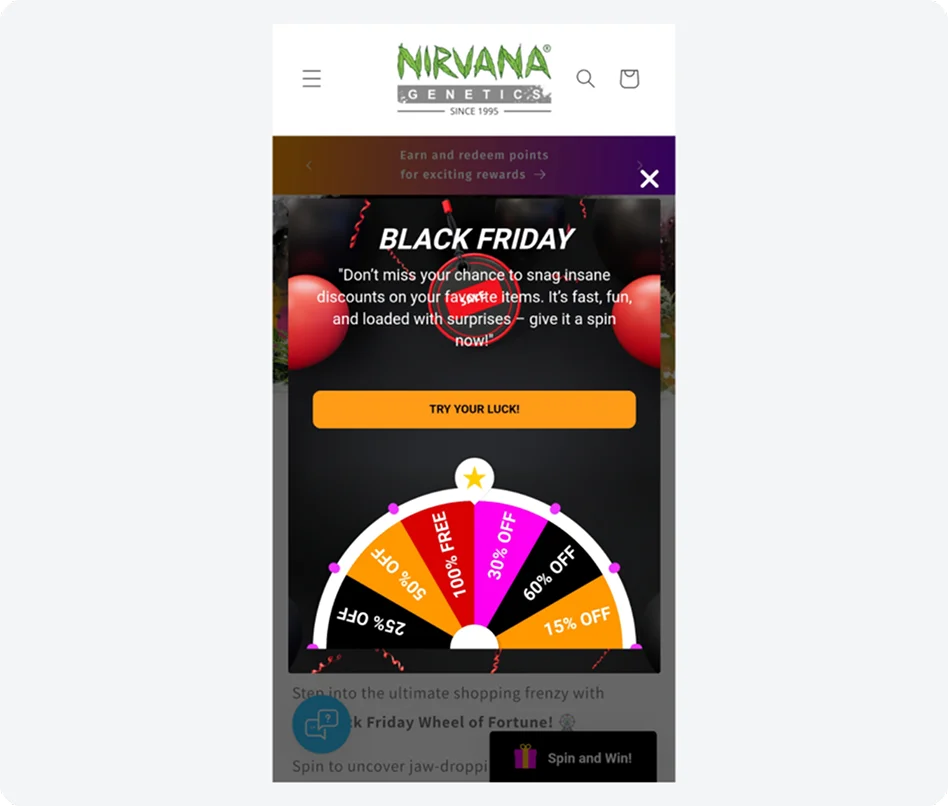
Another detail to check: the desktop version has a lot going on at once: bright wheel, balloons, sale graphics, teaser, chat widget, and page content behind the overlay. The wheel still wins attention, but the layout could feel cleaner with fewer competing elements.
Spin to win pop-up campaign types
Spin to win popups aren’t just about spinning — they’re all about lead generation and sales. Offering a prize can give website visitors a simple reason to act. Here are a few ways brands use popup gamification in practice.
Popup wheel for simple contacts capture
Users enter their email or phone number to play the game. It’s quick, easy, and ideal for growing your contact list. A spin-the-wheel email capture pop-up offers a clear value exchange: users know they’re giving their contacts to receive a chance to win a discount, gift, free shipping, etc. In this case, spin-the-wheel works as a lead capture popup that can be an essential tool for growing your email list and driving engagement.
What to watch for
Lower engagement: if users don’t win, they might feel sharing their email wasn’t worth it. Possible solution: include a small ‘thank you’ reward, such as a minor discount.
Spam concerns: some visitors might hesitate, fearing inbox overload.
See your reward, share email to unlock
The order of actions is as follows: users spin the wheel discount pop-up and see their prize but must share their email to claim it.
This can drive email capture, as a visible reward motivates users to complete the action. Sending rewards via email also increases open and click rates.
What to watch for
Drop-off risk: some users may spin but back out before sharing their email. So, make sure your prizes are valuable to your target audience. This will help reduce the bounce rate.
Disposable emails: a visitor might use an incorrect email address to grab the reward.
Purchase and spin-the-wheel popup
The trick is that users will only see a popup wheel after making a purchase. However, you can announce this opportunity with a homepage banner, as shown here:
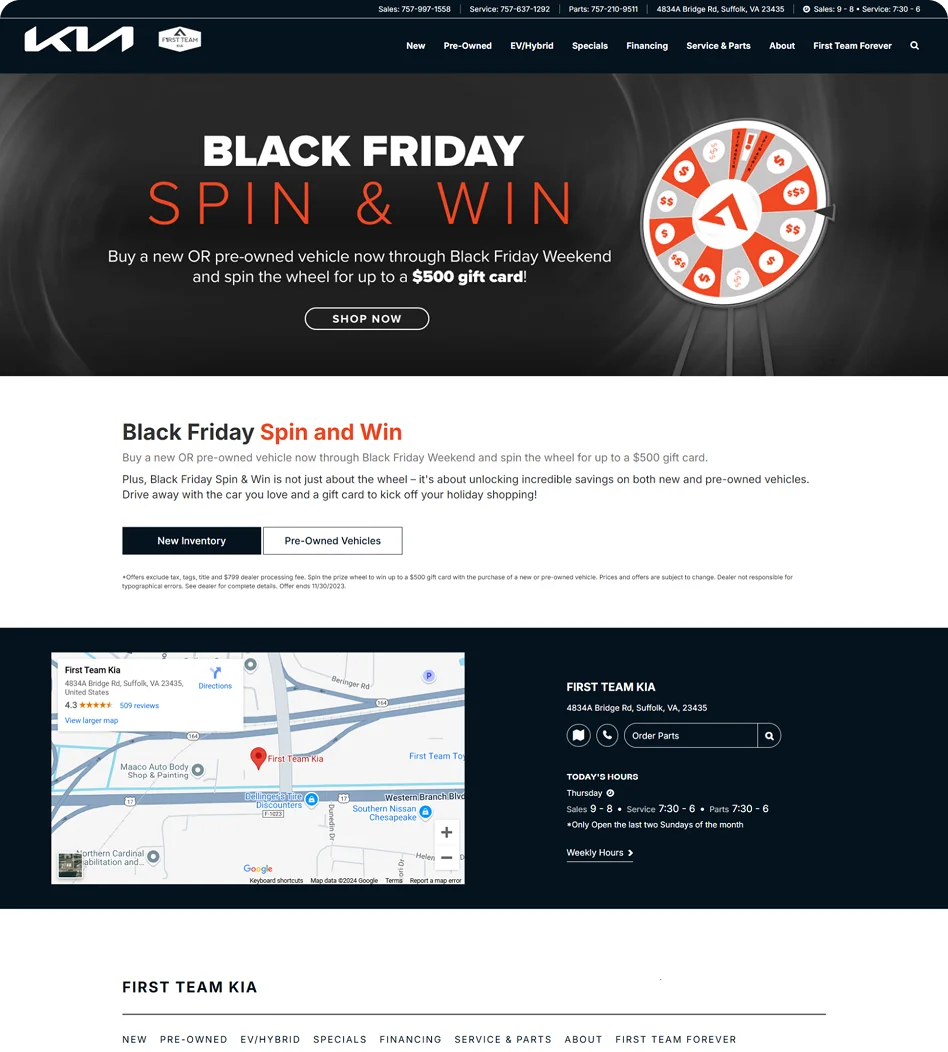
Offer customers the option to sign up for a newsletter to win a discount on their next order. This way, you encourage repeat purchases. Moreover, buyers will feel extra appreciated.
What to watch for
Lead capture limitations: this method doesn’t collect emails from non-purchasers. However, you can pair this spin the wheel offer with another pop-up type to ensure broader lead generation.
Multi-step spin to win popup for gradual contact capture
A spin to win popup does not have to ask for everything at once. A stronger multi-step form flow can look like this: spin first, then email, then a phone number field if the reward is strong enough.
This flow works best for stores that already use both email and SMS in their retention strategy.
What makes this effective:
The first step is easy. Visitors start with the wheel, not a long form.
The email ask comes after the reward. People already know what they are claiming.
The phone step feels more reasonable. It can be framed as a way to activate a bigger reward, get SMS-only deals, or receive the code by text.
The final screen closes the loop. Visitors see the promo code and can move straight to shopping.
What to watch for:
Do not make the flow feel like a trap. If you ask for a phone number after the email, explain why. If the phone number is not essential, test making it optional.
Abandonment risk: a lengthy or confusing process can lead to drop-offs.
Solution: use progress indicators for partial completion to keep users motivated. By the way, in our library, you'll find multi-step form templates that you can easily customize to your needs.
Spin the wheel popup prize strategy
The prize is what makes the wheel worth spinning. Before choosing discounts or gifts, decide how rewards will work: will every visitor win something, or will bigger prizes stay rare? This choice affects how exciting the game feels, how much margin you protect, and how willing visitors are to leave their contact details. Choose your reward logic first.
Opt-in popup wheel with guaranteed win
This strategy is about every user winning something when they spin, but the value of the reward can vary. For example, common prizes (think 5% off or free shipping) are appreciated. At the same time, rare gems (such as a bigger discount) are reserved for a lucky few.
Your marketing benefits are:
Better lead capture: when there’s a clear reward, people are more open to sharing their information — whether it’s email or even a phone number. It feels like a fair exchange, not just another form.
Positive first impression: even a small reward changes how the interaction feels. Instead of asking for something, you’re giving something back — and that tends to leave a better impression of the brand.
Faster decisions: a time limit (for example, a 24-hour coupon) gives people a reason to use the offer sooner instead of putting it off. That’s where the FOMO effect comes in. The same idea works with a pick-a-gift popup — choosing a reward makes the interaction feel more personal and nudges people to act.
The strategy is perfect for new companies or campaigns where the primary goal is list-building or creating brand trust. It also works well for attracting hesitant first-time buyers.
Pop-up wheels with probability-based win
In this setup, not every spin wins. You set the odds yourself — for example, a 30% chance — so some people get a reward and some don’t. This format is often used in longer campaigns. For example, during Christmas or New Year, brands sometimes allow one spin per day and keep a bigger prize in play, like a $500 gift card. It gives people a reason to come back and try again. Here’s an example of how this idea looks in practice. The campaign is associated with Black Friday and lasts for a week:
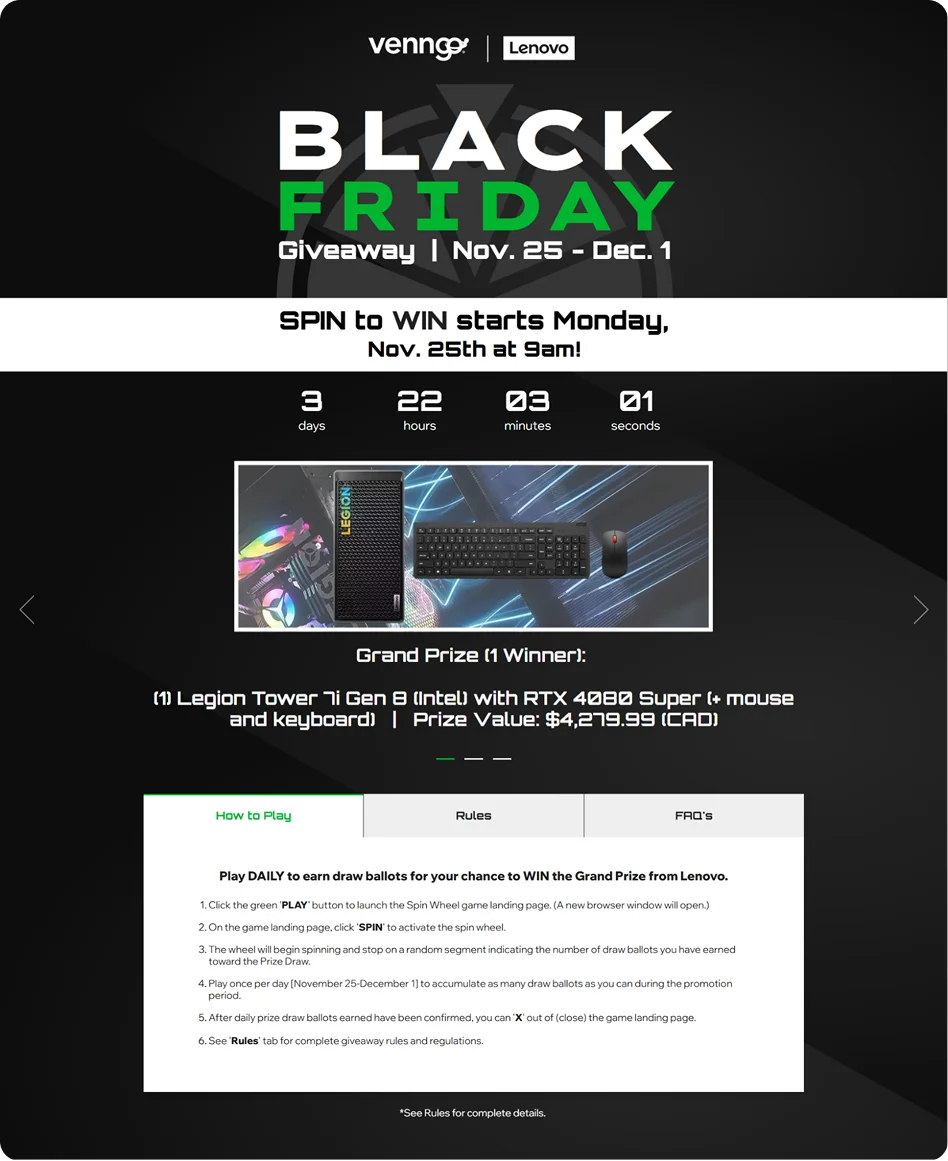
Here are the potential marketing benefits for you:
Higher website traffic: the chance to spin keeps users coming back, increasing site visits.
Brand recall: with spin the wheel gamification, people interact with your brand instead of just seeing it once. That small action tends to stick a bit longer than a static form.
Retention over time: if you allow repeat spins (for example, once per day), some visitors come back just to try again. That’s one of the simpler ways to influence retention rates without adding extra flows.
Extra browsing: people often stay on the site a bit longer after spinning. Some will look around, and in some cases, that leads to unplanned purchases.
Types of prizes you can add to Spin the wheel popups
What you offer in a spin to win popup usually depends on your business, the goal of the campaign, and what your audience responds to. Below are some common prize categories.
Discounts are universal crowd-pleasers. Unsurprisingly, these incentives are most often used in gamification in e-commerce. Easy to redeem and satisfying to win, these prizes are perfect to increase sales.
Free products or samples as spin the wheel offers encourage customers to add more to their cart.
Gift cards for your store or a partner brand. They’re like an open invitation for future purchases.
Bonus points for your loyalty program: useful if you already run one. People get an extra reason to sign up or come back.
Experiences or higher-value rewards (rare): these do not need to appear often. A larger prize can make more people notice the campaign.
Set the prize mix and winning odds
For a popup wheel, many brands split prizes by value and keep the higher rewards less common.
Low-tier rewards: 10% off, free shipping, or similar offers. Often used most frequently: 60-70% of spins.
Mid-tier rewards: a $10 gift card or a free product. Used less often: 15-20% of spins.
High-tier rewards: larger prizes, such as a $500 gift card. Usually rare. These drive excitement but are uncommon enough to remain sustainable. Acceptable frequency: 5-10% of spins.
How to manage a rewards pool in Claspo
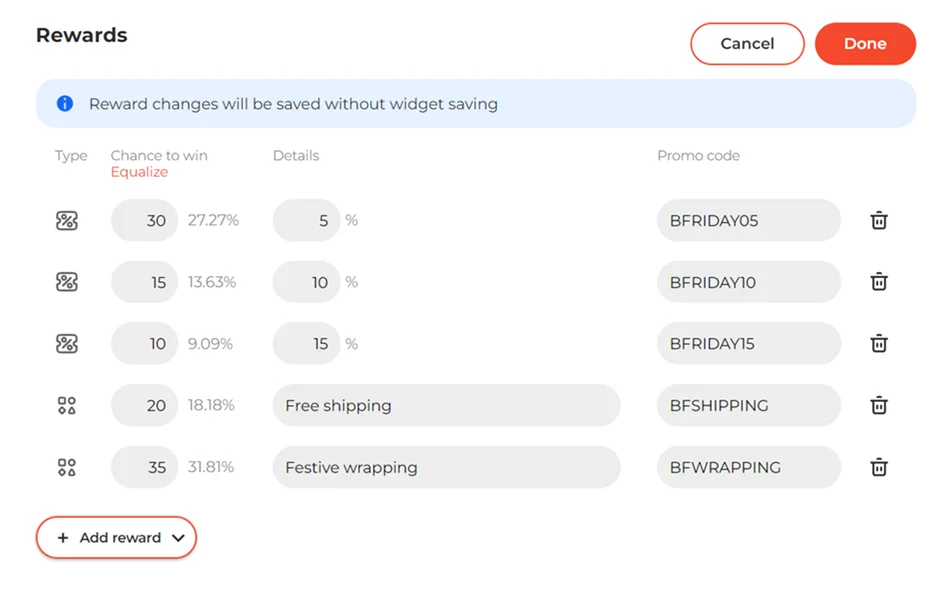
With Claspo, managing rewards and setting winning odds for your spin to win popups is as easy as spinning the wheel. Want to offer different discounts and need to control how often each prize lands? You’ve got it. You can set spin the wheel discounts of various sizes and specify the percentage of probability of winning for each option.
You can also add custom prizes, such as free shipping or festive packaging. It also helps to assign a separate promo code to each prize option. Here’s how that looks in this example:
How to create your Spin the wheel pop-up in Claspo
Once your prizes and setup are decided, you can build the campaign itself. Here’s how to create a spin the lucky wheel popup in the pop-up builder in a few minutes.
Step 1: Choose a popup wheel template
Pick a gamification widget template from our extensive library that fits your needs. At this stage, you can also use our intuitive pop-up maker to add a customizable pre-built teaser for your main widget.
Step 2: Customize the spin the lucky wheel popup template
In our drag-and-drop editor, you can change any element of the selected template. Add or remove components like a timer, data processing, etc.
To customize the wheel design, click on it in the editor. You can choose a theme — a cleaner, minimal one or a more detailed version — and set the primary and secondary colors to match your campaign or brand style. If you use the detailed theme, you can also upload your logo to the center of the wheel, so the game feels more branded
You can also change the background color, add an image, or even make it transparent. Customize the shape of the СTA button, add a shadow, change the shape of the input fields, and customize the closing button.
Please note that you need to check the design of additional windows that display the subscription status and make adjustments to their design if necessary.
Switch to mobile editing mode to ensure everything displays correctly.
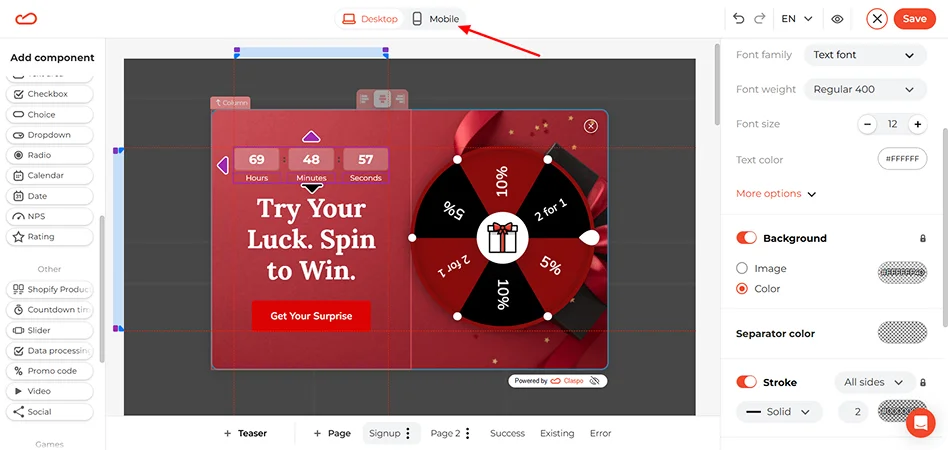
To keep the popup wheel design clean, you can hide unnecessary components, like images or social media buttons.
Enter your prize options for the spin the wheel offers and specify the probability of winning each.
These are the main settings for editing popup templates with the spin the wheel gamification component. If you need more detail, see our guide with step-by-step instructions for changing any Claspo widget design.
Step 3: Set up triggers and targeting
Setting up user-friendly display rules is key to creating a spin to win popup that feels fun, not pushy. The best part? Claspo widgets come with pre-set rules, like when and how often they appear, so they’re naturally non-intrusive. But why stop there? Customize the triggers to match your visitors’ behavior and show the spin the lucky wheel popup only when all the right conditions are met.
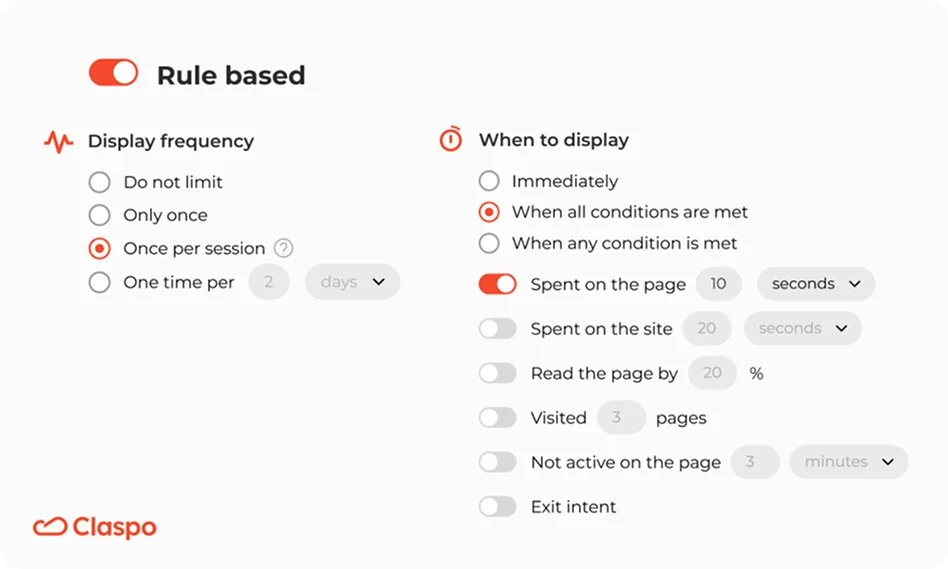
For example, create a free exit popup with spin the wheel and activate the exit-intent trigger.
Claspo also lets you target specific segments for a more personalized touch:
Newcomers vs returning: show a popup wheel only to first-time or only to returning visitors.
Geotargeting: get specific — countries, regions, or even cities.
UTM targeting: got UTM-tagged campaigns? Set the spin the wheel discount to appear only for traffic from those sources.
Specific page visitors: display the spin the wheel offers on specific pages, like adding them to a holiday sale page, as in the earlier example.
Device type: choose where it pops up — desktop, mobile, or both (default).
With these smart rules, your spin-the-wheel email capture pop-up will feel less like a salesperson and more like a game.
Step 4: Integrate, inspect, and impress
Next, set up integration with an external service to send popup wheel data for contact segmentation and email campaigns. Then use test mode to review the widget before launch. Check how it appears on different devices and browsers. When everything looks right, publish it.
What spin-the-lucky-wheel popup metrics to analyze and how to improve results?
When it comes to spin the wheel gamification, you’re not just playing a game — you’re running a marketing operation designed to grab attention, generate leads, and, ultimately, drive conversions. To understand the campaign's effectiveness, keep an eye on these key metrics:
Traffic spikes: a surge in traffic suggests your popup wheel is drawing attention.
Leads captured: how many emails, phone numbers, or other details are you snagging? If the number's low, your spin the wheel offers might need a facelift (or a better discount).
Conversion rates: how many of those new leads are taking action, like making a purchase? If the numbers don’t make you smile, it’s time to rethink the strategy.
These numbers help you understand whether the widget is performing well or needs more work. Improving spin the lucky wheel popup isn’t about luck; it’s about experimenting and making decisions based on hard data. The good news is that you can track widget metrics and run A/B tests on your Claspo account.
Here’s what to test and why:
Popup wheel design: try different layouts, colors, and prize sections. A neon wheel might scream ‘fun’ to some, while others prefer something sleek and understated.
Prize options: test various rewards — spin the wheel discounts, freebies, or even exclusive access to something special. Not all customers are motivated by the same things.
Timing: when does the spin the wheel offers appear? Right when someone lands on the page, after 15 seconds, or when they’re about to leave? Test the sweet spot for your audience.
Entry method: do visitors need to share personal information (name, phone number), or just enter their email? Lowering the barrier might capture more leads, but could they be lower quality?
Once the A/B test results roll in, here’s your next move. Did one version of the pop-up win? Roll it out site-wide! If one option fell flat, understand why. Was it too flashy? Too dull? Too confusing? Use this feedback to refine your next test. The job’s not done! Trends change, seasons shift, and audiences evolve. Regular testing keeps your pop-ups fresh and relevant.
Spin the wheel gamification best practices
So, how do you create a popup wheel that’s more jackpot than junk? Let’s dive into some best practices to make your spin the wheel email capture pop-ups effective and delightful for consumers.
Display your pop-up after a delay or upon exit. Shown at the right moment, they can feel less disruptive and support user engagement. Avoid displaying the widget the second someone lands on the site. Give visitors a little time first, or show the spin the wheel gamification with exit-intent technology when they are about to leave.
Focus on design and a memorable experience. Your popup wheel should look clean and easy to use. Clear colors, smooth animation, and solid mobile performance all matter. Mobile pop-ups need to fit smaller screens properly, so the offer stays visible and simple to use.
Test your widget before publishing to ensure it's functional. For example, this spin-the-wheel email capture pop-up looks good, but if scrolling doesn't work, users may only see the top of the CTA button, leaving them confused about the offer and rules.
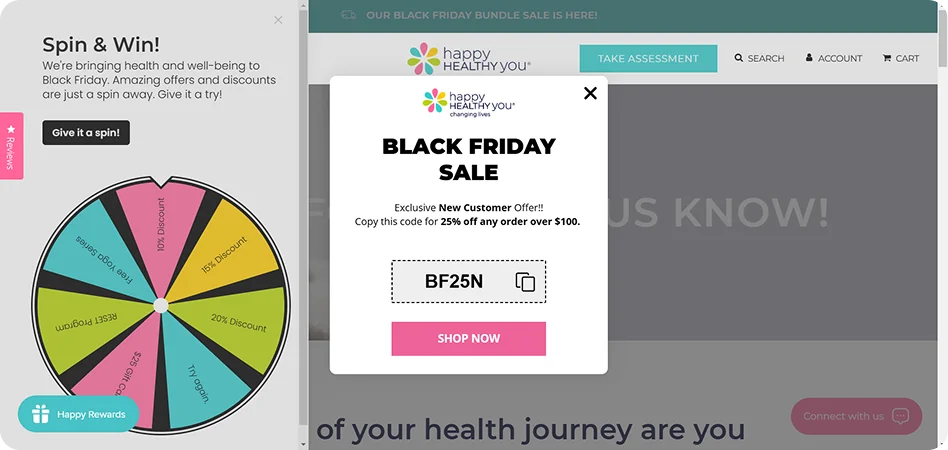
Also, avoid displaying multiple widgets at once — too much clutter will only frustrate users. For instance, showing a promo code widget next to a spin the lucky wheel popup may leave visitors wondering which one to engage with:
Limit campaign duration using a countdown timer. Deadlines trigger FOMO, which can nudge users to take immediate action. Explore our countdown popup examples for more ideas and real use cases.
Be careful with prizes. Avoid promising the moon if you’re only delivering a sticker. If prizes feel weak or misleading, people may not return. Rewards should look worthwhile but stay realistic for your budget. Choose options that fit your audience and make sense for the campaign.
Make it responsive. Your spin to win popup needs to look amazing on every device. A widget that doesn’t work on mobile is an instant dealbreaker. By the way, all Claspo’s widgets are responsive by default.
Add a twist to your website with Claspo
Now, you know how website gamification can make user experience more enjoyable and rewarding. You’ve also got all the tips for designing spin-the-wheel email capture pop-ups or straightforward spin the wheel discounts that mix creativity with marketing goals and understand what to test to improve the effectiveness of your campaigns.
So, it’s your turn to add some spin! You can launch a fully customized popup wheel with us in just 5 minutes. Claspo includes access to more than 1000 templates, including gamified and multistep formats. It also comes with full A/B testing, so you can compare different spin-the-wheel popup examples and improve your campaigns over time.
Ready to engage customers in a fun way? Sign up for Claspo and start your way to success!